
A white kitchen is the most common kitchen in Britain and the easiest to get slightly wrong. White units can look crisp and bright in a showroom and flat, grey or yellowish at home, because “white” is not one colour. Some whites lean warm, some lean cool, and the light in your kitchen pulls each one in a different direction. This page sets out six real whites and what sets them apart, how to match a white to the way your kitchen faces, which worktops and floors work with white units, and the practical details that keep a white kitchen looking clean after five years rather than five weeks.
Warm white or cool white: the choice that matters most
Every off-white paint is a white base with a small amount of another pigment added. That tint decides how the colour behaves:
- Warm whites have a touch of yellow or red. They feel soft and settled, and they stop a kitchen feeling clinical, but they can look creamy next to a bright white appliance or a pure white quartz worktop.
- Cool whites have a touch of grey, green or blue. They look clean and modern and sit well with steel, concrete and grey stone, but in a room with little direct sun they can turn cold and slightly grey.
- Pure whites with no added tint are the most neutral, and the safest choice if you are unsure.
As a rule of thumb, a north-facing kitchen, which gets cooler, bluer light all day, is better suited to a warm white. A south-facing kitchen with strong sun can take a cooler white without feeling chilly. East and west-facing rooms change through the day, so test a sample at breakfast and in the evening before deciding.
Six whites, and what makes each one different
These are all from Farrow & Ball, because its colour descriptions are specific about the tint in each white. Other paint makers have close equivalents; take a sample of any white you like and judge it in your own kitchen.
- All White No.2005. Farrow & Ball says it contains no pigment except white, which it describes as the softest white, without the colder blue undertones of a brilliant white. It suggests pairing it with Skimming Stone and Strong White for a warm scheme, or contrasting it with strong colours such as Pitch Black and St Giles Blue. A safe choice for units in almost any light.
- Wimborne White No.239. Only a shade away from pure white, with the smallest amount of warm yellow pigment added, making it a little softer than All White. Good for a north-facing kitchen or alongside oak.
- Pointing No.2003. Named after the colour of lime pointing in traditional brickwork and described as having a warm undertone. It suits period kitchens and softens strong traditional colours used nearby.
- School House White No.291. A soft off-white, described as without the cool undertones of the more contemporary neutral groups. It belongs to a group of whites designed to still read as white in deep shade, which makes it useful in a dark kitchen or a basement.
- Strong White No.2001. A cool white with light grey undertones that Farrow & Ball describes as giving a subtle urban feel. It suits a modern kitchen with steel and grey stone, and pairs with Skimming Stone, Elephant’s Breath and All White.
- Wevet No.273. A white with a hint of grey, described as clean, understated and easy to live with. On cabinets it gives a quiet, contemporary look, and its paired white is Cornforth White.
Farrow & Ball recommends its White and Light Tones primer and undercoat under all six. On cabinets, our guide to the best kitchen cupboard paint covers preparing timber, MDF and wrapped doors before painting, because white shows every brush mark and every patch of poor adhesion.
White kitchen ideas that work
All white, with texture
White units, white walls and a white worktop can look flat. What keeps it interesting is texture: a tongue and groove panel, a handmade-look tile with an uneven glaze, a ribbed glass wall cabinet, or matt units against a gloss splashback. If you keep the colour single, vary the surface.
White units with a dark worktop
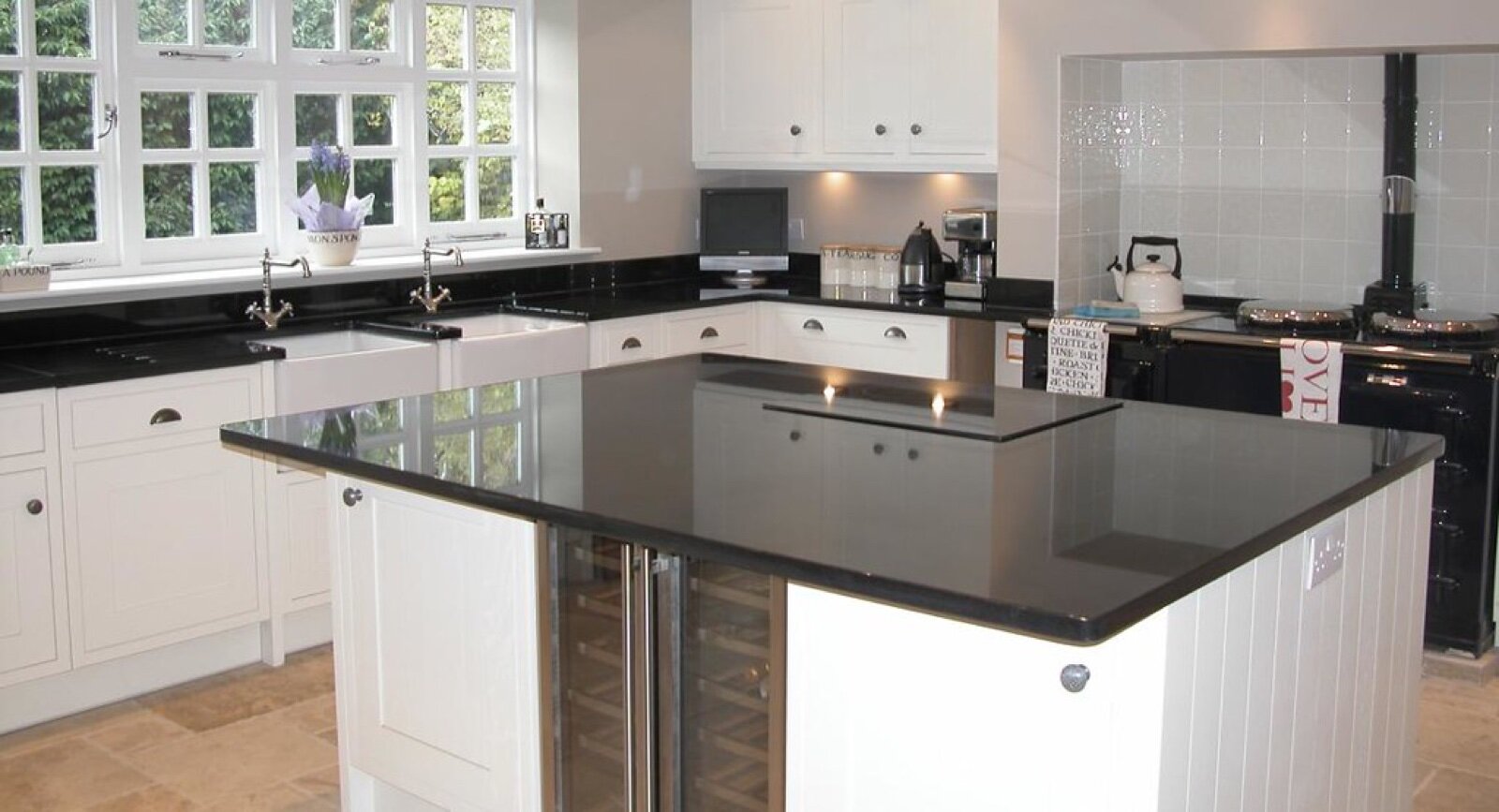
Black or dark grey stone, quartz or laminate under white units gives the strongest contrast and the most forgiving work surface, since it hides stains and wear. It suits shaker doors in a traditional kitchen and slab doors in a modern one.
White and timber
An oak or walnut worktop, open shelves, or an island in timber warms up a white kitchen more than any paint can. If you go for oak, a warm white such as Wimborne White sits more comfortably next to it than a cool grey-white. Our piece on oak worktops covers the maintenance they need.
White with one strong colour
Painting just the island, the lower units or the back wall in a dark colour, and keeping the rest white, gives you the brightness of a white kitchen with a clear focal point. Navy and black are the classic choices; see our guides to navy kitchens and black kitchens for specific shades and the whites paired with them.
Worktops, floors and handles for white units
- Worktops. A pure white worktop with off-white units can make the units look dirty by comparison. Either match the undertone (warm white units with a warm white or cream stone) or go for clear contrast with a dark or timber worktop.
- Floors. White units on a pale floor can look washed out; a mid-tone timber, a darker tile or a patterned floor anchors the room. In a busy family kitchen a darker floor also hides dirt better.
- Handles. Handles carry more weight in a white kitchen than in any other colour. Black handles give a graphic look, brass a warmer and more traditional one, and brushed steel suits a cool white. Handleless doors show finger marks on the door edges, so they need a wipeable finish.
- Appliances. Integrated appliances keep a run of white units uninterrupted. A freestanding range cooker in a strong colour or steel can act as the focal point instead.
Keeping a white kitchen white
The common worry about white kitchens is dirt. In practice, the finish matters more than the colour.
- Choose a wipeable finish. On painted units, an eggshell rather than a flat matt finish takes repeated cleaning. Factory lacquered and foil-wrapped doors are the easiest to wipe.
- Protect the edges. The edges of doors near the hob and the sink take the most wear and the most splashes. Painted timber doors chip here first.
- Mind the heat. Wrapped doors next to ovens can lift or discolour if the oven is not designed for integration. Check the heat deflectors are fitted.
- Grout. A white tiled splashback with white grout behind the hob will stain. A pale grey grout looks almost the same on day one and much better on day 500.
For layouts that suit a white kitchen, including galley and U-shaped plans, see our kitchen layout ideas.
Frequently asked questions
Are white kitchens going out of fashion?
White kitchens have outlasted most kitchen trends because they suit almost any house and are easy to update with new handles, worktops or a painted island. What dates is the detail, such as high gloss or a particular handle style, rather than the colour.
What is the best white for kitchen cabinets?
There is no single best white, because the light in your kitchen changes how each one looks. A pure white such as All White is the safest choice; a warm white such as Wimborne White suits a north-facing room; a cool white such as Strong White suits a bright modern kitchen.
Should I choose a warm or cool white for a north-facing kitchen?
A warm white usually works better. North light is cool and blue, which makes grey-based whites look colder and greyer.
What colour worktop goes with white cabinets?
Dark worktops give the strongest contrast and hide wear; timber warms the room; a white worktop works if its undertone matches the units. Avoid a bright white worktop with off-white units, which makes the units look dull.
Are white kitchens hard to keep clean?
Not if the finish is right. A wipeable eggshell, lacquer or wrapped door is easy to clean. Flat matt paint, open-grain timber and white grout behind the hob are what make white hard work.
Planning a new kitchen in Kent? Contemporary Structures covers layouts, costs and finishes across our kitchen guides.
Related guides
- Conservatory Roof Replacement vs Glass Film: Which Fixes a Too-Hot, Too-Cold Conservatory?
- Air Source Heat Pump Cost in 2026 After the £7,500 Grant: What You Actually Pay
- Do You Need Planning Permission for a Rear Extension in Kent? 2026 Permitted Development Rules
- How Much Does a Conservatory Base Cost in the UK? (2026 Price Guide)
- Do You Need a Party Wall Agreement for a Rear Extension? Cost and Rules Explained
- Underfloor Heating vs Radiators for a Home Extension: Cost, Running Bills and Which to Choose
- How Much Does a House Extension Cost in 2026? Full UK Price Breakdown
- Loft Conversion Cost and Types: Dormer, Hip-to-Gable and Velux Explained
- Kent Home Improvement News: June 2026
- House Extensions: The Complete UK Homeowner’s Guide
- Single Storey Extension Ideas, Costs and Planning Rules
- Double Storey Extensions: Costs, Designs and What You Can Build
- Side Return Extensions Explained: Cost, Light and Layout
- Kent Home Improvement News: Mid-June 2026
- Garage Conversion Guide: Cost, Building Regs and Best Uses
- Extension vs Moving House: Which Is Better Value in Kent?
- Wraparound vs Rear Extension: Cost and Space Compared
- House Extension Builders in Kent: Costs, Lead Times and How to Choose
- Conservatory Guide: Styles, Costs and How to Choose One
- Kent Home Improvement News: Late June 2026
- How Much Does a Conservatory Cost in 2026? UK Prices by Type
- Conservatory vs Orangery vs Extension: Which to Build?
- Conservatory Roof Options: Glass, Polycarbonate and Tiled Compared
- Kent Home Improvement News: Early July 2026
- How to Keep a Conservatory Warm in Winter and Cool in Summer
- Tiled Conservatory Roof Cost and Replacement Process Explained
- Conservatories in Kent: Choosing an Installer, Costs and What to Ask
- Kent Home Improvement News: Mid-July 2026
- Roofing Guide: Repairs, Replacement, Materials and Costs
- New Roof Cost UK 2026: Replacement Prices by Roof Type
- Roof Repair Cost UK 2026: Slipped Tiles and Flashing Prices
- 7 Signs Your Roof Needs Replacing (and What You Can Ignore)
- Flat Roof vs Pitched Roof: Cost, Lifespan and Best Uses
- EPDM vs Felt vs Fibreglass Flat Roofs Compared
- Kent Home Improvement News: Mid-July 2026
- Roof Tile Types Explained: Clay, Concrete and Slate Compared
- Fascias, Soffits and Guttering: When to Replace and What It Costs
- How to Find a Good Roofer: Vetting Checklist for UK Homeowners
- Roofers in Kent: Costs, How to Choose and What to Ask in 2026
- Kitchen Renovation Guide: Planning, Cost and Design in 2026
- How Much Does a New Kitchen Cost in 2026? UK Price Guide
- Kitchen Layout Ideas: Galley, L-Shape, Island and Open Plan
- Worktops Compared: Quartz vs Granite vs Laminate vs Solid Wood
- Fitted vs Bespoke vs Flat-Pack Kitchens: Cost and Quality
- Kitchen Island Ideas, Sizes and Costs: A 2026 UK Guide
- Kent Home Improvement News: Late July 2026
- Open Plan Kitchen Diner: Costs, Layouts and Knock-Through Rules
- How Long Does a Kitchen Fitting Take? Realistic UK Timeline
- Kitchen Fitters in Kent: Costs and How to Choose (2026)
- Bathroom Renovation Guide: Planning, Cost and Layout
- New Bathroom Cost 2026: What You’ll Pay in the UK
- Kent Home Improvement: Roofing Costs Rise (Aug 2026)
- Small Bathroom Ideas: Layouts That Feel Bigger
- Wet Room Cost 2026: £2,000 to £9,000 Fitted, by Size
- En Suite Cost and Minimum Size: £4,000 to £10,000 in 2026
- Kent Home News: £9,000 Heat Pump Grant Now Open
- Electric vs Mixer vs Power Shower: What Your Boiler Allows
- Bathroom Underfloor Heating Cost: 16p an Hour to Run
- Window Replacement Cost 2026: £350 to £600 Per uPVC Window
- uPVC vs Aluminium Windows: the 1.4 U-Value Rule
- How Long Does a Bathroom Take to Fit? 5 to 10 Working Days
- Home Improvement News: Solar Up 14%, Heat Pumps Down 17%
- Double vs Triple Glazing: Part L Still Stops at 1.4
- Bathroom Fitters in Kent: What to Ask Before You Pay
- Sash Window Repair or Replace? What Kent Councils Allow
- Bifold vs Sliding Doors: What Building Regs Actually Set
- Composite Door Cost 2026: £550 to £2,350 Fitted
- Window Energy Ratings: Band B Is the Rule, Not C
- Replacement Windows: the 1.4 U-Value and Vent Rules
- Double Glazing Kent: the 1.4 U-Value Every Quote Must Hit
- Heat Pumps in Kent: the £7,500 Grant and the 1.5m³ Rule
- Heat Pump vs Gas Boiler: Break-Even Is a SCOP of 3.0
- Permitted Development Rights: The 8m Rear Extension Rule
- Air Source vs Ground Source Heat Pump: £13k or £26k?
- Kent Home News: Council Merger Paused, Heat Pump Bids Up 81%
- Building Regulations Approval: Kent Fees, 10-Year Rule
- Boiler Upgrade Scheme: £9,000 Grants From 21 July 2026
- New Boiler Cost 2026: £1,800 to £4,500 Fitted
- Do Heat Pumps Work in Old Houses? Yes, With 3 Conditions
- Heat Pump Installers in Kent: 8 Checks Before You Sign
- House Rendering in Kent: When the Wall Must Be Insulated
- What Is TrustMark? The Kent Trade Badges That Count
- Home Improvement Grants in Kent: ECO4 Ends 31 December
- Kent Home News: Heating Oil to Be Regulated, £9,000 Grant
- Conservation Area Planning Rules: The 3m Rear Limit
- How to Apply for Planning Permission in Kent: £548, 8 Weeks
- Best Kitchen Cupboard Paint: Match It to the Door Surface
- Should You Pay Builders a Deposit? How Much, and How
- Porch Planning Permission: The 3m² Rule and When It Fails
- Black Kitchen Ideas: Matt or Gloss, and the Light It Needs
- Navy Kitchen Ideas: Hague Blue vs Stiffkey and What Pairs