
You are mid-way through planning a rear extension, the drawings are nearly there, and someone has told you that you need a party wall agreement. Half the pages you have read are written by surveyors who would quite like to sell you their services, so it is hard to tell whether you actually need one or whether you are being scared into it. This guide cuts through that. We explain the three situations that trigger the Party Wall etc. Act 1996, the exact notice periods, the realistic cost difference between one agreed surveyor and two, and the rule about who pays that catches a lot of homeowners out.
We build extensions across Kent, so we deal with this on real jobs every week. The honest answer is that plenty of rear extensions do need a party wall notice, but a good number of those notices never turn into a paid surveyor’s agreement at all. The difference comes down to how your neighbour responds.
What a party wall agreement actually is
A party wall agreement, properly called a Party Wall Award, is a legal document that sets out how notifiable building work near a shared boundary will be carried out, records the condition of your neighbour’s property before work starts, and protects both sides if damage occurs. It is created under the Party Wall etc. Act 1996, which covers England and Wales.
Two things people get wrong straight away. First, a party wall agreement is completely separate from planning permission and building regulations. You can have full planning approval and permitted development rights and still be legally required to serve a party wall notice. Second, you do not always end up with a formal Award. You serve a notice; only if a dispute is deemed to have arisen does the surveyor process and the Award kick in.
The three triggers: when the Party Wall Act applies to a rear extension
The Act bites in three situations. For a typical rear extension on a terraced or semi-detached house, you will usually hit one or two of them. The gov.uk explanatory booklet on the Party Wall Act sets these out in full, and it is worth reading before you spend a penny on a surveyor.
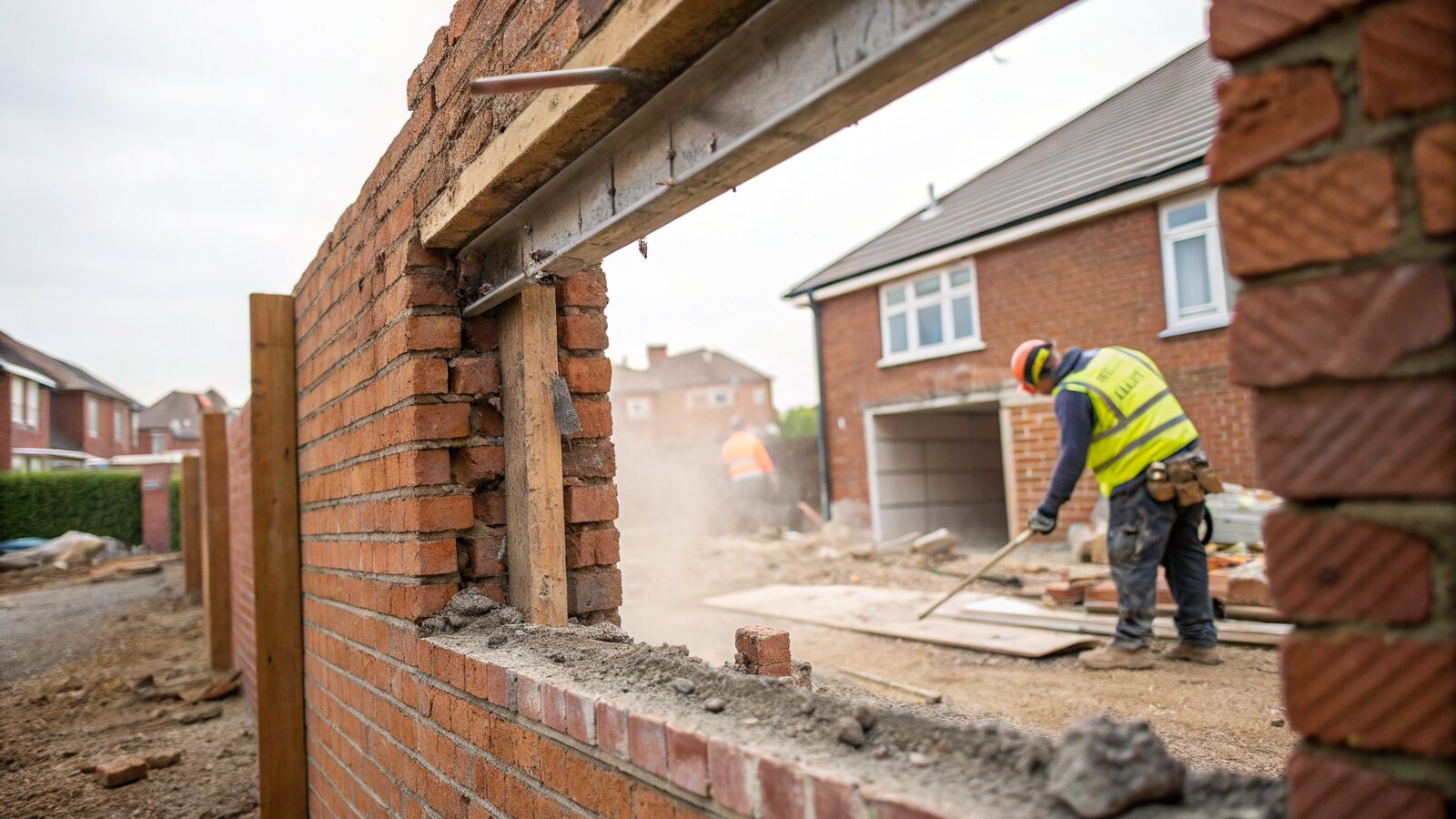
1. Building on or astride the boundary line
If you are building a new wall up to the boundary (the line of junction) or astride it, that is notifiable. On a rear extension this is common where the new flank wall sits right on the shared line. You serve a Line of Junction Notice for this.
2. Cutting into or working on an existing party wall
If your extension involves cutting into the shared wall, raising it, rebuilding part of it, inserting a beam, or removing a chimney breast on the party wall, that is work to an existing party structure. This is the one that needs the most warning, because the notice period is longer.
3. Excavating near your neighbour’s building (the 3m and 6m rules)
This is the trigger most rear extensions hit and the one people miss. New foundations mean digging, and the Act cares about how close and how deep you dig relative to your neighbour’s foundations:
- The 3 metre rule: if any part of your excavation is within 3 metres of your neighbour’s building or structure, measured horizontally, and goes deeper than the bottom of their foundations, you must serve notice.
- The 6 metre rule: if any part of your excavation is within 6 metres and a line drawn down at 45 degrees from the bottom of their foundations would meet your excavation, you must serve notice. This catches deeper digs further away, for example for piled or stepped foundations.
For a standard rear extension with strip foundations on a terrace, the 3 metre rule is almost always in play because your neighbour’s house is right there. That is why so many rear extensions are notifiable even when nothing touches the shared wall itself.
The notice timeline: how far ahead you have to tell your neighbour
You serve a written notice on every adjoining owner. There is no prescribed form, so you can write it yourself or use a template; gov.uk publishes sample wording. The notice periods are fixed by the Act and they are not the same for all three triggers:
- Line of Junction Notice (building on the boundary): at least 1 month before work starts.
- Party Structure Notice (work to an existing party wall): at least 2 months before work starts.
- Notice of Adjacent Excavation (the 3m and 6m rules): at least 1 month before work starts.
If your job involves cutting into the party wall, plan around the 2 month period; that is the one that holds people up. Serve the notice too late and your start date slips, builder booked or not.
Once served, your neighbour has 14 days to respond in writing. There are three outcomes:
- They consent in writing: you can proceed on the proposed date and, in most cases, you never need a surveyor or a paid Award at all. This is the cheapest route and it happens more often than the surveyor lead-generation pages admit.
- They dissent: a dispute is deemed to have arisen and you move into the surveyor process to produce a Party Wall Award.
- They do not respond within 14 days: silence does not count as agreement. After 14 days with no reply a dispute is deemed to have arisen, and you must appoint surveyors even though your neighbour has said nothing.
That last point surprises people. A neighbour who ignores your letter does not make the problem go away; it forces the formal route. It is worth talking to them in person first so the notice is not a shock.
Party wall agreement extension cost: one surveyor versus two
Here is the part that drives the budgeting. If your neighbour consents in writing, your cost can be close to zero beyond your own time and postage. If a dispute is deemed to have arisen, you have two routes, and they cost very different amounts. Figures below are realistic UK ranges and they vary by location, complexity and the surveyor; London and the South East sit at the top end.

The agreed surveyor route (one surveyor, both sides)
Both owners can agree to use a single impartial surveyor, known as the Agreed Surveyor. One professional serves the notices, prepares a Schedule of Condition recording your neighbour’s property, and drafts the Award. This is the quicker and cheaper route. For a straightforward single-storey rear extension you might expect a single-surveyor fee broadly in the region of £900 to £1,200 plus VAT, though it varies with location and complexity.
The two-surveyor route (one each, plus a third if needed)
Your neighbour is entitled to appoint their own surveyor instead. Now you have two surveyors corresponding, agreeing the Schedule of Condition and settling the Award between them. If those two cannot agree, they select a third surveyor to break the deadlock. More people, more correspondence, higher cost. The combined bill for the two-surveyor route commonly lands somewhere around £1,800 to £2,400 plus VAT and can run higher on more involved work. Party wall surveyors often charge by the hour, with rates that vary widely by experience and location and tend to sit roughly in the £150 to £300 per hour bracket, which is why the two-surveyor route adds up quickly.
Basement digs and structurally complex jobs cost considerably more than the figures above, because the Schedule of Condition and engineering checks are heavier. A standard single-storey rear extension is at the lower, simpler end.
The ‘who pays’ rule that catches owners out
This is the bit that stings. Under the Act, the building owner doing the work (that is you) normally pays the reasonable surveyor’s fees, because the work is for your benefit. If your neighbour appoints their own surveyor, you usually pay for their surveyor too, not just your own.
So the decision about one surveyor or two is not really yours. Your neighbour chooses whether to accept your Agreed Surveyor or bring in their own, and either way the cost falls largely on you. That is the single biggest reason to keep your neighbour onside early. A neighbour who trusts you is far more likely to accept a single Agreed Surveyor, which keeps your bill at the lower end. A neighbour who feels blindsided will appoint their own, and your costs roughly double.
One fair exception: if the work also fixes a genuine defect in the shared wall that benefits both properties, costs can be shared. For a standard new rear extension that is rarely the case, so budget on the basis that you pay.
Do you even need a surveyor? The honest answer
No, not automatically. You always need to serve the correct notice if any of the three triggers apply. You only need a surveyor if a dispute is deemed to have arisen, meaning your neighbour dissents or fails to respond within 14 days. If they sign and return their written consent, you are clear to start with no Award and no surveyor fee.
This is exactly where the surveyor-written ranking pages oversell. They tend to skip past the consent route because there is no fee in it for them. Serve a clear, friendly, correctly worded notice, give your neighbour the heads-up in person first, and there is a real chance you avoid the whole surveyor process. If it does go to a surveyor, push for a single Agreed Surveyor to keep the cost sensible. For the legal framework behind all of this, the Planning Portal’s party wall guidance is a reliable, neutral starting point.
Planning a rear extension in Kent and want the build managed properly, party wall step included? Take a look at what we do on the Contemporary Structures homepage and get in touch before you serve any notices, so the timeline works around your start date rather than against it.
Frequently asked questions
Do I need a party wall agreement for a detached house extension?
Often not, but check the excavation rules. If your extension is fully detached from any neighbour and your foundations are nowhere near their building, the Act may not apply. The catch is the 3 metre rule: if your new foundations are within 3 metres of a neighbour’s building or structure and go deeper than theirs, you still have to serve an excavation notice even on a detached property.
Can I serve the party wall notice myself or do I have to pay someone?
You can serve it yourself. The Act sets no prescribed form, and gov.uk publishes sample notice wording. Doing it yourself is fine and free, but the wording and the start date must be right or the notice is invalid and you have to start the clock again. Many homeowners write their own notice and only bring in a surveyor if a dispute is deemed to have arisen.
What happens if I start the extension without a party wall agreement?
You are taking a real risk. If work that needed a notice goes ahead without one, your neighbour can seek an injunction to stop the build, which is far more expensive and disruptive than serving the notice in the first place. You also lose the protection of an agreed Schedule of Condition, so if a crack appears next door you are in a much weaker position to argue about what caused it.
How long does the whole party wall process take?
Budget two to three months from serving notice to being clear to dig, sometimes more. The notice period alone is one or two months depending on the trigger, then your neighbour has 14 days to respond, and if a surveyor is involved the Award and Schedule of Condition take a few more weeks. Serve your notices early in the project, not the week before your builder is due to start.
Does my neighbour have to pay anything towards the party wall agreement?
Usually not. When the work is solely for your benefit, you pay your own surveyor’s reasonable fees and, if your neighbour appoints their own surveyor, theirs as well. Your neighbour would only contribute if the work also repairs a shared defect that benefits both properties, which is uncommon on a new rear extension.
Is a party wall agreement the same as planning permission?
No, they are completely separate. Planning permission and building regulations deal with whether and how you can build. The Party Wall Act deals with protecting your neighbour during notifiable work near the boundary. You can have permitted development rights, need no planning application at all, and still be legally required to serve a party wall notice.
Related guides
- Building Regulations Approval: Kent Fees, 10-Year Rule
- Permitted Development Rights: The 8m Rear Extension Rule
- Do You Need Planning Permission for a Rear Extension in Kent? 2026 Permitted Development Rules
- Garage Conversion Guide: Cost, Building Regs and Best Uses
- Bifold vs Sliding Doors: What Building Regs Actually Set