
Most conservatory quotes hand you one big number for the whole job. The base, the dwarf walls, the frame, the glazing and the roof all land in a single figure, so you never see what the groundwork on its own actually costs. That matters, because the base is the part most likely to throw up surprises once the digger arrives and the part that quietly absorbs the biggest price swings on Kent ground.
This guide isolates the base only. We break it down by foundation type, explain the depth rules that decide how much concrete goes in the ground, and flag the clay and access factors that installers around Kent price for but rarely spell out on the quote.
What counts as the “base” and why installers lump it in
When people say conservatory base, they usually mean three jobs stacked on top of each other:
- The foundation: the dug trench or slab that carries the load down to stable ground.
- The dwarf wall: the low brick or block wall the frame sits on, if you are not having a full-height glazed conservatory.
- The floor build-up: hardcore, sand blinding, damp proof membrane, insulation and the concrete slab you walk on.
A typical floor build-up runs roughly 150mm of well consolidated hardcore, a 50mm sand blinding layer, a damp proof membrane tied into the house damp proof course, floor insulation, and a concrete slab of around 100mm. Installers bundle all of this together because it is one continuous groundwork operation, but the foundation underneath is where the cost varies most, so that is where your questions should start.
Conservatory base cost by foundation type
Prices below are broad UK ranges for 2026 and will move with your ground, your access and concrete prices on the day. As a rough sense check, foundation groundwork for a conservatory commonly works out in the low thousands of pounds, but figures vary a lot by site. Treat any single number as a starting point, not a fixed price, and always get the base priced as its own line item.
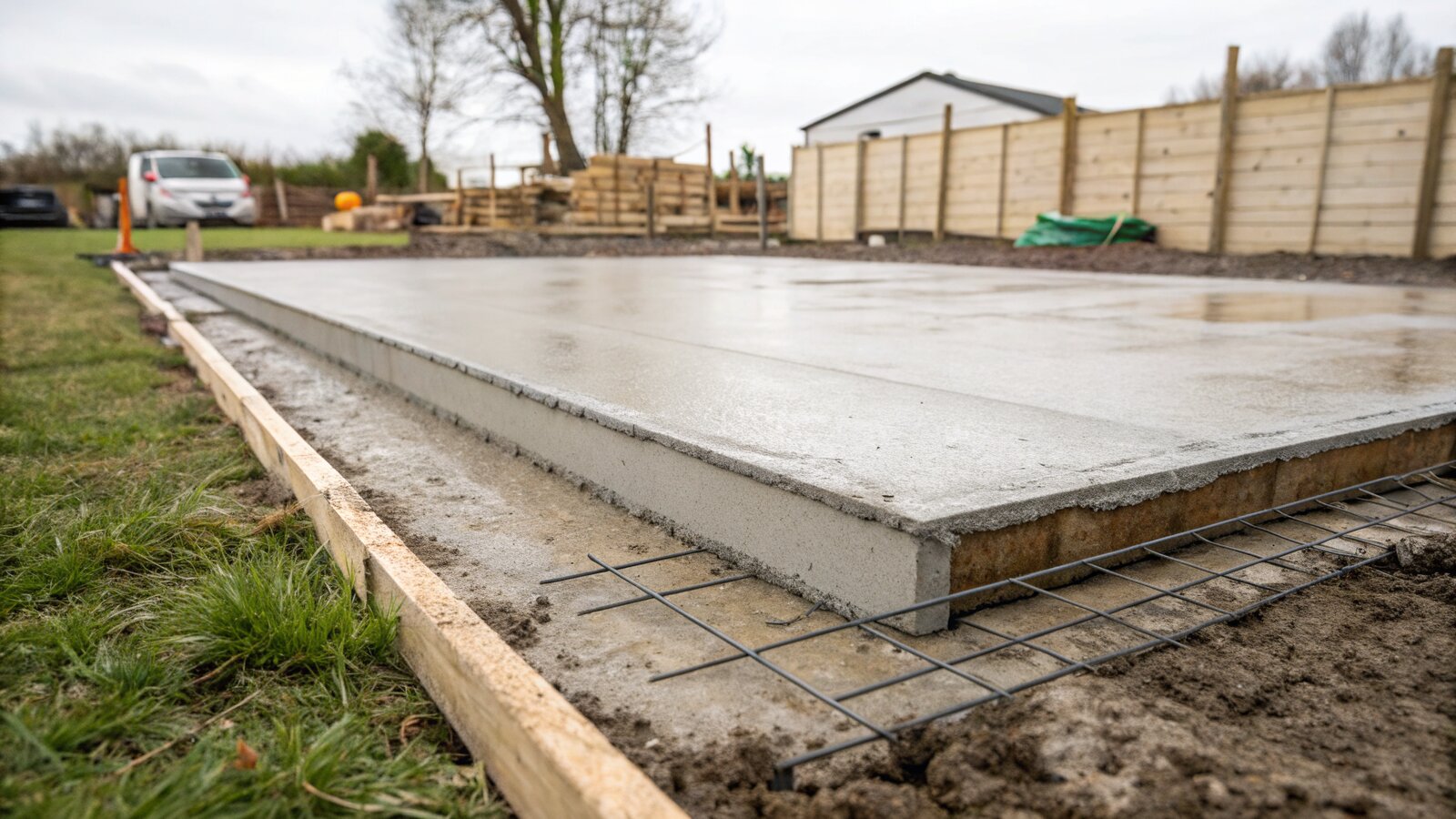
Concrete raft
A raft is a single reinforced slab that spreads the load over the whole footprint instead of channelling it down narrow trenches. It is the common choice for a standard conservatory on reasonable ground, and it is often the most economical on soft or variable soil where a deep trench would otherwise have to go down a long way. The cost scales with floor area rather than perimeter. Rafts use a fair amount of steel mesh and concrete, so the saving comes from avoiding deep digging, not from using less material.
Strip foundation
A strip foundation is a band of concrete poured along the line of the walls, with blockwork built up off it to ground level. It suits firm, even ground and a conservatory with dwarf walls. Cost is driven by the length of trench (the perimeter) and the depth you have to reach. On easy ground with machine digging it is competitive; once the depth climbs because of clay or trees, the price climbs with it, because every extra 100mm of depth means more spoil out and more concrete in.
Trench fill
Trench fill is a strip foundation taken to its logical end: instead of pouring a thin strip and building blockwork up, you fill the whole trench with concrete to just below ground level. It uses noticeably more concrete than a standard strip, but it saves the labour and time of laying blocks below ground. On deep digs in clay it often works out sensible, because bricklaying down a metre-deep trench is slow and awkward. Expect the concrete volume, and therefore the cost, to be higher than a like for like strip.
Piles over poor ground
If the ground is genuinely poor, made up of fill, very soft, or compromised by large trees close by, a normal foundation will not do. The answer is usually piles driven or bored down to firmer strata with a reinforced ground beam or raft spanning between them. This is the most expensive base by a wide margin and needs a structural engineer to design it. You will not see this on most conservatory jobs, but on a sloping Kent garden with old made ground or a mature oak nearby it can be the only safe option.
How deep does a conservatory base need to go?
Depth is the single biggest cost lever, because it controls how much you dig out and how much concrete you pour back. The rules are not arbitrary.
- Frost protection: on frost-susceptible ground the foundation needs to sit below the depth that freezes and thaws, which is generally taken as a minimum of around 450mm below ground level in most of the UK. That is the floor, not the answer; clay and trees usually push the depth a long way past it.
- Clay soils: on shrinkable clay the foundation has to sit below the zone that dries out and swells with the seasons, so a minimum of around 750mm is normal and 1m or more is common, as set out in general foundation guidance from industry sources on conservatory foundations.
- Near trees: tree roots pull moisture out of clay and make it shrink, so foundations near trees go deeper still, sometimes well past a metre, and may need a root barrier and heave precautions. The depth depends on the tree species, its mature height, its distance and the soil, and is worked out using NHBC guidance.
- Matching the house: ideally the conservatory foundation is as deep as the existing house foundation and tied into it, so the two move together rather than cracking apart. A conservatory on a shallow base bolted to a house on deep footings is a recipe for differential settlement.
The practical takeaway: a quote that assumes a shallow 600mm dig on clay near a tree is either optimistic or about to grow with a variation once the ground is open. Ask what depth the installer has allowed for and what happens if building control or the engineer wants more.
The Kent factors that add cost
Two things make Kent groundwork pricier than a flat figure suggests, and a careful installer prices both even if they do not break them out.
Clay ground
Much of the South East sits on shrinkable clays, and the British Geological Survey identifies the south-east of Britain as the area most exposed to shrink-swell ground movement. London Clay and Weald Clay swell when wet and shrink when dry, which is exactly the cyclical movement deep foundations are designed to escape. In practice that means deeper digs, more spoil to cart away, more concrete, and on the worst sites a raft or piled solution rather than a simple strip. If you have had subsidence locally or there are mature trees in the garden, expect the base spec to reflect it.
Access
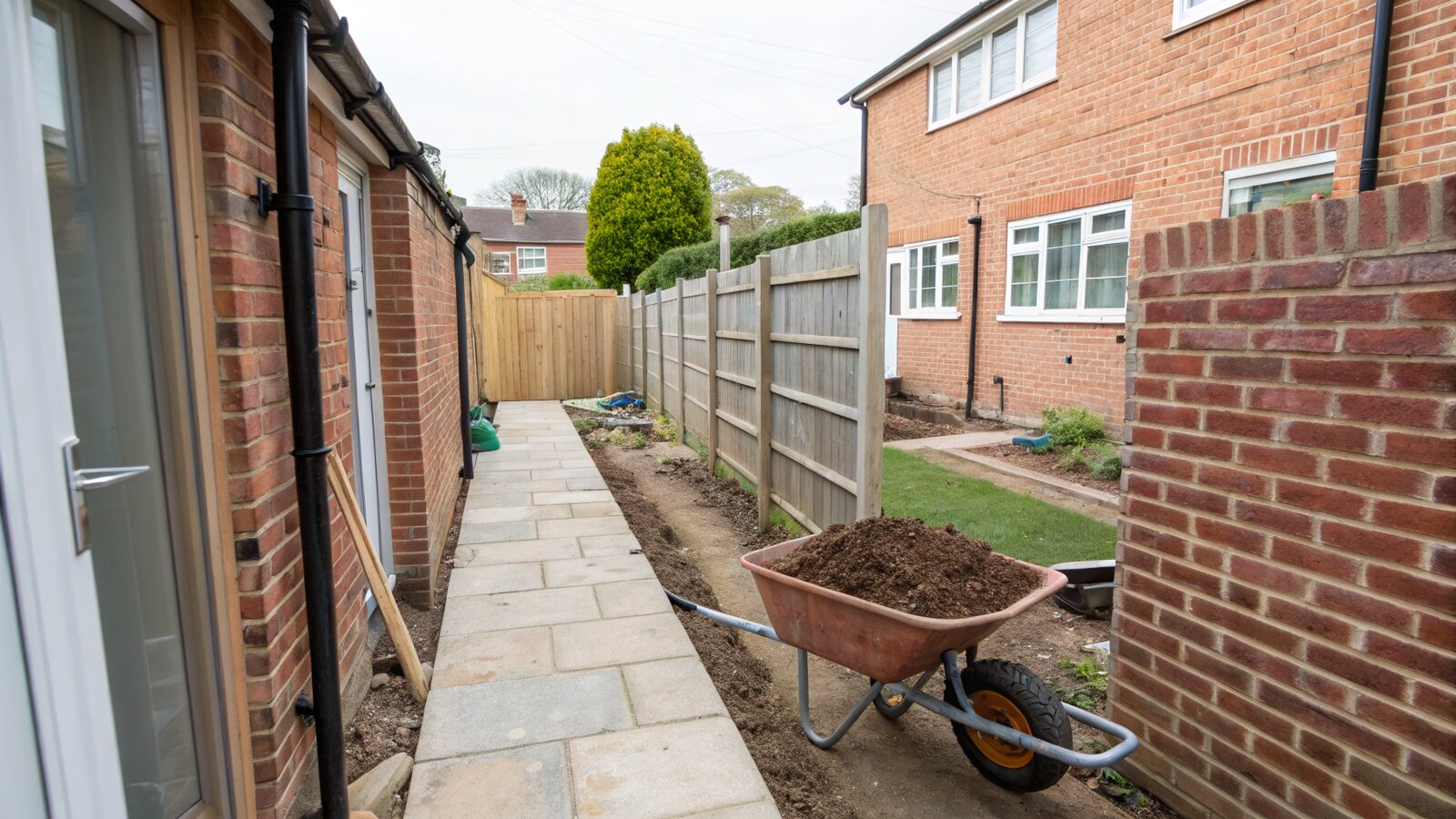
The other quiet cost is getting plant and muck in and out. A house with side access wide enough for a mini digger and a barrow run to the front is cheap to work. A terraced or mid-link Kent property where everything has to be dug by hand and carried through the house can roughly double the labour on the groundwork alone. Spoil removal is charged by volume, and on a deep clay dig there is a lot of it. When you compare two base quotes, the cheaper one is often the one that has not properly costed access.
Do you even need building regulations for the base?
Many conservatories are exempt from building regulations, which is part of why the base spec gets vague. According to the Planning Portal, a conservatory is generally exempt when it is built at ground level and is under 30 square metres in floor area, is separated from the house by external quality walls, doors or windows, has an independent heating system with its own temperature and on/off controls, and has glazing and fixed electrics that comply with the relevant building regulations.
Exempt does not mean you can skip the foundation. It means building control is not signing off the structure, so the quality of the base rests entirely on the installer doing it properly. The Planning Portal also notes that any new structural opening between the conservatory and the house, like knocking through a wall, needs building regulations approval even when the conservatory itself is exempt. If your installer is treating an exempt conservatory as an excuse for a thin, shallow slab, that is a red flag, not a saving.
One more thing the base can trigger: if there is a public drain or sewer within three metres of where you are building, you usually need a build over agreement from your water company before work starts. That can add time and a fee, so flag any inspection covers in the build area early.
How to read a conservatory base quote
To compare fairly and avoid mid-job surprises, ask for the base broken out and check these points:
- Foundation type and depth assumed, and whether the price holds if the ground demands more.
- Spoil removal: is muck-away included, and priced by volume or as a fixed allowance?
- Access: has hand digging and carrying through the house been allowed for where there is no side access?
- Floor build-up: hardcore, sand blinding, damp proof membrane tied into the house, insulation thickness and slab thickness.
- Trees and drains: any allowance for deeper foundations near trees, root barriers, or a build over agreement.
- Tie-in to the house: whether the new base is connected to the existing foundation to prevent differential movement.
For more on planning and building a glazed extension in Kent, see our home improvement guides.
Frequently asked questions
Can I build a conservatory on an existing base or old patio?
Sometimes, but only if the existing slab is the right depth, thickness and construction for the load, and is in good condition. A patio or thin garden slab is almost never adequate as a conservatory foundation. An installer should check what is under it before committing, and on clay an old shallow base often has to come out and be redone to avoid movement.
Does a full-height glazed conservatory need a different base from a dwarf wall one?
The foundation principle is the same: it still has to reach stable ground at the correct depth. A dwarf wall conservatory adds the cost of building the low brick wall on top of the foundation, while a full-height glazed one sits the frame straight onto the base. The groundwork below ground is comparable; the difference is mostly above it.
Why is my conservatory base quote more expensive than my neighbour’s?
Usually ground and access. Even on the same street, one garden can have firmer ground, better access for a digger and no trees, while the next has heavy clay, a mature tree and no side gate. Both push the depth and the labour up. Always compare quotes on the same assumed depth and the same spoil and access allowances.
How long does it take to lay a conservatory base?
For a straightforward base on good ground with machine access, the groundwork is often a few days, then the concrete needs time to cure before building continues. Deep clay digs, hand digging through a house, or a piled solution all add days. Wet weather can also hold up a pour, so build some slack into your timeline.
Do I need a structural engineer for a conservatory base?
Not for a standard base on decent ground. You do need one if the ground is poor and a piled solution is on the table, or if foundations near trees on shrinkable clay have to be designed to NHBC guidance. If your installer suggests an engineer, it is usually because the ground genuinely calls for it, not to pad the bill.
Is the base included in a typical conservatory price?
It depends on the company. Some all-in conservatory prices include the base, others quote the frame, glazing and roof and price the groundwork separately or subcontract it. Always confirm whether the base is in your quote and ask for its cost as a line item so you can compare it properly between suppliers.
Related guides
- Conservatory Roof Replacement vs Glass Film: Which Fixes a Too-Hot, Too-Cold Conservatory?
- Air Source Heat Pump Cost in 2026 After the £7,500 Grant: What You Actually Pay
- Do You Need Planning Permission for a Rear Extension in Kent? 2026 Permitted Development Rules
- Do You Need a Party Wall Agreement for a Rear Extension? Cost and Rules Explained
- Underfloor Heating vs Radiators for a Home Extension: Cost, Running Bills and Which to Choose
- How Much Does a House Extension Cost in 2026? Full UK Price Breakdown
- Loft Conversion Cost and Types: Dormer, Hip-to-Gable and Velux Explained
- Kent Home Improvement News: June 2026
- House Extensions: The Complete UK Homeowner’s Guide
- Single Storey Extension Ideas, Costs and Planning Rules
- Double Storey Extensions: Costs, Designs and What You Can Build
- Side Return Extensions Explained: Cost, Light and Layout
- Kent Home Improvement News: Mid-June 2026
- Garage Conversion Guide: Cost, Building Regs and Best Uses
- Extension vs Moving House: Which Is Better Value in Kent?
- Wraparound vs Rear Extension: Cost and Space Compared
- House Extension Builders in Kent: Costs, Lead Times and How to Choose
- Conservatory Guide: Styles, Costs and How to Choose One
- Kent Home Improvement News: Late June 2026
- How Much Does a Conservatory Cost in 2026? UK Prices by Type
- Conservatory vs Orangery vs Extension: Which to Build?
- Conservatory Roof Options: Glass, Polycarbonate and Tiled Compared
- Kent Home Improvement News: Early July 2026
- How to Keep a Conservatory Warm in Winter and Cool in Summer
- Tiled Conservatory Roof Cost and Replacement Process Explained
- Conservatories in Kent: Choosing an Installer, Costs and What to Ask
- Kent Home Improvement News: Mid-July 2026
- Roofing Guide: Repairs, Replacement, Materials and Costs
- New Roof Cost UK 2026: Replacement Prices by Roof Type
- Roof Repair Cost UK 2026: Slipped Tiles and Flashing Prices
- 7 Signs Your Roof Needs Replacing (and What You Can Ignore)
- Flat Roof vs Pitched Roof: Cost, Lifespan and Best Uses
- EPDM vs Felt vs Fibreglass Flat Roofs Compared
- Kent Home Improvement News: Mid-July 2026
- Roof Tile Types Explained: Clay, Concrete and Slate Compared
- Fascias, Soffits and Guttering: When to Replace and What It Costs
- How to Find a Good Roofer: Vetting Checklist for UK Homeowners
- Roofers in Kent: Costs, How to Choose and What to Ask in 2026
- Kitchen Renovation Guide: Planning, Cost and Design in 2026
- How Much Does a New Kitchen Cost in 2026? UK Price Guide
- Kitchen Layout Ideas: Galley, L-Shape, Island and Open Plan
- Worktops Compared: Quartz vs Granite vs Laminate vs Solid Wood
- Fitted vs Bespoke vs Flat-Pack Kitchens: Cost and Quality
- Kitchen Island Ideas, Sizes and Costs: A 2026 UK Guide
- Kent Home Improvement News: Late July 2026
- Open Plan Kitchen Diner: Costs, Layouts and Knock-Through Rules
- How Long Does a Kitchen Fitting Take? Realistic UK Timeline
- Kitchen Fitters in Kent: Costs and How to Choose (2026)
- Bathroom Renovation Guide: Planning, Cost and Layout
- New Bathroom Cost 2026: What You’ll Pay in the UK
- Kent Home Improvement: Roofing Costs Rise (Aug 2026)
- Small Bathroom Ideas: Layouts That Feel Bigger
- Wet Room Cost 2026: £2,000 to £9,000 Fitted, by Size
- En Suite Cost and Minimum Size: £4,000 to £10,000 in 2026
- Kent Home News: £9,000 Heat Pump Grant Now Open
- Electric vs Mixer vs Power Shower: What Your Boiler Allows
- Bathroom Underfloor Heating Cost: 16p an Hour to Run
- Window Replacement Cost 2026: £350 to £600 Per uPVC Window
- uPVC vs Aluminium Windows: the 1.4 U-Value Rule
- How Long Does a Bathroom Take to Fit? 5 to 10 Working Days
- Home Improvement News: Solar Up 14%, Heat Pumps Down 17%
- Double vs Triple Glazing: Part L Still Stops at 1.4
- Bathroom Fitters in Kent: What to Ask Before You Pay
- Sash Window Repair or Replace? What Kent Councils Allow
- Bifold vs Sliding Doors: What Building Regs Actually Set
- Composite Door Cost 2026: £550 to £2,350 Fitted
- Window Energy Ratings: Band B Is the Rule, Not C
- Replacement Windows: the 1.4 U-Value and Vent Rules
- Double Glazing Kent: the 1.4 U-Value Every Quote Must Hit
- Heat Pumps in Kent: the £7,500 Grant and the 1.5m³ Rule
- Heat Pump vs Gas Boiler: Break-Even Is a SCOP of 3.0
- Permitted Development Rights: The 8m Rear Extension Rule