
The composite door cost most Kent homeowners end up paying, supplied and fitted, sits between £550 and £2,350 according to MyJobQuote’s July 2026 figures, against £400 to £850 for uPVC and £1,500 to £4,000 for aluminium. The average front door installation across the UK runs £550 to £1,500 and takes two to five hours on site. That is a wide band for what looks like the same product in a showroom, and the reason is what sits inside the door rather than the colour on the outside.
Here is what actually drives the price, what the Building Regulations require of a front door in 2026, and how to compare three quotes that all claim to be for a “high security composite door”.
What a composite front door costs in 2026
Composite is the middle of the market. It costs more than uPVC and usually less than a made-to-measure hardwood or aluminium door, and it is the default choice for most replacement front doors in Kent.
Expect the spread to be driven by size, glazing, sidelights, the hardware specification and how much making good the opening needs. Location matters too: MyJobQuote puts London and the South East around £20 to £60 above the rest of the UK for the same job.
A supply and fit quote should normally cover:
- the door and, where required, a new frame
- standard hardware and locks
- removal and disposal of the old door and frame
- fitting and adjustment
- trims, sealing and making good around the opening
If a quote is materially cheaper than the others, check which of those five it leaves out. Frame renewal and making good are the two most commonly excluded, and both cost real money when they land on you afterwards.
What you are actually paying for: the core
Composite means a door built from several materials rather than one. Almost all of them have a glass reinforced plastic (GRP) skin, an insulating core and a subframe holding it together. The core is where the price difference lives and it is the thing showrooms are vaguest about.
Solid timber core. Solidor builds its doors around a solid timber core, and Endurance uses a 48mm solid timber core made from laminated veneer for stiffness. A solid core door feels heavier and duller when you knock it, which is exactly what you want in a front door.
Foam-filled core. Lighter, cheaper, and thermally very good, but the fixings for hinges and locks have to be carried by a subframe rather than by the core itself. Ask what that subframe is made of and how far the lock keeps run into it.
Reinforced construction. Rockdoor takes a different route again, with a 360 degree aluminium inner frame, 3mm skins and bonded glazing, paired with multipoint locking using 25mm steel hooks and a three star anti-snap cylinder.
None of these is automatically the right answer. What matters is that the salesperson can tell you which one you are buying, in those terms, without checking.
Security: what Building Regulations require, and what they do not
Approved Document Q covers security in dwellings, and its scope is written into the regulation itself: “Requirement Q1 applies only in relation to new dwellings.” It does not apply when you replace the front door of an existing house.
Where it does apply, it is specific. Every easily accessible doorset giving access into a dwelling should be a secure doorset, either manufactured to a design shown by test to meet PAS 24, or designed and built to the detailed hardware specification in Appendix B of the document. Standards offering similar or better performance are also accepted, and the document names STS 201 Issue 5:2013, LPS 1175 Issue 7:2010 security rating 2, STS 202 Issue 3:2011 burglary rating 2 and LPS 2081 Issue 1:2015 security rating B.
Two more requirements are worth quoting because almost nobody selling doors mentions them. Letter plates should have a maximum aperture of 260mm by 40mm and be designed to hinder anyone fishing for keys, which is what the Door and Hardware Federation’s TS 008 specification tests. And the main door into the dwelling should have a door viewer, unless there is clear glass in the door or a window beside it, plus a door chain or limiter.
PAS 24 certifies the whole doorset, not the slab. The certificate applies to a tested combination of leaf, frame, hinges, lock, cylinder and glazing, fitted the way the manufacturer specifies. A PAS 24 door hung in a frame that was not part of the test, or with a cheaper cylinder swapped in, is not a PAS 24 doorset any more. Ask for the certificate and check that the hardware on your quote matches it.
The cylinder is the weak point, and it is cheap to fix
Most forced entries through a composite door go through the euro cylinder rather than the door. The relevant standard is TS 007, run by the Door and Hardware Federation, and it works on a star rating.
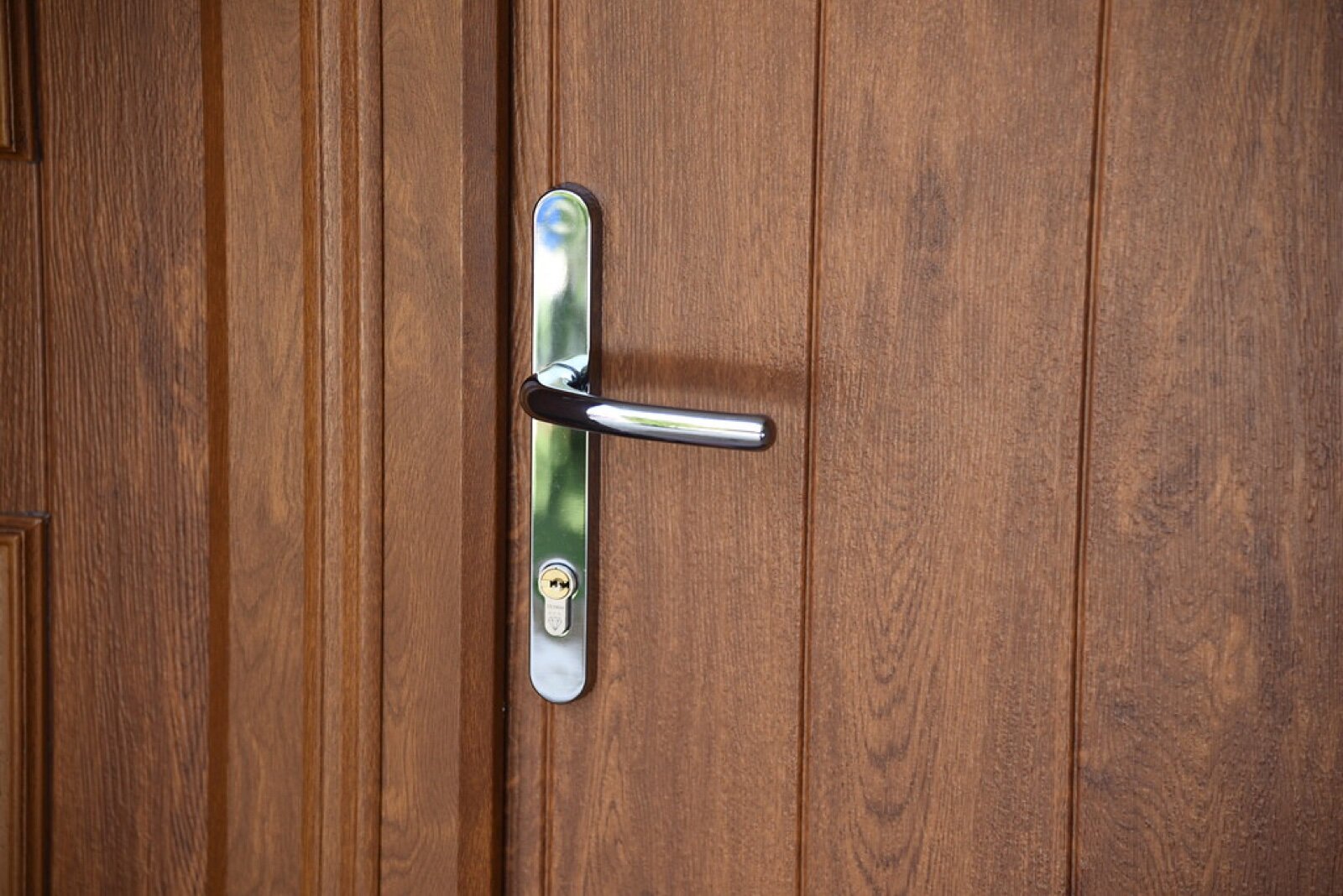
A three star Kitemarked cylinder carries the full range of protection on its own. The alternative route is a one star cylinder combined with a two star Kitemarked armoured handle or lock surround, which reaches the same level as a package. Cylinders meeting the Master Locksmiths Association’s Sold Secure Diamond standard (SS312) achieve that level of protection too, and are recognised by the police Secured by Design scheme.
If a quote does not state the cylinder rating, assume it is the cheapest one that fits. Upgrading a cylinder is a small cost against a door, and it is the single best value item on the whole order.
Part L: what a replacement front door has to achieve
Energy efficiency is where replacement doors do come under the Building Regulations. Approved Document L Volume 1 sets a limiting standard for new and replacement doors in existing dwellings:
- doors with more than 60 per cent of the internal face glazed: a maximum U-value of 1.4 W/(m²·K), or a Doorset Energy Rating of Band C or better
- other doors: a maximum U-value of 1.4 W/(m²·K), or a Doorset Energy Rating of Band B or better
The unit must also be draught-proofed, and insulated cavity closers fitted where appropriate. Building control bodies can accept a Doorset Energy Rating from a quality assured certification scheme as evidence of compliance.
There is a genuine loophole, and it is in the regulations rather than in the marketing. A controlled fitting means the entire unit including the frame. Replacing a door in its existing frame is not providing a controlled fitting, so that work does not have to meet the energy efficiency requirements. In practice a composite door needs its own frame to perform, so this rarely helps, but it explains why slab-only replacements are treated differently.
The 2026 edition of Approved Document L has been published and takes effect on 24 March 2027 for work not connected with higher-risk buildings, and 24 September 2027 for work that is. It keeps the same 1.4 W/(m²·K) door figure, so anyone telling you to buy now before the door rules tighten is selling, not advising.
Who signs the work off
Replacing a front door and frame is notifiable work. The usual route is an installer registered with a competent person scheme such as FENSA, set up in April 2002 as the first such scheme for window and door installers, which lets registered companies self-certify compliance with the Building Regulations. The certificate should be issued within 30 days of completion, and the installation is registered with the local council.
If your installer is not scheme registered, or you are fitting the door yourself, you submit a building notice to the local authority building control team instead. Either route is fine. No route at all is a problem you will meet again when you sell the house, because conveyancing solicitors ask for the certificate.
How to compare three quotes properly
Ask each supplier the same five questions and write down the answers:
- What is the core, in one word: solid timber, foam, or a reinforced frame system?
- Is the doorset PAS 24 certified, and can I see the certificate covering this frame and hardware combination?
- What is the cylinder rated to: TS 007 three star, or one star with a two star handle, or Sold Secure Diamond?
- What U-value or Doorset Energy Rating is quoted for the finished doorset?
- Are you FENSA or Certass registered, and is the guarantee insurance backed?
Every one of those has a factual answer that can be checked. A supplier who deflects on all five is selling you a colour swatch.
Frequently asked questions
How much does a composite front door cost fitted?
MyJobQuote’s July 2026 data puts supply and fit at £550 to £2,350, with the average front door installation across all materials at £550 to £1,500 and two to five hours of labour. London and the South East run roughly £20 to £60 above the national figure for the same job.
Are composite doors more secure than uPVC?
Usually, because the core and the subframe are stiffer, but the certification matters more than the material. A PAS 24 tested uPVC doorset with a three star cylinder beats an uncertified composite door with a basic cylinder. Compare the certificates, not the brochures.
Do I need building regulations approval for a new front door?
Replacing the whole doorset, frame included, is notifiable and must meet the Part L standard of 1.4 W/(m²·K) or the equivalent Doorset Energy Rating. A FENSA or Certass registered installer self-certifies it; otherwise you submit a building notice. Replacing the door in its existing frame is not a controlled fitting and does not have to meet the energy requirements.
Does Approved Document Q apply to my house?
Only if it is a new dwelling or a building being converted into one. Existing homes replacing a door are not covered, though the standards it names are still the best benchmark to buy against.
How long does a composite front door last?
The GRP skin does not rot or need painting, so the life is usually decided by the hardware and the seals rather than the door. Hinges, the multipoint mechanism and the cylinder are all replaceable, which is why the length and terms of the guarantee are worth reading before you sign.
What is a Doorset Energy Rating?
It is a rating band for the whole doorset, in the same family as the window energy ratings on double glazing. Approved Document L accepts Band B for a solid door, or Band C for a door with more than 60 per cent of its internal face glazed, as an alternative way of showing the 1.4 W/(m²·K) standard has been met.
Getting a straight quote in Kent
A front door is one of the few home improvements where the specification is genuinely checkable before you buy. Get the core, the certification, the cylinder rating and the energy figure in writing, then compare like with like. If you want that done properly on a Kent property, see how we work at Contemporary Structures, and read our related guides on window replacement costs and uPVC, aluminium and timber frames.
Primary sources for this article: Approved Document Q, Security in dwellings and Approved Document L, Conservation of fuel and power.
Related guides
- Conservatory Roof Replacement vs Glass Film: Which Fixes a Too-Hot, Too-Cold Conservatory?
- Air Source Heat Pump Cost in 2026 After the £7,500 Grant: What You Actually Pay
- Do You Need Planning Permission for a Rear Extension in Kent? 2026 Permitted Development Rules
- How Much Does a Conservatory Base Cost in the UK? (2026 Price Guide)
- Do You Need a Party Wall Agreement for a Rear Extension? Cost and Rules Explained
- Underfloor Heating vs Radiators for a Home Extension: Cost, Running Bills and Which to Choose
- How Much Does a House Extension Cost in 2026? Full UK Price Breakdown
- Loft Conversion Cost and Types: Dormer, Hip-to-Gable and Velux Explained
- Kent Home Improvement News: June 2026
- House Extensions: The Complete UK Homeowner’s Guide
- Single Storey Extension Ideas, Costs and Planning Rules
- Double Storey Extensions: Costs, Designs and What You Can Build
- Side Return Extensions Explained: Cost, Light and Layout
- Kent Home Improvement News: Mid-June 2026
- Garage Conversion Guide: Cost, Building Regs and Best Uses
- Extension vs Moving House: Which Is Better Value in Kent?
- Wraparound vs Rear Extension: Cost and Space Compared
- House Extension Builders in Kent: Costs, Lead Times and How to Choose
- Conservatory Guide: Styles, Costs and How to Choose One
- Kent Home Improvement News: Late June 2026
- How Much Does a Conservatory Cost in 2026? UK Prices by Type
- Conservatory vs Orangery vs Extension: Which to Build?
- Conservatory Roof Options: Glass, Polycarbonate and Tiled Compared
- Kent Home Improvement News: Early July 2026
- How to Keep a Conservatory Warm in Winter and Cool in Summer
- Tiled Conservatory Roof Cost and Replacement Process Explained
- Conservatories in Kent: Choosing an Installer, Costs and What to Ask
- Kent Home Improvement News: Mid-July 2026
- Roofing Guide: Repairs, Replacement, Materials and Costs
- New Roof Cost UK 2026: Replacement Prices by Roof Type
- Roof Repair Cost UK 2026: Slipped Tiles and Flashing Prices
- 7 Signs Your Roof Needs Replacing (and What You Can Ignore)
- Flat Roof vs Pitched Roof: Cost, Lifespan and Best Uses
- EPDM vs Felt vs Fibreglass Flat Roofs Compared
- Kent Home Improvement News: Mid-July 2026
- Roof Tile Types Explained: Clay, Concrete and Slate Compared
- Fascias, Soffits and Guttering: When to Replace and What It Costs
- How to Find a Good Roofer: Vetting Checklist for UK Homeowners
- Roofers in Kent: Costs, How to Choose and What to Ask in 2026
- Kitchen Renovation Guide: Planning, Cost and Design in 2026
- How Much Does a New Kitchen Cost in 2026? UK Price Guide
- Kitchen Layout Ideas: Galley, L-Shape, Island and Open Plan
- Worktops Compared: Quartz vs Granite vs Laminate vs Solid Wood
- Fitted vs Bespoke vs Flat-Pack Kitchens: Cost and Quality
- Kitchen Island Ideas, Sizes and Costs: A 2026 UK Guide
- Kent Home Improvement News: Late July 2026
- Open Plan Kitchen Diner: Costs, Layouts and Knock-Through Rules
- How Long Does a Kitchen Fitting Take? Realistic UK Timeline
- Kitchen Fitters in Kent: Costs and How to Choose (2026)
- Bathroom Renovation Guide: Planning, Cost and Layout
- New Bathroom Cost 2026: What You’ll Pay in the UK
- Kent Home Improvement: Roofing Costs Rise (Aug 2026)
- Small Bathroom Ideas: Layouts That Feel Bigger
- Wet Room Cost 2026: £2,000 to £9,000 Fitted, by Size
- En Suite Cost and Minimum Size: £4,000 to £10,000 in 2026
- Kent Home News: £9,000 Heat Pump Grant Now Open
- Electric vs Mixer vs Power Shower: What Your Boiler Allows
- Bathroom Underfloor Heating Cost: 16p an Hour to Run
- Window Replacement Cost 2026: £350 to £600 Per uPVC Window
- uPVC vs Aluminium Windows: the 1.4 U-Value Rule
- How Long Does a Bathroom Take to Fit? 5 to 10 Working Days
- Home Improvement News: Solar Up 14%, Heat Pumps Down 17%
- Double vs Triple Glazing: Part L Still Stops at 1.4
- Bathroom Fitters in Kent: What to Ask Before You Pay
- Sash Window Repair or Replace? What Kent Councils Allow
- Bifold vs Sliding Doors: What Building Regs Actually Set
- Window Energy Ratings: Band B Is the Rule, Not C
- Replacement Windows: the 1.4 U-Value and Vent Rules