
The heat pump vs gas boiler argument usually gets fought over anecdotes: a neighbour whose bills doubled, a cousin who swears by it. It does not need to be. One number settles the running-cost question, and on this winter’s price cap it lands at a seasonal performance factor of about 3.0. Above that, a heat pump costs less per unit of heat than a gas boiler. Below it, it costs more.
Everything else, the grant, the radiators, the planning rules, hangs off that. Here is the arithmetic, the real-world performance data behind it, and the cases where a boiler is still the sensible answer.
The only number that decides it: cost per kWh of heat
Both systems are measured the same way: what does it cost to put one kilowatt hour of heat into your house? A gas boiler burns gas at a seasonal efficiency of roughly 90 per cent in a well-commissioned condensing system, so divide the gas unit rate by 0.9. A heat pump moves heat rather than making it, so divide the electricity unit rate by its seasonal performance factor (SPF), the real-world, whole-year version of the headline COP.
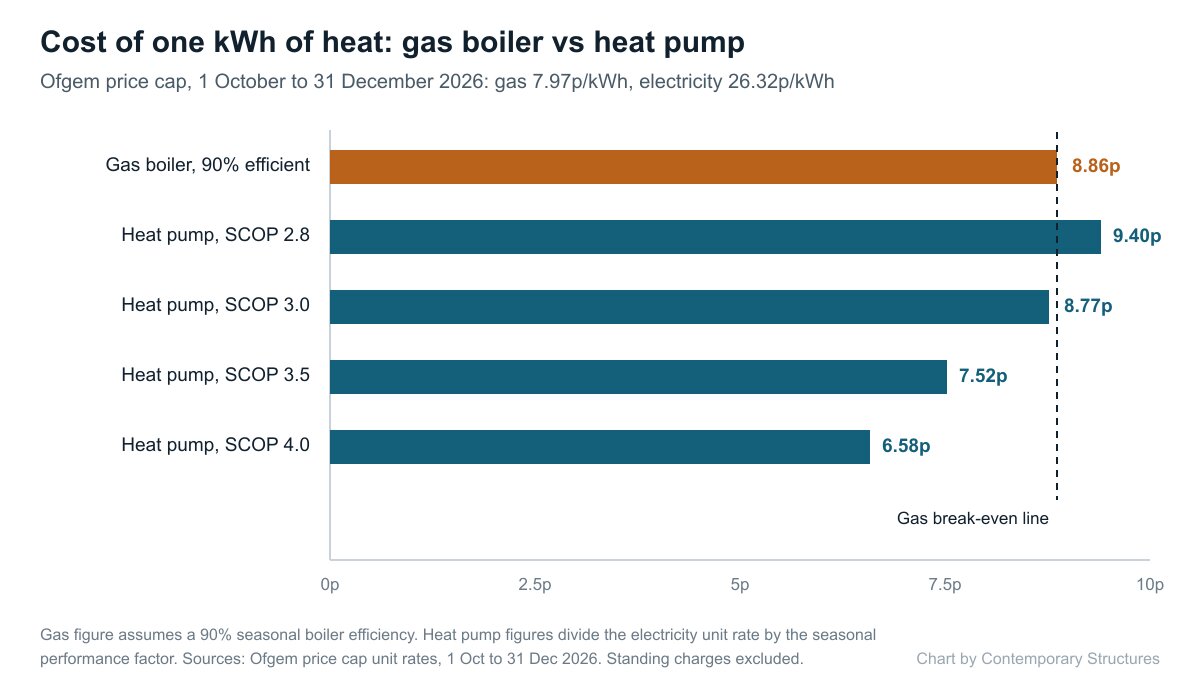
On the Ofgem cap for 1 October to 31 December 2026, that gives:
- Gas boiler at 90 per cent: 8.86p per kWh of heat
- Heat pump at SPF 2.8: 9.40p
- Heat pump at SPF 3.0: 8.77p
- Heat pump at SPF 3.5: 7.52p
- Heat pump at SPF 4.0: 6.58p
Break-even is 2.97. A heat pump at SPF 3.5 runs about 15 per cent cheaper than gas; one stuck at 2.5 runs about 19 per cent dearer. Installation quality, not the badge on the box, decides which you get.
What the price cap actually says this winter
From 1 October 2026 the cap sits at £1,723 for a typical direct debit household, up 4 per cent from £1,663. The split matters more than the headline: gas bills rose about 8 per cent on higher wholesale prices while electricity stayed broadly flat, partly because the government removed VAT from domestic electricity. Ofgem says that without it the figure would have been around £45 higher.
The published unit rates for direct debit customers are 26.32p per kWh for electricity and 7.97p for gas, with daily standing charges of 54.83p and 29.68p. That is a price ratio of 3.30 to 1.
The direction of travel matters as much as the level. Every increase that lands on gas and not on electricity moves the break-even SPF down, and this cap did exactly that.
What real UK heat pumps actually achieve
The best British evidence is the Electrification of Heat Demonstration Project, funded by the government and run by Energy Systems Catapult. It monitored 742 air source heat pumps in detached, semi-detached and terraced homes and flats built from before 1919 to the 2000s, between November 2020 and August 2022. The median SPF was 2.80, with a median coefficient of performance on cold days of 2.44. That sits just below the current break-even line.
Both camps misuse that figure. It does not mean heat pumps do not work: the study found no property type where one could not be installed, and the median rose by 0.3 to 0.4 on the earlier 2011 to 2014 trial. It means an average installation, on today’s tariffs, roughly matches gas rather than beating it. The homes that saved money ran low flow temperatures through radiators sized for the job.
So ask an installer what flow temperature the design assumes. A system designed around 35 to 45 degrees will hit an SPF in the threes. One designed at 55 because the existing radiators were left alone will not, and no tinkering afterwards fixes it.
The standing charge nobody counts
Disconnect the gas supply and you stop paying the gas standing charge. At 29.68p a day that is about £108 a year, whatever you use.
Take a home needing 12,000 kWh of delivered heat a year. On the current cap a 90 per cent efficient gas boiler costs roughly £1,063 in gas plus £108 standing charge, about £1,171. A heat pump at SPF 2.8 costs about £1,128 in electricity and no gas standing charge; at SPF 3.5, about £902. The heat pump wins on the total even at the study median, purely because the second standing charge disappears. That only works if you remove gas entirely: keep a gas hob and the comparison reverts to unit rates alone.
What it costs to fit, and what the grant covers
Nesta’s analysis of four years of Boiler Upgrade Scheme data puts the median air source heat pump installation at £13,041 in 2025/26, up 0.4 per cent on the previous year but down 11 per cent in real terms since April 2022. The scheme supported 30,600 air source heat pumps in 2025/26, up 24 per cent, and almost 80,000 in total.
Against that, the Boiler Upgrade Scheme pays £7,500 towards an air or ground source heat pump, £5,000 for biomass and £2,500 for air-to-air. Oil or LPG homes with no mains gas get an extra £1,500 until March 2027, taking it to £9,000. The installer claims it and it comes off the quote.
Median net cost is therefore around £5,500. A like-for-like combi replacement is a fraction of that, which is the honest answer to why most people still fit a boiler: the running-cost gap is not yet wide enough to repay the capital gap inside a boiler’s lifetime.
Carbon is not close
Running cost is a near-tie. Emissions are not. On the 2026 government conversion factors, natural gas is 0.18231 kgCO2e per kWh on a gross calorific value basis, so heat from a 90 per cent boiler carries about 0.203 kgCO2e per kWh. UK grid electricity fell to 0.13096 kgCO2e per kWh in the 2026 factors, from 0.17700 in 2025, a drop of about 26 per cent driven mostly by grid decarbonisation. At an SPF of 2.8, heat pump heat carries roughly 0.047 kgCO2e per kWh: more than four times cleaner. The gap widens every year the grid gets greener, while gas stays exactly as carbon-intensive as it has always been.
Planning permission and where the unit can go
The rules loosened and much published advice is out of date. In England an air source heat pump is normally permitted development, and the old one metre boundary requirement has gone. Current conditions on the Planning Portal include:
- Outdoor unit volume no more than 1.5 cubic metres on a house, or 0.6 cubic metres on a block of flats
- The first two heat pumps on a detached house are permitted development; on other houses and flats, only the first
- Not permitted on a pitched roof, and at least one metre from the edge of a flat roof
- In a conservation area or World Heritage Site, not on a wall or roof facing a highway
- Permitted development rights do not apply to listed buildings or scheduled monuments
- From 28 May 2026, MCS 020a is the only permitted certification standard for the planning exemption
That last point matters: if an installer works to an older standard, the exemption may not apply.
When a gas boiler is still the right answer
- Your boiler has failed in December. A heat pump needs a heat loss survey, radiator sizing and often a cylinder: weeks, not days.
- There is nowhere compliant for the outdoor unit. Flats and terraces with no rear access are genuinely difficult.
- You are moving within five years. The capital gap will not pay back.
- The fabric is poor and you are not fixing it. High heat loss pushes the design flow temperature up and the SPF down.
- You want to keep a gas hob. Not disqualifying, but it removes the standing-charge saving that tips the sums.
One thing that is not a reason: a coming ban. There is none on replacing a gas boiler in an existing home. The 2026 edition of Approved Document L, in force from 24 March 2027, tightens standards for new homes, not for boiler swaps.
What this means for a Kent home
Kent sits in the mildest part of England, so fewer very cold hours means a higher seasonal average than the same unit would manage further north. The constraint is the housing stock, not the weather: Victorian and Edwardian terraces and solid-wall cottages need radiator upsizing to run at low flow temperatures, and that work is often the difference between an SPF of 2.5 and one of 3.5. Conservation areas in the older town centres restrict where the outdoor unit can sit, so check that early.
The sequence is insulation and radiators first, heat pump second. The other way round is how you end up owning the expensive version of a break-even system. If you are planning wider work, we look at heating alongside the fabric at Contemporary Structures.
Frequently asked questions
Is a heat pump cheaper to run than a gas boiler?
Only above a seasonal performance factor of about 3.0 on the October 2026 cap. Gas heat costs 8.86p per kWh at 90 per cent boiler efficiency; heat pump heat costs 26.32p divided by the SPF. A good system at SPF 3.5 runs roughly 15 per cent cheaper, a poor one at 2.5 about 19 per cent dearer.
Do heat pumps work in cold weather?
Yes, but less efficiently. The Electrification of Heat project recorded a median coefficient of performance of 2.44 on cold days against 2.80 across the year. The system still delivers the heat, it simply uses more electricity to do it, which is why the design outdoor temperature in the sizing calculation matters.
How much is the heat pump grant in 2026?
£7,500 for an air source or ground source heat pump in England and Wales, £5,000 for biomass and £2,500 for air-to-air. Homes off the mains gas grid running on oil or LPG get an extra £1,500 until March 2027. The installer must be MCS certified and takes the grant off your quote.
Do I need planning permission for an air source heat pump?
Usually not in England. It is permitted development within limits: 1.5 cubic metres on a house, not on a pitched roof, one metre back from a flat roof edge. The old one metre boundary rule has gone. Listed buildings are excluded and conservation areas restrict highway-facing positions.
Will my radiators need replacing?
Some of them, usually. Heat pumps work best at flow temperatures of 35 to 45 degrees rather than the 65 to 75 a boiler uses, so each radiator must be larger to give out the same heat. A room-by-room heat loss survey tells you which, and skipping it is the commonest cause of a disappointing system.
Are gas boilers being banned?
Not in existing homes. You can still replace a gas boiler with another. The 2026 edition of Approved Document L, in force from 24 March 2027, raises the new-build standard so far that a gas boiler cannot realistically meet it, but that applies to new homes, not replacements.
Related guides
- New Boiler Cost 2026: £1,800 to £4,500 Fitted
- Boiler Upgrade Scheme: £9,000 Grants From 21 July 2026
- Heat Pumps in Kent: the £7,500 Grant and the 1.5m³ Rule
- Electric vs Mixer vs Power Shower: What Your Boiler Allows
- Underfloor Heating vs Radiators for a Home Extension: Cost, Running Bills and Which to Choose