
Every window quote you get will offer a triple-glazed upgrade, and the sales line is always the same: three panes must beat two. Deciding between double vs triple glazing is not really a question about panes, though. It is a question about whether the extra money buys you anything the building regulations do not already force your installer to deliver. In England, replacement windows have to hit a whole-window U-value of 1.4 W/(m²·K) or a Window Energy Rating of band B, and good double glazing clears that comfortably.
Here is what actually changes when you add the third pane, what it costs, and the specific situations where it earns its place on a Kent home.
What actually changes when you add a third pane
A double-glazed unit is two panes of glass with a spacer bar between them and the cavity filled with air or, on anything decent, argon. A triple unit adds a third pane and a second cavity. The extra glass and the extra gas layer slow heat loss, which shows up as a lower U-value: the lower the number, the less heat escapes per square metre for each degree of temperature difference.
Three things change with it, and only one of them is the selling point:
- Heat loss falls. This is the headline and it is real.
- Solar gain falls too. Every pane and every coating blocks some of the free warmth the sun puts through the glass in winter. That is the part nobody mentions.
- The unit gets heavier and deeper. Roughly half again the weight of glass, in a frame that has to be deep enough to hold it, on hinges that have to carry it.
Noise is a fourth factor, and it behaves less predictably than people expect. Acoustic performance depends far more on having panes of different thicknesses and a wide cavity than on having three of them. A well-specified acoustic double unit will often outperform a standard triple.
What the building regulations actually require
Replacement windows are controlled fittings under Part L of the Building Regulations. Table 4.2 of Approved Document L, Volume 1: Dwellings, the edition in force now, sets a maximum U-value of 1.4 W/(m²·K) for a window in an existing home, or a Window Energy Rating of band B as an alternative route to compliance. Doors follow at 1.4 and rooflights are allowed up to 2.2, but put those figures next to the rest of the fabric and the picture gets more interesting.
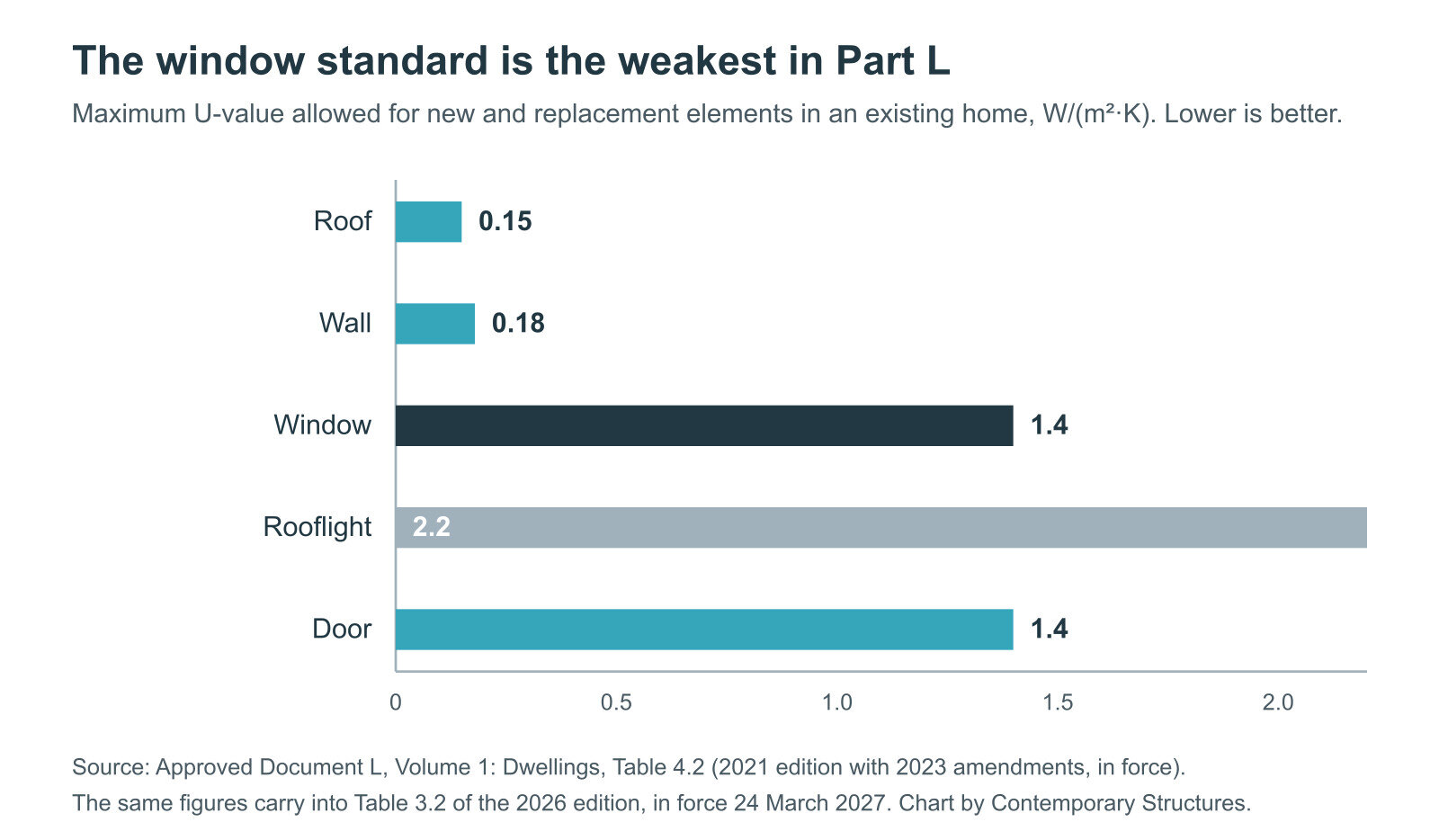
A wall in an existing home has to reach 0.18 and a roof 0.15. The window standard is nearly eight times looser than the wall standard. That is not regulatory laziness; glass is simply a poor insulator compared with 100mm of mineral wool. It is also why, if you have a cold house and a fixed budget, loft and wall insulation buy more comfort per pound than a third pane of glass ever will.
Nor is the threshold about to tighten. The 2026 edition of Approved Document L has been published and takes effect on 24 March 2027 for ordinary building work in England, and it carries exactly the same figures into its Table 3.2: window 1.4, or WER band B. Anyone telling you that you need triple glazing to meet upcoming regulations is selling, not advising.
One exception is worth knowing. If you are in a conservation area or a listed building and normal units would spoil the character, Approved Document L allows a centre-pane U-value of no more than 1.2 instead, or single glazing supplemented with low-emissivity secondary glazing.
What the third pane costs
The Energy Saving Trust puts triple glazing at around 20% more expensive than double, and prices a set of A-rated windows for a semi-detached house at around £4,800. On that basis the triple-glazed version of the same job lands near £5,800, so you are looking at roughly £1,000 of extra spend on a typical semi.
That is the honest headline figure. Two things can push it higher. Deeper frames sometimes mean a different profile system rather than a like-for-like swap. And the weight of triple units can require upgraded hinges and, on large opening sashes, restricts how big a single opener can be.
What you actually save
This is where the sums get uncomfortable for triple glazing. The Energy Saving Trust’s figure for installing A-rated double glazing in an entirely single-glazed semi-detached home is £85 a year in Great Britain and £140 in Northern Ireland, cutting 290kg of CO2 a year in GB and 550kg in NI.
Read that carefully, because it is the number most sales conversations skip past. That £85 is the saving for going from single glazing to A-rated double. It is the whole prize. Triple glazing does not add another £85; it shaves a further slice off an already much smaller heat loss, and it does so at roughly £1,000 of extra cost.
If you are replacing tired double glazing with new double glazing, the energy saving is smaller again. Most of the benefit there comes from the seals, the frames and the draught-proofing rather than the glass, which is why a 25-year-old A-rated unit with blown seals is worth replacing even though the pane count is not changing.
The window energy rating trap
Here is the counterintuitive part. Triple glazing does not automatically give you a better energy rating.
The Window Energy Rating scheme run by the British Fenestration Rating Council assesses the whole window, frame and glass together, and it combines three things: heat loss, solar gain and air leakage. A window that keeps more heat in but lets less free solar heat through can end up scoring the same or worse overall.
The BFRC’s own technical guidance is blunt about it: solar gain values in triple-glazed windows are at least 10% lower than in equivalent double-glazed windows, and adding an extra coated pane with the wrong coating can cut the g-value sharply enough to drop a window from an A to a B or even a C. A properly specified triple unit, two panes of soft-coat low-emissivity glass with argon fill, does achieve an A rating. A badly specified one does not.
The practical lesson: ask for the certified WER band and the whole-window U-value in writing, for the exact product being quoted. Do not accept “triple glazed” as if it were a performance figure. It is a description of construction, not of performance.
Where triple glazing genuinely earns its place
There are real cases for it, and they are more specific than “you want a warmer house”:
- Large areas of glass. A big rear extension with sliding doors and a wall of glazing loses heat through that glass in proportion to its area. The bigger the glazed area relative to the room, the more the third pane matters.
- Rooms that feel cold near the window. A lower U-value raises the internal surface temperature of the glass, which cuts the cold downdraught you feel sitting beside a window. That comfort gain is often more noticeable than the bill saving.
- Condensation-prone rooms. Warmer glass means less internal condensation. Worth noting that condensation on the outside is a sign the window is working, not failing.
- New builds and deep retrofits. If the walls are already at 0.18 and the loft at 0.15, the windows become the weak point and it is worth spending there. In an average Kent semi with an uninsulated cavity, they are not.
- Exposed or very cold sites. North-facing elevations on open ground, where there is little solar gain to lose anyway.
Notice what is not on that list: a standard three-bedroom house with reasonable insulation, replacing failed double glazing. There, A-rated double glazing with argon fill, warm-edge spacers and low-emissivity coating is the sensible buy, and the £1,000 is better spent on insulation or on better frames.
How to compare quotes properly
Whichever you choose, insist on the same four things from every installer:
- The certified whole-window U-value and WER band for the specific product, not for a demo unit.
- Confirmation of the gas fill and spacer type. Argon and warm-edge spacers make more difference per pound than a third pane.
- Registration with a competent person scheme such as FENSA or Certass. Without one you have to apply for building control approval yourself.
- Three quotes, priced on identical specification, so the comparison means something.
If you are weighing up a whole-house replacement in Kent and want the specification pinned down before you commit, we cover windows, doors and the rest of the fabric on the Contemporary Structures homepage.
Frequently asked questions
Is triple glazing worth it in the UK?
For most existing homes with reasonable insulation, no. Good A-rated double glazing already meets Part L, and the Energy Saving Trust prices triple at around 20% more. Triple is worth it for large glazed areas, very cold or exposed rooms, deep retrofits, and new builds where the walls and roof are already well insulated.
Do the building regulations require triple glazing?
No. Approved Document L requires replacement windows in an existing home to achieve 1.4 W/(m²·K) or Window Energy Rating band B. The 2026 edition, which takes effect on 24 March 2027, keeps the same figures. Double glazing meets that standard.
Is triple glazing better for noise than double?
Not necessarily. Acoustic performance depends mainly on using panes of differing thickness and a wide cavity, not on the number of panes. A purpose-made acoustic double-glazed unit often beats a standard triple. If noise is your main reason for replacing, ask for the sound reduction figure in decibels rather than the pane count.
Why do some triple-glazed windows have a worse energy rating than double?
Because the Window Energy Rating counts solar gain as well as heat loss. The BFRC notes that solar gain in triple units is at least 10% lower than in equivalent double units, and the wrong coating can push a window down from an A to a B or C. Always ask for the certified band for the exact product.
Can I fit triple glazing into my existing frames?
Usually not. Triple units are deeper and considerably heavier, so they generally need a frame profile designed for them and hinges rated to carry the weight. On a like-for-like replacement into existing openings, check the profile depth and the maximum opener size before ordering.
Does triple glazing stop condensation?
It reduces condensation on the inside of the glass, because a lower U-value keeps the internal surface warmer. It does not fix the underlying cause, which is moisture in the air with nowhere to go. Keep trickle vents open and ventilate kitchens and bathrooms; condensation forming on the outside of the glass is a sign the window is performing well.
Related guides
- Conservatory Roof Replacement vs Glass Film: Which Fixes a Too-Hot, Too-Cold Conservatory?
- Air Source Heat Pump Cost in 2026 After the £7,500 Grant: What You Actually Pay
- Do You Need Planning Permission for a Rear Extension in Kent? 2026 Permitted Development Rules
- How Much Does a Conservatory Base Cost in the UK? (2026 Price Guide)
- Do You Need a Party Wall Agreement for a Rear Extension? Cost and Rules Explained
- Underfloor Heating vs Radiators for a Home Extension: Cost, Running Bills and Which to Choose
- How Much Does a House Extension Cost in 2026? Full UK Price Breakdown
- Loft Conversion Cost and Types: Dormer, Hip-to-Gable and Velux Explained
- Kent Home Improvement News: June 2026
- House Extensions: The Complete UK Homeowner’s Guide
- Single Storey Extension Ideas, Costs and Planning Rules
- Double Storey Extensions: Costs, Designs and What You Can Build
- Side Return Extensions Explained: Cost, Light and Layout
- Kent Home Improvement News: Mid-June 2026
- Garage Conversion Guide: Cost, Building Regs and Best Uses
- Extension vs Moving House: Which Is Better Value in Kent?
- Wraparound vs Rear Extension: Cost and Space Compared
- House Extension Builders in Kent: Costs, Lead Times and How to Choose
- Conservatory Guide: Styles, Costs and How to Choose One
- Kent Home Improvement News: Late June 2026
- How Much Does a Conservatory Cost in 2026? UK Prices by Type
- Conservatory vs Orangery vs Extension: Which to Build?
- Conservatory Roof Options: Glass, Polycarbonate and Tiled Compared
- Kent Home Improvement News: Early July 2026
- How to Keep a Conservatory Warm in Winter and Cool in Summer
- Tiled Conservatory Roof Cost and Replacement Process Explained
- Conservatories in Kent: Choosing an Installer, Costs and What to Ask
- Kent Home Improvement News: Mid-July 2026
- Roofing Guide: Repairs, Replacement, Materials and Costs
- New Roof Cost UK 2026: Replacement Prices by Roof Type
- Roof Repair Cost UK 2026: Slipped Tiles and Flashing Prices
- 7 Signs Your Roof Needs Replacing (and What You Can Ignore)
- Flat Roof vs Pitched Roof: Cost, Lifespan and Best Uses
- EPDM vs Felt vs Fibreglass Flat Roofs Compared
- Kent Home Improvement News: Mid-July 2026
- Roof Tile Types Explained: Clay, Concrete and Slate Compared
- Fascias, Soffits and Guttering: When to Replace and What It Costs
- How to Find a Good Roofer: Vetting Checklist for UK Homeowners
- Roofers in Kent: Costs, How to Choose and What to Ask in 2026
- Kitchen Renovation Guide: Planning, Cost and Design in 2026
- How Much Does a New Kitchen Cost in 2026? UK Price Guide
- Kitchen Layout Ideas: Galley, L-Shape, Island and Open Plan
- Worktops Compared: Quartz vs Granite vs Laminate vs Solid Wood
- Fitted vs Bespoke vs Flat-Pack Kitchens: Cost and Quality
- Kitchen Island Ideas, Sizes and Costs: A 2026 UK Guide
- Kent Home Improvement News: Late July 2026
- Open Plan Kitchen Diner: Costs, Layouts and Knock-Through Rules
- How Long Does a Kitchen Fitting Take? Realistic UK Timeline
- Kitchen Fitters in Kent: Costs and How to Choose (2026)
- Bathroom Renovation Guide: Planning, Cost and Layout
- New Bathroom Cost 2026: What You’ll Pay in the UK
- Kent Home Improvement: Roofing Costs Rise (Aug 2026)
- Small Bathroom Ideas: Layouts That Feel Bigger
- Wet Room Cost 2026: £2,000 to £9,000 Fitted, by Size
- En Suite Cost and Minimum Size: £4,000 to £10,000 in 2026
- Kent Home News: £9,000 Heat Pump Grant Now Open
- Electric vs Mixer vs Power Shower: What Your Boiler Allows
- Bathroom Underfloor Heating Cost: 16p an Hour to Run
- Window Replacement Cost 2026: £350 to £600 Per uPVC Window
- uPVC vs Aluminium Windows: the 1.4 U-Value Rule
- How Long Does a Bathroom Take to Fit? 5 to 10 Working Days
- Home Improvement News: Solar Up 14%, Heat Pumps Down 17%
- Bathroom Fitters in Kent: What to Ask Before You Pay
- Sash Window Repair or Replace? What Kent Councils Allow
- Bifold vs Sliding Doors: What Building Regs Actually Set
- Composite Door Cost 2026: £550 to £2,350 Fitted
- Window Energy Ratings: Band B Is the Rule, Not C
- Replacement Windows: the 1.4 U-Value and Vent Rules