
A two storey extension is one of the most cost-efficient ways to add real space to a Kent home. You dig one set of foundations and lift one roof, then get two floors of usable area out of it. That is why the cost per square metre tends to come out lower than a single storey job: the expensive groundwork and roofing are shared across twice the floor area.
This guide covers what you can realistically build, current 2026 cost ranges, the design options that work, and the planning, party wall and building regulations process you will need to navigate. It is written for homeowners weighing up whether a double storey extension is worth it, with the Kent context in mind.
What a two storey extension can give you
The classic brief is a bigger kitchen-diner below and an extra bedroom, often with an en suite, above. A two storey rear extension on a typical semi or detached house can comfortably deliver that. Other common combinations include a larger sitting room with a bedroom over, a utility and downstairs WC with a study above, or a wider hallway and family bathroom upstairs.
The key point is that you are doubling the return on the most expensive parts of the build. If a single storey rear extension already needs foundations, drainage diversions and a roof, adding a second storey on top is the marginal extra cost, not a fresh start. That is the core reason many Kent homeowners who started thinking about a single storey kitchen extension end up going two storeys.
Where you can build: rear, side and over-garage
- Rear extension: the most common option. Extends out from the back of the house across one or both floors. Best for opening up the kitchen and gaining a bedroom.
- Side extension: uses a side return or driveway. Good for narrow but long plots. Two storey side extensions almost always need full planning permission (see below).
- Over-garage extension: building a room over an existing attached garage. Often the cheapest route to an extra bedroom because the garage walls and footprint already exist, but the existing foundations and garage walls must be checked by a structural engineer before any load goes on top of them.
- Wrap-around: combining rear and side into an L-shape. More expensive and more likely to need planning permission, but transformative on the right plot.
Two storey extension costs in 2026
Costs vary by region, specification and ground conditions, so treat any figure as a planning range rather than a quote. As a guide for 2026, UK builders and cost guides put double storey extensions broadly in the region of £2,000 to £3,000 per square metre of total floor area for a standard specification, with London and the South East at the upper end and northern regions lower. Kent sits closer to the South East end of that scale, so budgeting toward the higher figures is sensible.
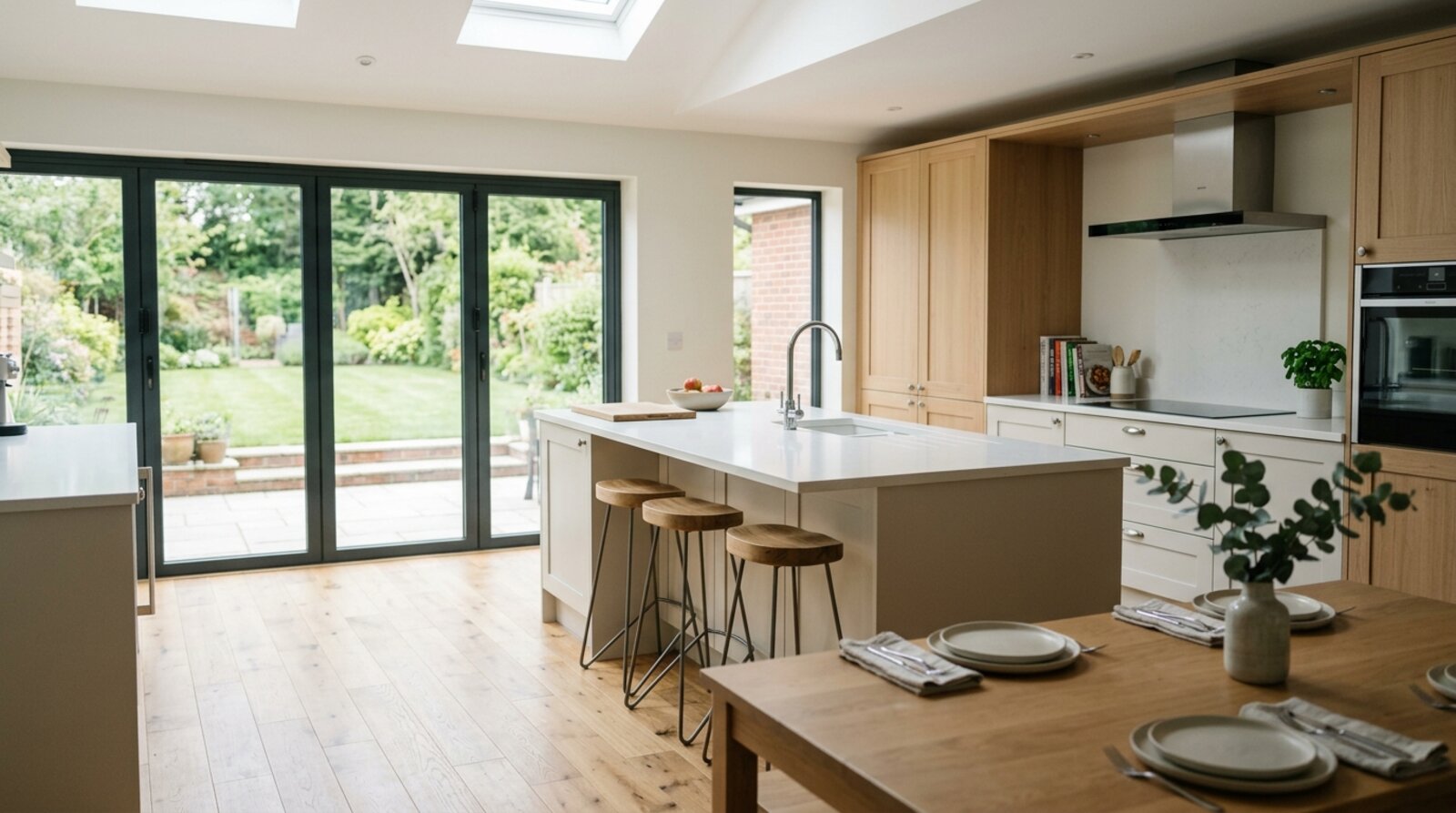
Because you measure the cost per m2 across both floors, the rate per square metre usually undercuts a comparable single storey extension. The shared foundations and roof are doing more work. On total project cost, a modest two storey rear extension can start in the region of £40,000 and larger, higher-specification projects can run to £100,000 or well beyond once you factor in finishes.
What pushes the number up:
- Kitchens and bathrooms: fit-out for the new rooms is often the biggest variable. Two storey extensions usually add at least one bathroom or en suite, and those rooms cost far more per square metre than a bedroom.
- Ground conditions: clay soil, trees nearby or a high water table mean deeper or special foundations.
- Glazing and structural openings: large sliding doors, rooflights and wide steel beams to knock through into the existing house.
- Professional fees: architect or designer, structural engineer, planning fees, building control and a party wall surveyor if needed.
Always price the work to two or three vetted local builders against the same drawings and specification, and keep a contingency of around 10 to 15 per cent. Use a written contract that sets out the scope, the payment stages and what happens if the work overruns, and never pay a large sum up front before any work has started. You can find more Kent-specific building guides on the Contemporary Structures homepage.
Planning permission versus permitted development
This is where two storey extensions differ sharply from single storey ones, and where a lot of homeowners get caught out. Permitted development rights for more than one storey are much tighter, and several popular configurations are simply not allowed without full planning permission.
Under permitted development in England, a two storey rear extension can be possible, but only if it meets all of these conditions:
- It must not extend beyond the rear wall of the original house by more than 3 metres.
- No part of it may be within 7 metres of any boundary opposite the rear wall of the house.
- It must not be on the principal elevation or a side elevation that fronts a highway, and two storey extensions to the side or front are not permitted development.
- The roof pitch should match the existing house as far as practicable, and the materials should be similar in appearance to the existing house.
- Any upper-floor window in a side-facing wall must be obscure-glazed, and non-opening unless the openable part is more than 1.7 metres above the floor.
- The extension must not be higher than the highest part of the existing roof.
Note that the “larger home extension” prior approval route, which lets some single storey rear extensions go deeper after a neighbour consultation, applies to single storey extensions only. It does not cover two storey work. If your double storey extension does not meet every permitted development condition above, you need full planning permission. The authoritative reference for the conditions and any designated-land restrictions is the Planning Portal.
Designated areas and Article 4
Permitted development rights are restricted or removed in conservation areas, on listed buildings, in National Landscapes (formerly Areas of Outstanding Natural Beauty, and parts of Kent fall into this category, including the Kent Downs National Landscape) and where an Article 4 Direction is in place. In those situations you will very likely need full planning permission even for a modest rear extension. Always check with your local planning authority before assuming permitted development applies. A lawful development certificate is worth obtaining even when you believe the work is permitted, because it gives you written proof for the future, particularly when you sell.
Party Wall Act: notifying your neighbours
If your extension involves work on a shared wall, building a new wall up to the boundary, or excavating foundations near a neighbour’s building, the Party Wall etc. Act 1996 applies. This is separate from planning permission and building control; the council is not involved. You serve written notice on the affected neighbours yourself.
- Work on an existing party wall: at least two months notice before work starts.
- Building a new wall at the boundary or excavating near a neighbour’s structure: at least one month notice.
If the neighbour does not respond in writing within 14 days of a party wall notice, a dispute is deemed to have arisen, and both sides then appoint surveyors (or agree a single surveyor) to draw up a binding party wall award. The government’s explanatory booklet on the Party Wall etc. Act 1996 sets out the notice forms and the dispute procedure in full. Serve notices early; the two month period for party wall work can otherwise hold up your start date.
Building regulations and foundations
Every two storey extension needs building regulations approval, regardless of whether it needs planning permission. Building control checks structural safety, fire safety, insulation, ventilation, drainage and energy efficiency, and signs the work off at key stages. You can use the local authority building control service or an approved inspector.
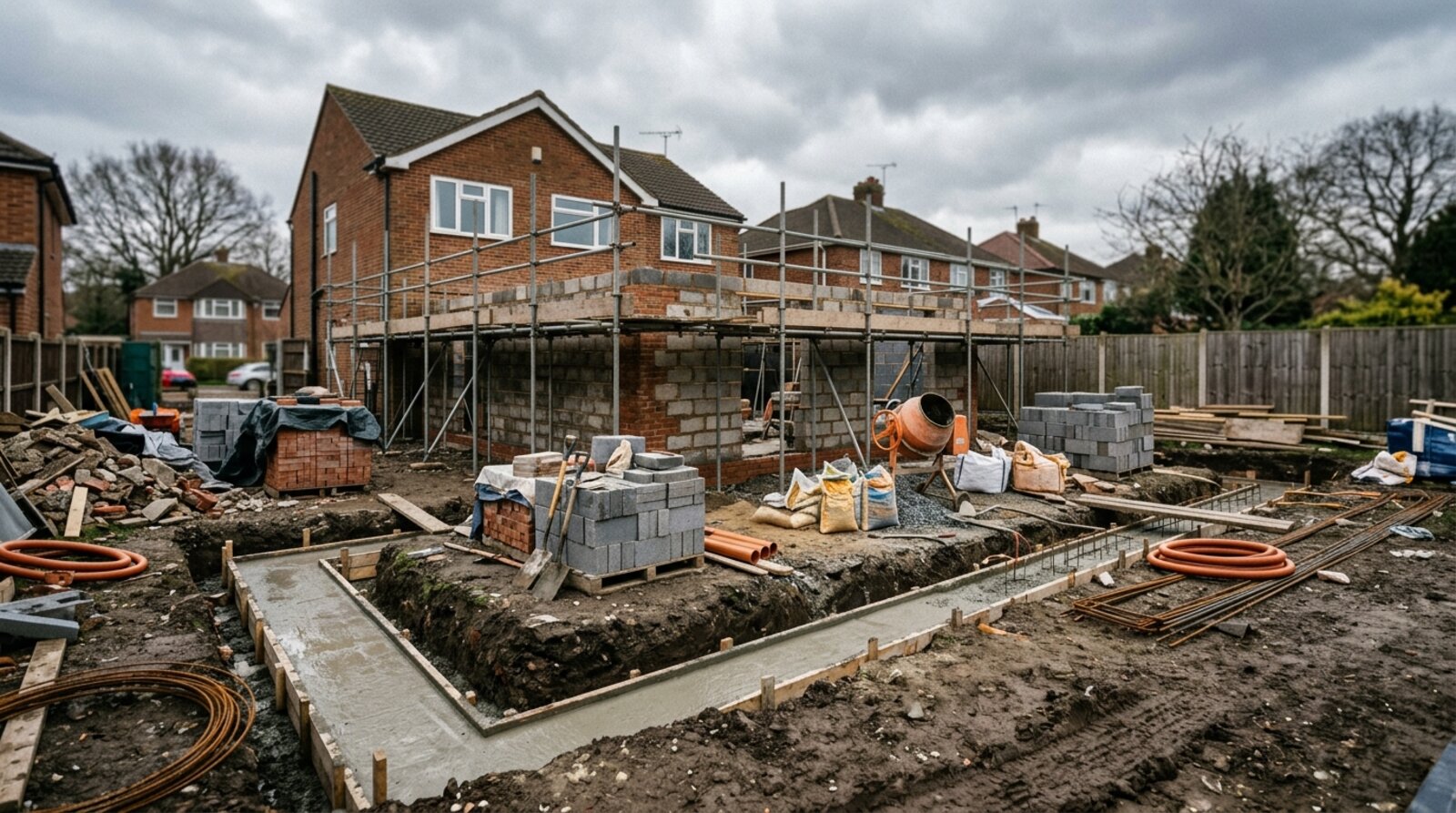
Foundations are the part most likely to surprise you on cost and time. The depth and type depend on the soil, the proximity of trees and the loads from two floors above. Where the extension sits near a neighbour’s building, good practice is to excavate at least to the same depth as the bottom of the adjoining foundation so you do not undermine it, and any special foundations need plans, sections and construction details agreed in advance. Trees on clay soil are a common Kent issue and can force deeper trench fill or piled foundations. The Planning Portal building regulations foundations guidance explains the principles building control will apply.
A structural engineer should design the foundations, the steel beams that open the extension into the existing house, and the floor and roof structure. On an over-garage extension this is non-negotiable, because the existing garage walls and footings were rarely built to carry a habitable room above.
Disruption and timeline
A two storey extension is a major project and you should plan for real disruption. The most intrusive phase is opening the rear of the house into the new structure, when you may lose use of the kitchen and have the back of the property exposed. Many families stay put through it, but it helps to set up a temporary kitchen and agree a phasing plan with the builder.
As a rough timeline for a standard double storey rear extension:
- Design and planning: 2 to 4 months, including drawings and a planning decision (typically around 8 weeks for a householder application once validated).
- Tendering and party wall notices: 1 to 3 months, overlapping where possible.
- On site: usually 3 to 6 months for the build, depending on size, ground conditions and fit-out.
From first sketch to finished rooms, a realistic expectation is around 9 to 12 months. Front-loading the design, planning and party wall steps is the single biggest thing you can do to keep the build itself moving.
Frequently asked questions
Is a two storey extension cheaper per square metre than a single storey one?
Usually yes. Because the foundations and roof are shared across two floors, the cost per m2 of total floor area tends to be lower than a comparable single storey extension. The total project cost is higher because you are building more space, but each square metre often works out more efficiently.
Can I build a two storey extension under permitted development?
Sometimes, but only a rear extension that meets every condition: no more than 3 metres beyond the original rear wall, at least 7 metres from the boundary opposite the rear wall, matching roof pitch and materials, and obscured side windows. Two storey side and front extensions always need full planning permission, and rights are restricted in conservation areas and National Landscapes.
Do I always need a party wall agreement?
Only if the work affects a shared wall, builds a new wall up to the boundary, or excavates foundations near a neighbour’s building. When the Act applies you must serve written notice: two months for existing party wall work, one month for new walls or excavation. If the neighbour does not consent within 14 days, surveyors prepare a binding award.
How deep do the foundations need to be?
It depends on the soil, nearby trees and the loads from two floors. On stable ground, standard strip foundations may be enough; on clay or near trees, deeper trench fill or piled foundations are common. A structural engineer designs them and building control inspects before they are covered.
How long does a double storey extension take?
Expect roughly 9 to 12 months end to end. Design and planning take 2 to 4 months, with a householder planning decision typically around 8 weeks. The build itself usually runs 3 to 6 months depending on size and fit-out.
Will an over-garage extension save money?
It can, because the garage footprint and walls already exist, so you may avoid new foundations. The catch is that existing garage walls and footings often were not built to carry a room above, so a structural engineer must assess them. If they need strengthening, the saving narrows.
Related guides
- Conservatory Roof Replacement vs Glass Film: Which Fixes a Too-Hot, Too-Cold Conservatory?
- Air Source Heat Pump Cost in 2026 After the £7,500 Grant: What You Actually Pay
- Do You Need Planning Permission for a Rear Extension in Kent? 2026 Permitted Development Rules
- How Much Does a Conservatory Base Cost in the UK? (2026 Price Guide)
- Do You Need a Party Wall Agreement for a Rear Extension? Cost and Rules Explained
- Underfloor Heating vs Radiators for a Home Extension: Cost, Running Bills and Which to Choose
- How Much Does a House Extension Cost in 2026? Full UK Price Breakdown
- Loft Conversion Cost and Types: Dormer, Hip-to-Gable and Velux Explained
- Kent Home Improvement News: June 2026
- House Extensions: The Complete UK Homeowner’s Guide
- Single Storey Extension Ideas, Costs and Planning Rules
- Side Return Extensions Explained: Cost, Light and Layout
- Kent Home Improvement News: Mid-June 2026
- Garage Conversion Guide: Cost, Building Regs and Best Uses
- Extension vs Moving House: Which Is Better Value in Kent?
- Wraparound vs Rear Extension: Cost and Space Compared
- House Extension Builders in Kent: Costs, Lead Times and How to Choose
- Conservatory Guide: Styles, Costs and How to Choose One
- Kent Home Improvement News: Late June 2026
- How Much Does a Conservatory Cost in 2026? UK Prices by Type
- Conservatory vs Orangery vs Extension: Which to Build?
- Conservatory Roof Options: Glass, Polycarbonate and Tiled Compared
- Kent Home Improvement News: Early July 2026
- How to Keep a Conservatory Warm in Winter and Cool in Summer
- Tiled Conservatory Roof Cost and Replacement Process Explained
- Conservatories in Kent: Choosing an Installer, Costs and What to Ask
- Kent Home Improvement News: Mid-July 2026
- Roofing Guide: Repairs, Replacement, Materials and Costs
- New Roof Cost UK 2026: Replacement Prices by Roof Type
- Roof Repair Cost UK 2026: Slipped Tiles and Flashing Prices
- 7 Signs Your Roof Needs Replacing (and What You Can Ignore)
- Flat Roof vs Pitched Roof: Cost, Lifespan and Best Uses
- EPDM vs Felt vs Fibreglass Flat Roofs Compared
- Kent Home Improvement News: Mid-July 2026
- Roof Tile Types Explained: Clay, Concrete and Slate Compared
- Fascias, Soffits and Guttering: When to Replace and What It Costs
- How to Find a Good Roofer: Vetting Checklist for UK Homeowners
- Roofers in Kent: Costs, How to Choose and What to Ask in 2026
- Kitchen Renovation Guide: Planning, Cost and Design in 2026
- How Much Does a New Kitchen Cost in 2026? UK Price Guide
- Kitchen Layout Ideas: Galley, L-Shape, Island and Open Plan
- Worktops Compared: Quartz vs Granite vs Laminate vs Solid Wood
- Fitted vs Bespoke vs Flat-Pack Kitchens: Cost and Quality
- Kitchen Island Ideas, Sizes and Costs: A 2026 UK Guide
- Kent Home Improvement News: Late July 2026
- Open Plan Kitchen Diner: Costs, Layouts and Knock-Through Rules
- How Long Does a Kitchen Fitting Take? Realistic UK Timeline
- Kitchen Fitters in Kent: Costs and How to Choose (2026)
- Bathroom Renovation Guide: Planning, Cost and Layout
- New Bathroom Cost 2026: What You’ll Pay in the UK
- Kent Home Improvement: Roofing Costs Rise (Aug 2026)
- Small Bathroom Ideas: Layouts That Feel Bigger
- Wet Room Cost 2026: £2,000 to £9,000 Fitted, by Size
- En Suite Cost and Minimum Size: £4,000 to £10,000 in 2026
- Kent Home News: £9,000 Heat Pump Grant Now Open
- Electric vs Mixer vs Power Shower: What Your Boiler Allows
- Bathroom Underfloor Heating Cost: 16p an Hour to Run
- Window Replacement Cost 2026: £350 to £600 Per uPVC Window
- uPVC vs Aluminium Windows: the 1.4 U-Value Rule
- How Long Does a Bathroom Take to Fit? 5 to 10 Working Days
- Home Improvement News: Solar Up 14%, Heat Pumps Down 17%
- Double vs Triple Glazing: Part L Still Stops at 1.4
- Bathroom Fitters in Kent: What to Ask Before You Pay
- Sash Window Repair or Replace? What Kent Councils Allow
- Bifold vs Sliding Doors: What Building Regs Actually Set
- Composite Door Cost 2026: £550 to £2,350 Fitted
- Window Energy Ratings: Band B Is the Rule, Not C
- Replacement Windows: the 1.4 U-Value and Vent Rules
- Double Glazing Kent: the 1.4 U-Value Every Quote Must Hit
- Heat Pumps in Kent: the £7,500 Grant and the 1.5m³ Rule
- Heat Pump vs Gas Boiler: Break-Even Is a SCOP of 3.0
- Permitted Development Rights: The 8m Rear Extension Rule