
Window energy ratings are the A++ to E labels stuck in the corner of almost every new double glazed unit sold in Britain, and they are the quickest way to tell two lookalike quotes apart. They are also widely misquoted. Plenty of installer websites, and even some industry guidance, still tell homeowners that a C rating satisfies the Building Regulations. In England it has not done since 15 June 2022.
Here is what the letter on the label is actually measuring, the standard your replacement windows have to meet, and the exceptions that change the answer.
What the letter on the label measures
The scheme most UK manufacturers use is run by the British Fenestration Rating Council, which “assesses the energy performance of windows and doors and gives them a rating between A++ and E”. It rates the whole window, frame and glass together, not just the sealed unit. Three things feed the calculation:
- Solar gain, the heat arriving through the glass, counted as a positive.
- Thermal transmittance, the heat escaping through frame and glazing, counted as a negative. This is the U-value, in watts per square metre kelvin.
- Air leakage, uncontrolled airflow through gaps and seals, also a negative.
Add the gain, subtract the losses, and the result is an energy index in kilowatt hours per square metre per year, which is then banded into a letter. That has one consequence worth understanding before you spend money: a window can improve its band by letting more sun in as well as by losing less heat. Two windows with the same U-value can sit in different bands, and a heavily coated low-gain glass unit can rate worse than a plainer one that lets more solar heat through. The band is a balance, not a heat loss score.
The legal minimum in England is Band B
Replacement windows in an existing home are what the regulations call a controlled fitting. Table 4.2 of Approved Document L, Volume 1 (2021 edition, in force since 15 June 2022) sets the standard as a maximum U-value of 1.4 W/(m²K), or Window Energy Rating Band B as a minimum. Either route is acceptable, and your installer only has to demonstrate one of them.
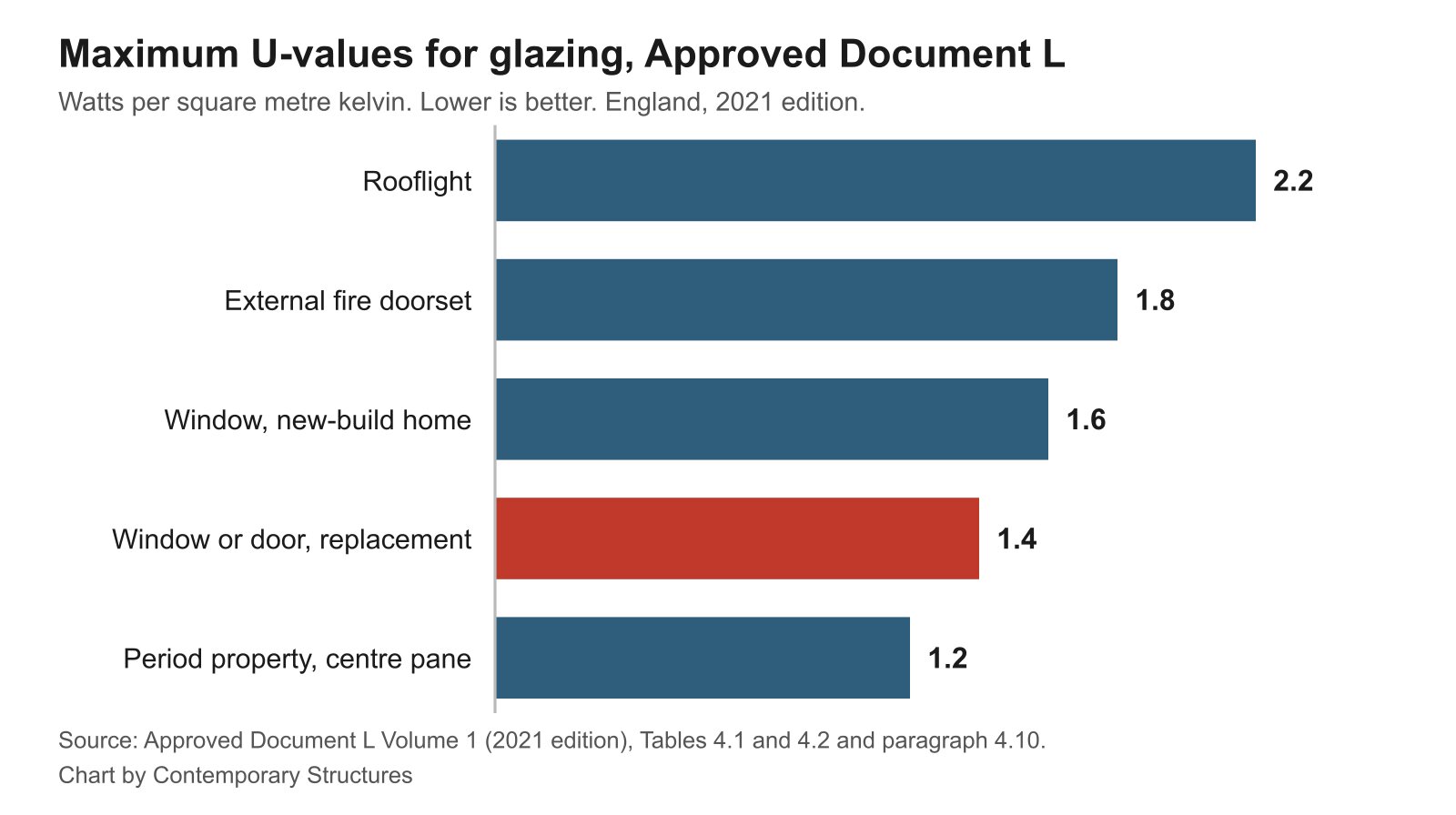
The older figure of Band C, or 1.6 W/(m²K), came from the previous edition of Part L. It is still repeated on a lot of double glazing websites. There was a transitional concession, but it has expired: timber windows were allowed 1.6 W/(m²K) or Band C until 14 June 2023, and from 15 June 2023 the full standard applies to them as well.
If a quote promises “Building Regulations compliant, C rated”, that is not compliant. Ask for the U-value in writing instead, because it is a single number and harder to fudge.
A new house gets an easier window standard than yours
This surprises people. Table 4.1, which covers new dwellings, sets a limiting window U-value of 1.6 W/(m²K). Table 4.2, which covers work to existing homes, sets 1.4. Your replacement windows have to beat the backstop figure for a brand new house.
The reason is that a new build is judged as a whole dwelling: heating, insulation, airtightness and glazing are assessed together against a target, so Table 4.1 is only a floor no element may fall below, and most new homes fit far better windows than 1.6. A replacement window is assessed on its own, so its number has to do all the work.
Doors and rooflights sit on different numbers
The same table covers the rest of the openings, and the bands are not the same as for windows:
- Doors with more than 60% of the internal face glazed: 1.4 W/(m²K), or Doorset Energy Rating Band C.
- All other doors: 1.4 W/(m²K), or Doorset Energy Rating Band B.
- Rooflights: 2.2 W/(m²K). There is no band route here, and the U-value is based on the outer developed surface area, which is usually larger than the hole in the roof.
- External fire doorsets: 1.8 W/(m²K) is permitted.
So a mostly glazed door can comply on a lower band than a solid one. That is not a loophole, it is the solar gain in the calculation doing its job.
Period property: the exception, and what it costs you
Paragraph 4.10 covers the case where windows or fully glazed doors cannot meet Table 4.2 without harming the character of the building. Then one of two things should be met: the fittings should not exceed a centre pane U-value of 1.2 W/(m²K), or single glazing should be supplemented with low emissivity secondary glazing.
Note that the first route is a centre pane figure, measured through the glass only, not the whole window including frame. It is a different and easier test, which is what makes slim double glazed units in traditional timber frames workable in a conservation area. This is separate from planning: listed building consent or a conservation area restriction is a different permission from Building Regulations, and you can need both.
Changing the glass but keeping the frame is a different job
Paragraph 10.6 is short and worth quoting, because it decides whether the energy standard applies at all. A controlled fitting “refers to the entire unit of a window, roof window, rooflight or door, including the frame. Replacing glazing, or a window or door in its existing frame is not providing a controlled fitting. Such work does not need to meet the energy efficiency requirements.”
In plain terms: swap a failed misted unit into the existing frame and the Table 4.2 numbers do not bite. Take the frame out and the whole thing has to comply. That is often the honest reason a repair quote and a replacement quote are so far apart, and it can be the cheaper answer on a sound frame. For what full replacement costs, see our window replacement cost breakdown.
Trickle vents catch more people than the U-value
Since the 2021 ventilation rules came in alongside Part L, replacing windows also has to leave the ventilation in the property no worse than it was. Where the original windows had trickle vents, the replacements need vents that are not smaller than the ones removed. Where they did not, the usual route is to fit vents anyway, and the equivalent areas normally quoted are 8,000mm² in habitable rooms and kitchens and 4,000mm² in bathrooms.
Two things follow. First, a quote with no vents on it either has a technical justification behind it or a problem. Second, “we will leave them off and you can sign a disclaimer” is not a route to compliance. If you dislike the look, ask about vents built into the frame head rather than cut through the glass bead.
How to check the rating before you pay
- Look for the label. Genuine BFRC rated products carry a small official sticker inside the frame, and often a large rainbow label on the surface of the window.
- Get the compliance route in writing. Ask whether the order complies by whole window U-value or by energy band, and have the figure printed on the contract, not just the brochure.
- Check the scheme registration. Installers registered with a competent person scheme such as FENSA, Certass or BSI self-certify the work, notify your council and issue you a certificate. If your installer is not registered, you need a building regulations application to the local authority before the work starts.
- Keep the paperwork. The certificate is one of the first documents a buyer’s solicitor asks for, and replacing it later is slower and more expensive than filing it now.
One caution on catalogue figures: the rating belongs to a specific window configuration. A manufacturer’s A++ headline is usually earned on a particular size, glass and frame combination, and a smaller window with more frame in proportion to glass performs differently. Ask for the rating of the window you are buying.
What this means for a Kent home
Approved Document L applies in England, so it is the document that governs work in Kent. Wales and Scotland set their own standards, which is worth knowing if you are comparing advice found online.
Most Kent housing stock being reglazed now falls into two camps. Post-war and later houses with tired first generation double glazing are straightforward: 1.4 is comfortably achievable with a decent uPVC or aluminium system, and the question is only whether to pay for a better band. Our home improvement guides cover the rest of that decision. Victorian and Edwardian terraces, and anything listed or in a conservation area, need the character conversation first, because paragraph 4.10 and your district council between them decide what you may fit before energy performance is on the table at all.
Frequently asked questions
Do I legally need A-rated windows?
No. In England the standard for a replacement window in an existing home is a U-value of 1.4 W/(m²K) or Window Energy Rating Band B, whichever route your installer chooses to demonstrate. A rated windows exceed that, which is a reason to buy them, not a legal requirement.
Is it worth paying more for A++ instead of B?
Sometimes. The gap between a compliant Band B window and an A++ one is real but modest per window, and it is usually worth more in a heavily glazed, exposed elevation than in a small north facing bathroom. Spend the extra where the glass area is largest, and check the U-value alongside the band rather than the band alone.
Does triple glazing always get a better rating?
No. Triple glazing lowers the U-value, but the extra pane and its coatings also cut solar gain, which the energy rating counts as a positive. A triple glazed window can end up in the same band as a good double glazed one, or occasionally below it, while still losing less heat. If you care about heat loss specifically, compare U-values, and see our fuller comparison of double and triple glazing.
My installer says a C rating is fine. Are they right?
Not for a full window replacement in England. Band C was the standard under the previous edition of Part L, and the timber concession that kept 1.6 W/(m²K) alive ended on 14 June 2023. Ask them to confirm compliance by U-value instead and the ambiguity disappears.
Do I need building control approval to replace a single window?
Yes, replacing the whole unit is notifiable work whether it is one window or twelve. The usual route is an installer registered with a competent person scheme, who notifies on your behalf. Otherwise you apply to your local authority yourself.
Related guides
- Conservatory Roof Replacement vs Glass Film: Which Fixes a Too-Hot, Too-Cold Conservatory?
- Air Source Heat Pump Cost in 2026 After the £7,500 Grant: What You Actually Pay
- Do You Need Planning Permission for a Rear Extension in Kent? 2026 Permitted Development Rules
- How Much Does a Conservatory Base Cost in the UK? (2026 Price Guide)
- Do You Need a Party Wall Agreement for a Rear Extension? Cost and Rules Explained
- Underfloor Heating vs Radiators for a Home Extension: Cost, Running Bills and Which to Choose
- How Much Does a House Extension Cost in 2026? Full UK Price Breakdown
- Loft Conversion Cost and Types: Dormer, Hip-to-Gable and Velux Explained
- Kent Home Improvement News: June 2026
- House Extensions: The Complete UK Homeowner’s Guide
- Single Storey Extension Ideas, Costs and Planning Rules
- Double Storey Extensions: Costs, Designs and What You Can Build
- Side Return Extensions Explained: Cost, Light and Layout
- Kent Home Improvement News: Mid-June 2026
- Garage Conversion Guide: Cost, Building Regs and Best Uses
- Extension vs Moving House: Which Is Better Value in Kent?
- Wraparound vs Rear Extension: Cost and Space Compared
- House Extension Builders in Kent: Costs, Lead Times and How to Choose
- Conservatory Guide: Styles, Costs and How to Choose One
- Kent Home Improvement News: Late June 2026
- How Much Does a Conservatory Cost in 2026? UK Prices by Type
- Conservatory vs Orangery vs Extension: Which to Build?
- Conservatory Roof Options: Glass, Polycarbonate and Tiled Compared
- Kent Home Improvement News: Early July 2026
- How to Keep a Conservatory Warm in Winter and Cool in Summer
- Tiled Conservatory Roof Cost and Replacement Process Explained
- Conservatories in Kent: Choosing an Installer, Costs and What to Ask
- Kent Home Improvement News: Mid-July 2026
- Roofing Guide: Repairs, Replacement, Materials and Costs
- New Roof Cost UK 2026: Replacement Prices by Roof Type
- Roof Repair Cost UK 2026: Slipped Tiles and Flashing Prices
- 7 Signs Your Roof Needs Replacing (and What You Can Ignore)
- Flat Roof vs Pitched Roof: Cost, Lifespan and Best Uses
- EPDM vs Felt vs Fibreglass Flat Roofs Compared
- Kent Home Improvement News: Mid-July 2026
- Roof Tile Types Explained: Clay, Concrete and Slate Compared
- Fascias, Soffits and Guttering: When to Replace and What It Costs
- How to Find a Good Roofer: Vetting Checklist for UK Homeowners
- Roofers in Kent: Costs, How to Choose and What to Ask in 2026
- Kitchen Renovation Guide: Planning, Cost and Design in 2026
- How Much Does a New Kitchen Cost in 2026? UK Price Guide
- Kitchen Layout Ideas: Galley, L-Shape, Island and Open Plan
- Worktops Compared: Quartz vs Granite vs Laminate vs Solid Wood
- Fitted vs Bespoke vs Flat-Pack Kitchens: Cost and Quality
- Kitchen Island Ideas, Sizes and Costs: A 2026 UK Guide
- Kent Home Improvement News: Late July 2026
- Open Plan Kitchen Diner: Costs, Layouts and Knock-Through Rules
- How Long Does a Kitchen Fitting Take? Realistic UK Timeline
- Kitchen Fitters in Kent: Costs and How to Choose (2026)
- Bathroom Renovation Guide: Planning, Cost and Layout
- New Bathroom Cost 2026: What You’ll Pay in the UK
- Kent Home Improvement: Roofing Costs Rise (Aug 2026)
- Small Bathroom Ideas: Layouts That Feel Bigger
- Wet Room Cost 2026: £2,000 to £9,000 Fitted, by Size
- En Suite Cost and Minimum Size: £4,000 to £10,000 in 2026
- Kent Home News: £9,000 Heat Pump Grant Now Open
- Electric vs Mixer vs Power Shower: What Your Boiler Allows
- Bathroom Underfloor Heating Cost: 16p an Hour to Run
- Window Replacement Cost 2026: £350 to £600 Per uPVC Window
- uPVC vs Aluminium Windows: the 1.4 U-Value Rule
- How Long Does a Bathroom Take to Fit? 5 to 10 Working Days
- Home Improvement News: Solar Up 14%, Heat Pumps Down 17%
- Double vs Triple Glazing: Part L Still Stops at 1.4
- Bathroom Fitters in Kent: What to Ask Before You Pay
- Sash Window Repair or Replace? What Kent Councils Allow
- Bifold vs Sliding Doors: What Building Regs Actually Set
- Composite Door Cost 2026: £550 to £2,350 Fitted
- Replacement Windows: the 1.4 U-Value and Vent Rules