
Finding good bathroom fitters in Kent is less about scrolling through star ratings and more about knowing which questions separate a fitter who will finish on time from one who will disappear for a fortnight halfway through second fix. A bathroom is the most trade-dense room in a house: plumbing, electrics, tiling, plastering, ventilation and sometimes gas, compressed into a space you cannot use while the work is going on. This guide covers what a Kent bathroom job actually involves, which rules apply and which do not, and the specific things worth asking before you hand over a deposit.
We work across Kent on home improvement projects, and the pattern is consistent: the jobs that go wrong rarely go wrong because someone laid a tile badly. They go wrong because the sequence was not planned, the electrical work was not certificated, or nobody wrote down what was included.
What a bathroom fitter in Kent actually does, and what they subcontract
“Bathroom fitter” is not a protected title and it does not describe one trade. In practice you are hiring one of three arrangements, and it is worth knowing which.
A plumber who fits bathrooms. Common, and often excellent on the plumbing, with tiling and electrics brought in. Ask who those people are and whether they have worked together before.
A multi-skilled fitter. One person doing plumbing, tiling and the non-notifiable parts of the job, calling in an electrician for anything that needs certifying. This is the most common model for a straight swap and usually the best value on a simple refit.
A bathroom company. Design, supply and fit as one contract. More expensive, but one point of accountability, and usually the right answer if you are moving the soil pipe, knocking out a wall or converting to a wet room.
None of these is inherently better. What matters is that whoever you hire can tell you clearly who is doing the electrical work and who is issuing the certificate for it.
The rules that apply to a Kent bathroom refit, and the ones that do not
There is a lot of confident misinformation about bathroom regulations, some of it repeated by fitters. Here is what is actually the case in England.
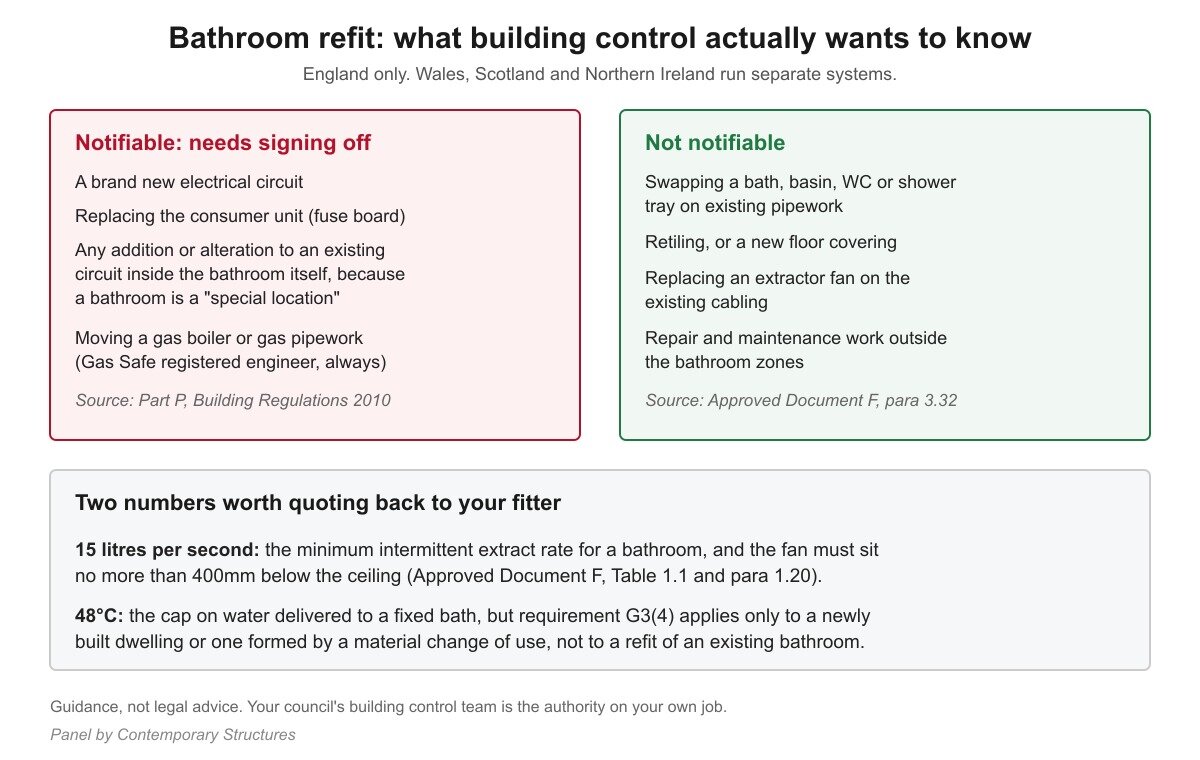
Electrical work. A bathroom is a “special location” under Part P of the Building Regulations. Notifiable work is a new circuit, replacing the consumer unit, and any addition or alteration to an existing circuit inside the bathroom. That last one matters: moving a shaver socket or adding downlights in a bathroom is notifiable even though the same work in a bedroom would not be. It must be either signed off by a registered competent person under a scheme such as NICEIC or NAPIT, or notified to your district council’s building control team in advance. Get the certificate. It is the document a buyer’s solicitor will ask for.
Ventilation. Approved Document F sets a minimum intermittent extract rate of 15 litres per second for a bathroom, and the fan should sit as high as practicable and no more than 400mm below the ceiling. Two useful nuances for a refit: if there was no ventilation system in the original room, you are not obliged to add one, and replacing an extractor fan on the existing cabling does not need to be notified to building control. Both come from the same document, at paragraph 3.31 and 3.32.
The 48 degree rule. Approved Document G requires that hot water delivered to a fixed bath does not exceed 48°C, which normally means a thermostatic mixing valve. Fitters sometimes present this as compulsory on every job. It is not. Requirement G3(4) applies only where a dwelling is newly erected or formed by a material change of use. Refitting the bathroom in an existing house does not trigger it. It is still a sensible thing to fit if there are young children or elderly people in the house, but you should know it is your choice rather than a legal obligation, and you should not be charged for it as a compliance item.
Gas. Anything touching gas pipework or a gas boiler must be done by an engineer on the Gas Safe Register. There is no grey area and no self-certification route for a general builder. Ask to see the card and check the categories on the back cover the work.
Full text of both approved documents is on GOV.UK: Approved Document F covers ventilation and Approved Document G covers hot water safety.
Your 14 day cancellation right, and why it matters more than the guarantee
This is the most valuable thing in this guide and almost nobody mentions it.
If you agree a bathroom contract in your own home, which is how nearly all of them are agreed, it is an off-premises contract under the Consumer Contracts Regulations 2013. You get 14 days to cancel without giving a reason, starting the day after the contract is made. The trader must give you written information about that right before you enter the contract, and failing to do so is a criminal offence.
Two consequences worth understanding:
- If they do not tell you about the cancellation right, the period extends. It runs for up to 12 months, and starts afresh for 14 days from the day they eventually do give you the information.
- If you want work to start inside the 14 days, you have to ask in writing. The trader needs your express written request, and you should be told you lose the cancellation right once the work is finished. If a trader starts work without that written request and you then cancel, you do not owe them for the work done.
A fitter who hands you a written cancellation notice with the quote is telling you something useful about how they run their business. One who has never heard of it is telling you something too. The Trading Standards guidance for businesses is at Business Companion, and it is worth a read before you sign anything.
What to ask before you accept a quote
Quotes for the same bathroom can differ by thousands, and it is almost never because one fitter is greedy. It is because they have quoted for different work. Get every quote to answer the same questions.
- Who is doing the electrics, and which scheme are they registered with? You want a name and a registration number, not “my sparky”.
- Is the electrical certificate included in the price? It should be. If the job is notifiable and nobody is certifying it, walk away.
- Is making good included? Plastering, the ceiling after the downlights go in, the doorway architrave, the floor outside the bathroom. This is where quotes quietly diverge.
- Who is supplying what? Suite, brassware, shower, tiles, adhesive, trims, waste, and who eats the cost if something arrives damaged.
- What happens if the floor is rotten? Under an old bath there is often a surprise. Ask how variations are priced before one appears, not after.
- How long, and how many working days will we have no bathroom? A full refit in a normal house is usually a working week to a fortnight. Anyone promising three days for a full strip-out and retile is telling you what you want to hear.
- What is the payment schedule? Staged payments against completed stages are normal. A large deposit up front for labour is not.
On deposits: a modest deposit to secure materials is reasonable. Paying a large proportion of the total before anyone arrives is the single most common way people lose money on home improvement work. Pay by credit card where you can, because for transactions over £100 you get additional protection under section 75 of the Consumer Credit Act.
Checking a Kent fitter is who they say they are
Reviews are useful but gameable. These checks are not:
- Companies House. Free, instant, and tells you when the company was incorporated, who runs it and whether previous companies at the same address were dissolved. A brand new company run by someone with three dissolved predecessors is worth a pause.
- Their registration, verified at source. TrustMark is the government-endorsed quality scheme and lets you search registered businesses. WaterSafe lists approved plumbers. Search the scheme’s own register rather than trusting a logo on a van or a website.
- Public liability insurance. Ask for the certificate, check the expiry date and check the name on it matches the business you are contracting with.
- An address in Kent. A local fitter with a real address and a decade of local work has an incentive to come back and fix a leak. A phone number and a national-sounding brand does not.
- Two recent local addresses you can go and look at. A confident fitter will offer.
Two things specific to Kent homes
Hard water. Most of Kent sits on chalk, and the mains supply across the county is hard to very hard. That has real consequences for a bathroom. Limescale attacks shower heads, valves and glass first, so a thermostatic shower valve with accessible serviceable parts will outlast a sealed unit, and a plain glass screen with a factory-applied coating stays looking clean far longer than an untreated one. It is also worth discussing where a water softener would go if you want one later, because the time to run the pipework is while the floor is up. You can check your own supply on the South East Water hardness checker, or with Southern Water depending on which part of the county you are in.
Older housing stock. Much of Kent’s housing is Victorian or Edwardian terraces and interwar semis, and both bring predictable issues: suspended timber floors that will not take a large-format tile without an overboard or an uncoupling layer, soil pipes on the outside wall that constrain where the WC can go, solid walls that need attention before tiling, and lead or old copper pipework that turns a simple swap into a rewire of the plumbing. None of this is a problem if it is priced in. It is a serious problem if it is discovered on day two of a fixed-price job.
If you are planning a wider project rather than a single room, our other home improvement guides cover extensions, kitchens and heating.
Frequently asked questions
Do I need building regulations approval to fit a new bathroom in Kent?
Usually not for the bathroom as a whole, but specific parts of it are notifiable. In England, a new electrical circuit, a consumer unit replacement, and any addition or alteration to an existing circuit within the bathroom all fall under Part P and must be certified by a registered competent person or notified to your district council’s building control team. Swapping sanitaryware on existing pipework, retiling and replacing an extractor fan on existing cabling are not notifiable. Converting a bedroom into a bathroom, or forming a new one where none existed, brings in more, including drainage and structural considerations.
How long does a full bathroom refit take?
For a standard family bathroom with no layout changes, a working week to a fortnight is realistic, and the room is unusable for most of it. Moving the WC or soil pipe, converting to a wet room or discovering a rotten floor adds days. The programme is usually set by the drying and curing times rather than the labour, so a fitter who tells you honestly that tanking and adhesive need time to cure is being straight with you.
Should I pay a deposit to a bathroom fitter?
A modest deposit to cover materials being ordered is normal and reasonable. A large up-front payment covering labour is not, and it is the most common way homeowners lose money on this kind of work. Pay in stages against completed work, and where possible pay by credit card, since transactions over £100 attract additional protection under section 75 of the Consumer Credit Act.
Can I cancel after signing a bathroom contract at home?
Yes. A contract agreed in your home is an off-premises contract under the Consumer Contracts Regulations 2013, giving you 14 days to cancel without a reason, starting the day after the contract was made. The trader must give you written notice of that right beforehand, and failing to do so is a criminal offence that extends your cancellation period by up to 12 months. If you want work to begin within the 14 days, you must request it in writing.
Does a bathroom need an extractor fan by law?
For a new bathroom, yes, and Approved Document F sets the minimum intermittent extract rate at 15 litres per second. For a refurbishment of an existing bathroom the position is softer: existing fans should be retained or replaced, but if the original room had no ventilation system, you are not required to add one. Given how much moisture a shower produces and how much of Kent’s housing stock is older and solid-walled, fitting an adequate fan is worth doing regardless of whether it is compulsory.
Is a thermostatic mixing valve on the bath a legal requirement?
Not for a refit of an existing bathroom. Approved Document G requires hot water to a fixed bath to be limited to 48°C, but requirement G3(4) applies only where the dwelling is newly built or formed by a material change of use. If a fitter presents a TMV as a legal necessity on a straightforward refurbishment, that is wrong. It remains a sensible safety measure in a household with young children or vulnerable adults.
What qualifications should a bathroom fitter have?
There is no single mandatory qualification for bathroom fitting itself, which is why the checks matter. What must be in place is trade-specific: gas work by a Gas Safe registered engineer, notifiable electrical work by someone registered with a competent person scheme such as NICEIC or NAPIT, and ideally plumbing by a WaterSafe approved contractor. TrustMark registration across the business is a further useful signal. Verify each one on the scheme’s own register rather than accepting a logo.
Related guides
- Conservatory Roof Replacement vs Glass Film: Which Fixes a Too-Hot, Too-Cold Conservatory?
- Air Source Heat Pump Cost in 2026 After the £7,500 Grant: What You Actually Pay
- Do You Need Planning Permission for a Rear Extension in Kent? 2026 Permitted Development Rules
- How Much Does a Conservatory Base Cost in the UK? (2026 Price Guide)
- Do You Need a Party Wall Agreement for a Rear Extension? Cost and Rules Explained
- Underfloor Heating vs Radiators for a Home Extension: Cost, Running Bills and Which to Choose
- How Much Does a House Extension Cost in 2026? Full UK Price Breakdown
- Loft Conversion Cost and Types: Dormer, Hip-to-Gable and Velux Explained
- Kent Home Improvement News: June 2026
- House Extensions: The Complete UK Homeowner’s Guide
- Single Storey Extension Ideas, Costs and Planning Rules
- Double Storey Extensions: Costs, Designs and What You Can Build
- Side Return Extensions Explained: Cost, Light and Layout
- Kent Home Improvement News: Mid-June 2026
- Garage Conversion Guide: Cost, Building Regs and Best Uses
- Extension vs Moving House: Which Is Better Value in Kent?
- Wraparound vs Rear Extension: Cost and Space Compared
- House Extension Builders in Kent: Costs, Lead Times and How to Choose
- Conservatory Guide: Styles, Costs and How to Choose One
- Kent Home Improvement News: Late June 2026
- How Much Does a Conservatory Cost in 2026? UK Prices by Type
- Conservatory vs Orangery vs Extension: Which to Build?
- Conservatory Roof Options: Glass, Polycarbonate and Tiled Compared
- Kent Home Improvement News: Early July 2026
- How to Keep a Conservatory Warm in Winter and Cool in Summer
- Tiled Conservatory Roof Cost and Replacement Process Explained
- Conservatories in Kent: Choosing an Installer, Costs and What to Ask
- Kent Home Improvement News: Mid-July 2026
- Roofing Guide: Repairs, Replacement, Materials and Costs
- New Roof Cost UK 2026: Replacement Prices by Roof Type
- Roof Repair Cost UK 2026: Slipped Tiles and Flashing Prices
- 7 Signs Your Roof Needs Replacing (and What You Can Ignore)
- Flat Roof vs Pitched Roof: Cost, Lifespan and Best Uses
- EPDM vs Felt vs Fibreglass Flat Roofs Compared
- Kent Home Improvement News: Mid-July 2026
- Roof Tile Types Explained: Clay, Concrete and Slate Compared
- Fascias, Soffits and Guttering: When to Replace and What It Costs
- How to Find a Good Roofer: Vetting Checklist for UK Homeowners
- Roofers in Kent: Costs, How to Choose and What to Ask in 2026
- Kitchen Renovation Guide: Planning, Cost and Design in 2026
- How Much Does a New Kitchen Cost in 2026? UK Price Guide
- Kitchen Layout Ideas: Galley, L-Shape, Island and Open Plan
- Worktops Compared: Quartz vs Granite vs Laminate vs Solid Wood
- Fitted vs Bespoke vs Flat-Pack Kitchens: Cost and Quality
- Kitchen Island Ideas, Sizes and Costs: A 2026 UK Guide
- Kent Home Improvement News: Late July 2026
- Open Plan Kitchen Diner: Costs, Layouts and Knock-Through Rules
- How Long Does a Kitchen Fitting Take? Realistic UK Timeline
- Kitchen Fitters in Kent: Costs and How to Choose (2026)
- Bathroom Renovation Guide: Planning, Cost and Layout
- New Bathroom Cost 2026: What You’ll Pay in the UK
- Kent Home Improvement: Roofing Costs Rise (Aug 2026)
- Small Bathroom Ideas: Layouts That Feel Bigger
- Wet Room Cost 2026: £2,000 to £9,000 Fitted, by Size
- En Suite Cost and Minimum Size: £4,000 to £10,000 in 2026
- Kent Home News: £9,000 Heat Pump Grant Now Open
- Electric vs Mixer vs Power Shower: What Your Boiler Allows
- Bathroom Underfloor Heating Cost: 16p an Hour to Run
- Window Replacement Cost 2026: £350 to £600 Per uPVC Window
- uPVC vs Aluminium Windows: the 1.4 U-Value Rule
- How Long Does a Bathroom Take to Fit? 5 to 10 Working Days
- Home Improvement News: Solar Up 14%, Heat Pumps Down 17%
- Double vs Triple Glazing: Part L Still Stops at 1.4
- Sash Window Repair or Replace? What Kent Councils Allow
- Bifold vs Sliding Doors: What Building Regs Actually Set
- Composite Door Cost 2026: £550 to £2,350 Fitted
- Window Energy Ratings: Band B Is the Rule, Not C
- Replacement Windows: the 1.4 U-Value and Vent Rules