
Air source vs ground source heat pump: for most homes the air source model wins on price, and the gap is bigger than most quotes suggest. Government figures from the Boiler Upgrade Scheme put the median installed cost at £13,021 for an air source heat pump and £26,200 for a ground source system in 2025/26. Both get the same £7,500 grant, so after it comes off, ground source still costs roughly three times as much. This page sets out where that extra money goes, when it is worth paying, and what the planning and garden requirements are for each.
We work on homes across Kent, and the question we hear most is whether a ground source heat pump’s reputation for efficiency justifies the spend. Sometimes it does. Usually it does not. The deciding factors are your garden, your heat demand and whether you are already digging up the ground for something else.
The short answer
- Choose air source if you have a typical house, a modest garden, a gas or oil boiler to replace and a budget that has to stretch to radiators or insulation as well.
- Consider ground source if you have a large plot with machine access, a big or poorly insulated house with high heat demand, a self-build where the groundworks are happening anyway, or a strong reason to avoid an outdoor fan unit.
- Either way, the grant is the same £7,500, it is claimed by an MCS certified installer on your behalf, and it has to be taken off your quote up front.
How each one collects heat
Both are heat pumps: they move heat from outside into your home using electricity, rather than burning fuel to make it. The difference is where the heat comes from.
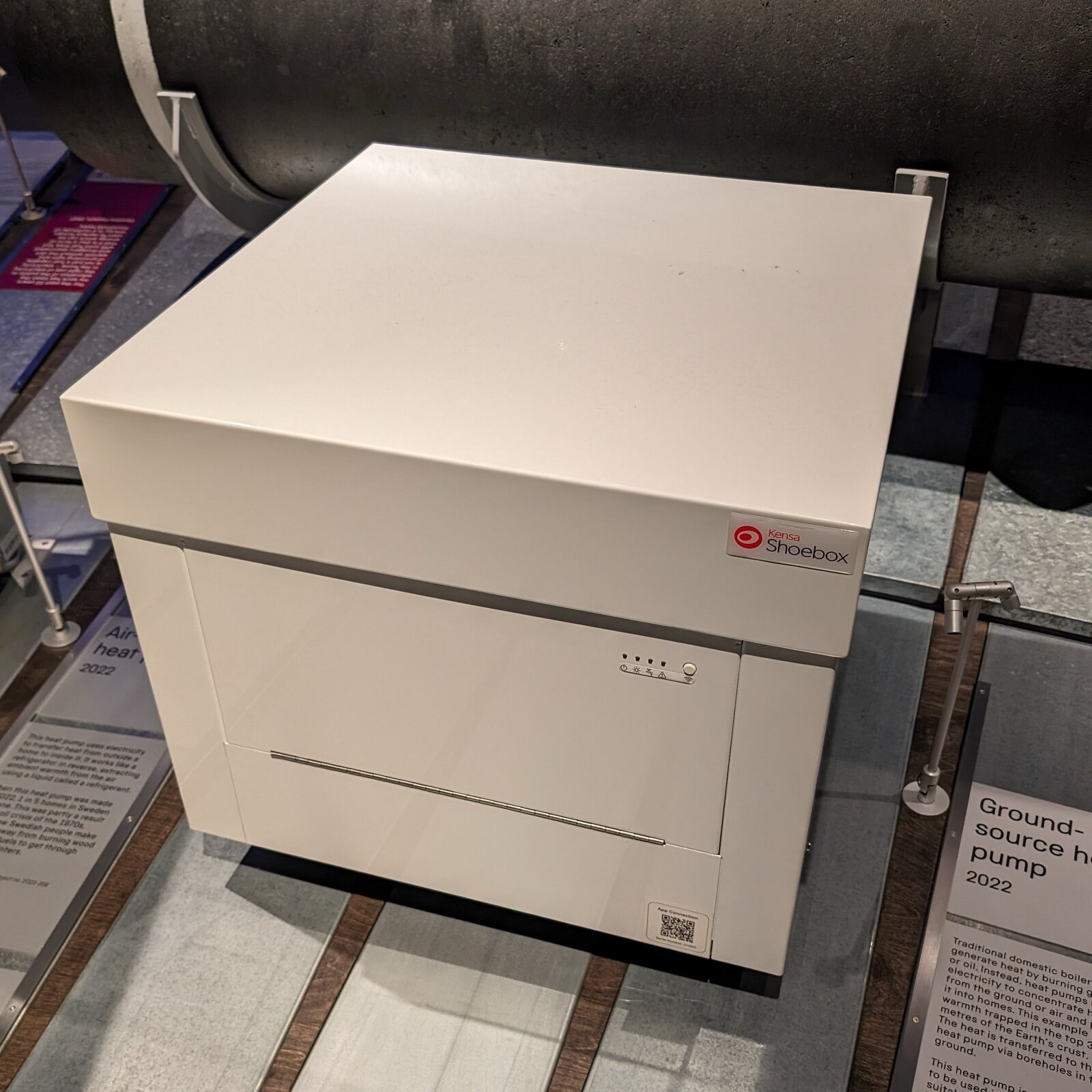
An air source heat pump works like a fridge in reverse. A fan unit outside the house draws air across a heat exchanger, a refrigerant absorbs the warmth, and a compressor raises its temperature for your radiators and hot water cylinder. MCS, the certification body for small-scale renewables, notes that these units can still produce heat when it is minus 15 outside.
A ground source heat pump circulates water mixed with antifreeze through pipe buried in your garden, either laid flat in trenches or dropped down vertical boreholes. The ground a metre or two down holds a far steadier temperature through the year than the winter air does, and the heat pump concentrates that low-level warmth. The heat pump unit itself usually sits indoors, often in a utility room or garage, so there is no fan unit on the outside wall.
That steadier source is the whole case for ground source. On the coldest days, when an air source unit is working hardest against freezing air, a ground loop is drawing on ground that has barely changed temperature. How much that saves you depends heavily on the design, above all on the flow temperature your radiators or underfloor heating need, which is why a proper heat loss survey matters more than the badge on the box.
What they really cost: the government figures
Rather than rely on installer marketing, it is worth going to the source. The Department for Energy Security and Net Zero publishes the installed cost of every heat pump paid for through the grant in its Boiler Upgrade Scheme statistics. The July 2026 release, published on 27 August 2026, gives these medians for the 2025/26 financial year:
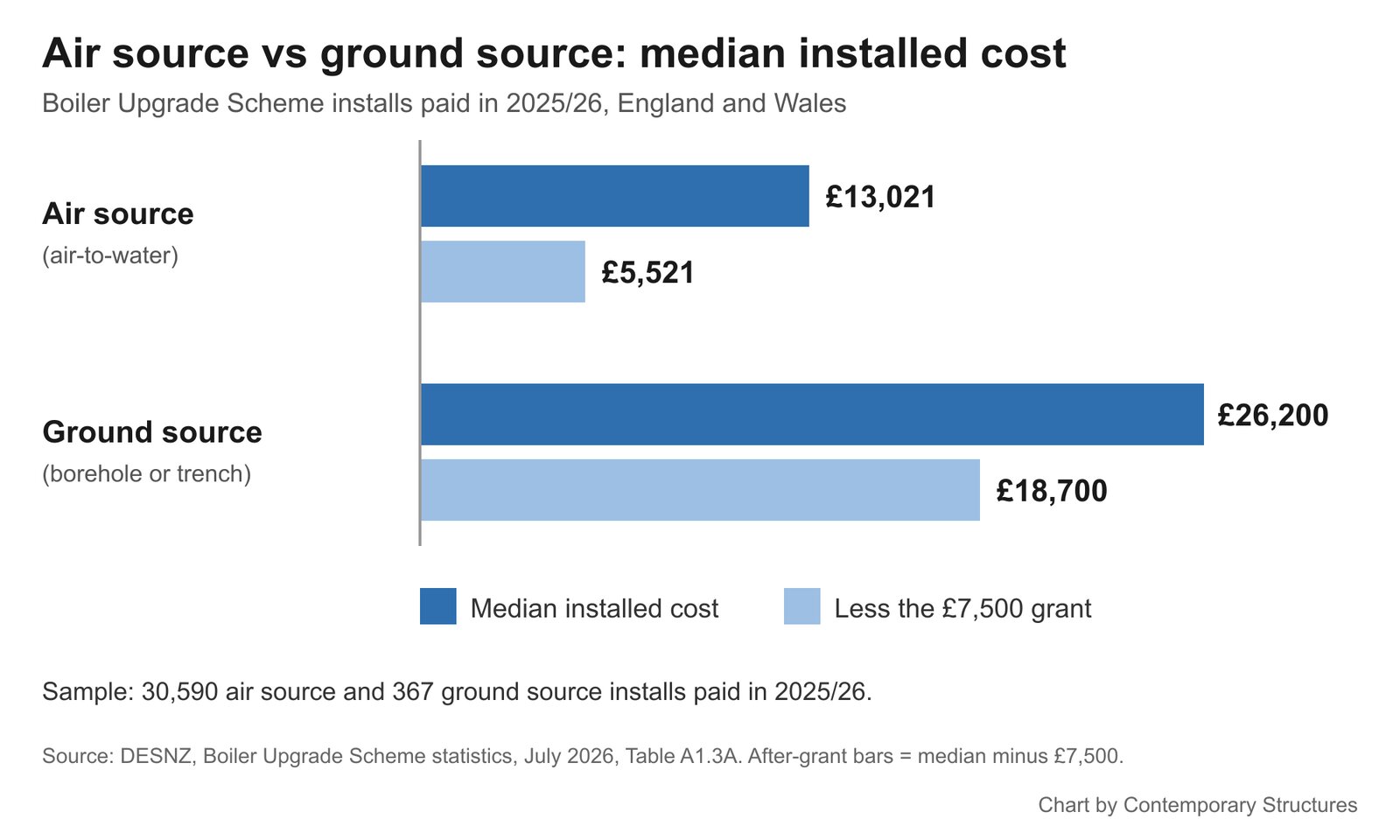
- Air source (air-to-water): £13,021 median, across 30,590 installs.
- Ground source: £26,200 median, across 367 installs.
The spread is wider for ground source because boreholes, trench length and ground conditions vary so much. In the latest quarter, April to June 2026, the middle half of air source installs cost between £11,128 and £15,627. The middle half of ground source installs cost between £18,136 and £42,110.
Comparing systems of the same size makes the gap clearer. For 2025/26:
- 8 to 10kW: air source £12,686, ground source £21,298.
- 12 to 14kW: air source £15,365, ground source £25,542.
Take the £7,500 grant off each median and you are looking at roughly £5,500 for air source against roughly £18,700 for ground source. Since 28 April 2026 installers have been required to deduct the grant from the upfront price, so it should appear as a line on your quote and invoice rather than as a refund later. Homes off the gas grid that currently heat with oil or LPG can get £9,000 towards either type, a top-up that opened on 21 July 2026 and runs until March 2027.
One practical difference: a ground source voucher is valid for six months, against three months for an air source voucher, which reflects how much longer the groundworks take to organise.
For a closer look at what an air source install costs once the grant is applied, see our breakdown of air source heat pump cost after the grant.
Garden space and groundworks
This is where most ground source plans stop. According to MCS guidance on ground source heat pumps, some installers size the loop at between 50 and 80 metres of pipe per kilowatt, laid in trenches typically 1 to 2 metres deep. By that rule of thumb, an 8kW system needs somewhere between 400 and 640 metres of pipe.
Horizontal trenches are the cheaper option but need a large, reasonably clear garden and access for digging machinery. If space is tight, the loop can go into vertical boreholes instead, which take up very little surface area but need a specialist drilling rig and cost more. For a lot of terraced and semi-detached houses in Kent towns, neither is practical: there is no room for the trenches and no way to get a rig into the back garden.
An air source unit, by contrast, needs a patch of wall or ground with clear airflow around it. That is the main reason it accounts for the overwhelming majority of installs.
Planning permission for each type
In England both are normally permitted development, so most homeowners do not need to apply for planning permission. They sit in different classes of Part 14 of the General Permitted Development Order.
- Ground source (Class C): installing a ground source heat pump within the curtilage of a house is permitted development. The pipework is underground, so there is little to see once the garden is reinstated.
- Air source (Class G): since 29 May 2025, the old rule keeping units at least 1 metre from the boundary has gone. A house can have an outdoor unit of up to 1.5 cubic metres, and a detached house can have two. The unit cannot go on a pitched roof, and on a listed building, or within its grounds, it is not permitted development at all.
- Conservation areas: an air source unit cannot go on a wall or roof facing a highway, or nearer to the road than the house itself. This is one of the few situations where ground source has a genuine planning advantage.
Our guide to permitted development rights covers how these classes interact with extensions and outbuildings.
What the numbers say about who picks ground source
The scheme data shows how rare ground source is. Of the 90,115 grant payments made between May 2022 and July 2026, only 1,567 were for ground source heat pumps, under 2 per cent. In the South East, the region that includes Kent, installers had applied for 27,196 air source grants and 407 ground source grants by July 2026.
The data also shows what kind of property ground source goes into. Just over half of the ground source grants paid replaced no existing heating system at all, compared with about one in eight for air source. That pattern fits self-builds, which can claim the grant, and large rural properties where the ground loop is designed in from the start rather than retrofitted.
Which suits your home
Ground source earns its extra cost in a fairly narrow set of cases:
- A large house with high heat demand, where the steadier ground temperature makes a real difference to running costs over twenty-plus years.
- A big plot with easy machine access, especially if you are landscaping or building anyway.
- A property where an outdoor fan unit would be a problem: a conservation area frontage, or a neighbour very close to the only possible position.
- An off-grid home on oil or LPG, where the £9,000 grant narrows the gap slightly.
For everyone else, an air source heat pump designed around a proper heat loss calculation, with radiators sized for a lower flow temperature, gets most of the benefit for about half the price. If you are weighing a heat pump against simply replacing your boiler, our heat pump vs gas boiler comparison runs through that decision, and the rest of our home improvement advice is on the Contemporary Structures homepage.
Frequently asked questions
Is a ground source heat pump more efficient than air source?
Generally yes, because the ground holds a steadier temperature than winter air, so the heat pump does less work on cold days. The size of the advantage depends on the design, especially the flow temperature your heating system needs, so compare installers’ predicted running costs for your house rather than relying on general claims.
How much does a ground source heat pump cost in 2026?
The median installed cost of a ground source heat pump paid through the Boiler Upgrade Scheme was £26,200 in 2025/26, before the £7,500 grant. The middle half of installs in April to June 2026 cost between £18,136 and £42,110, with boreholes at the top end.
Do both types get the same grant?
Yes. The Boiler Upgrade Scheme pays £7,500 towards either an air source (air-to-water) or a ground source heat pump in England and Wales, rising to £9,000 for off-gas homes heated by oil or LPG until March 2027. Air-to-air heat pumps get a smaller £2,500 grant.
How much garden do I need for a ground source heat pump?
MCS says some installers allow 50 to 80 metres of pipe per kilowatt, laid in trenches 1 to 2 metres deep, so an 8kW system needs 400 to 640 metres of pipe. If you lack the space, vertical boreholes are an option, but they cost more.
Do I need planning permission for either type?
Usually not in England. Ground source heat pumps are permitted development under Class C and air source under Class G. Listed buildings and air source units facing a road in a conservation area are the main exceptions.
Can I get a hybrid system with the grant?
No. The Boiler Upgrade Scheme does not fund hybrid systems that combine a heat pump with a gas boiler. The heat pump has to replace the fossil fuel heating system.