
The choice between an extension vs moving house comes down to one honest question: do you like where you live but need more room, or do you want a genuinely different home? In Kent, where the average property changed hands for around £425,000 over the past year, both routes carry five-figure costs that are easy to underestimate. Moving looks simpler because someone else has already done the building work, but the transaction taxes and fees stack up fast. Extending looks expensive on the headline build figure, yet it keeps your postcode, your schools and your commute. This guide puts the real numbers side by side for Kent homeowners so you can compare like with like.
The true cost of moving house in Kent
People tend to budget for the new house and forget the cost of the move itself. Selling and buying again involves several separate bills, and most of them scale with the price of a Kent home rather than a national average.

Stamp Duty Land Tax (SDLT) is usually the biggest single cost, and it is paid on the property you buy. The current England rates, confirmed on GOV.UK, are tiered: nothing on the first £125,000, 2% on the slice from £125,001 to £250,000, 5% from £250,001 to £925,000, 10% from £925,001 to £1.5 million, and 12% above that. Because most Kent semis and detached houses sit well above £250,000, you reach the 5% band quickly. Buy a larger home in Kent at £550,000 and the SDLT bill is £17,500. Move up to £700,000 and it is £25,000. If you are buying before your current home sells, or keeping it as a second property, an extra 5% surcharge applies across the bands, which can add tens of thousands more.
Estate agent fees come out of the sale of your old home. High-street sole agency in Kent typically runs at 1% to 1.8% plus VAT, with the UK average around 1.42% including VAT. On a £425,000 sale at 1.5% plus VAT, that is roughly £7,650. Online and hybrid agents charge a fixed fee instead, often a few hundred to around £1,500, but you usually do more of the legwork yourself.
Conveyancing is needed twice, once to sell and once to buy. Legal fees plus disbursements such as searches and Land Registry charges commonly total £1,300 to £1,900 across both transactions. Removals for a typical two or three bedroom Kent move average around £1,100, more if you need packing or storage. Add an EPC for the sale (£60 to £120) and any mortgage arrangement or valuation fees on the new loan, and the picture is clear.
Tally a realistic Kent upsizing move: SDLT around £17,500 to £25,000, agent fees around £7,500, conveyancing around £1,600, removals around £1,100, plus EPC and mortgage costs. That is comfortably £28,000 to £36,000 spent on the act of moving before you gain a single extra square metre. None of it stays in your pocket or adds to your equity.
The true cost of extending in Kent
An extension converts spend into space and, usually, into resale value. The headline figure is the build cost, which in 2026 runs at roughly £2,200 to £3,200 per square metre for a single-storey rear extension across most of the UK. Kent and the wider South East sit at the upper end and can push past £3,000 per square metre on better finishes, because labour and materials cost more here than in the north.
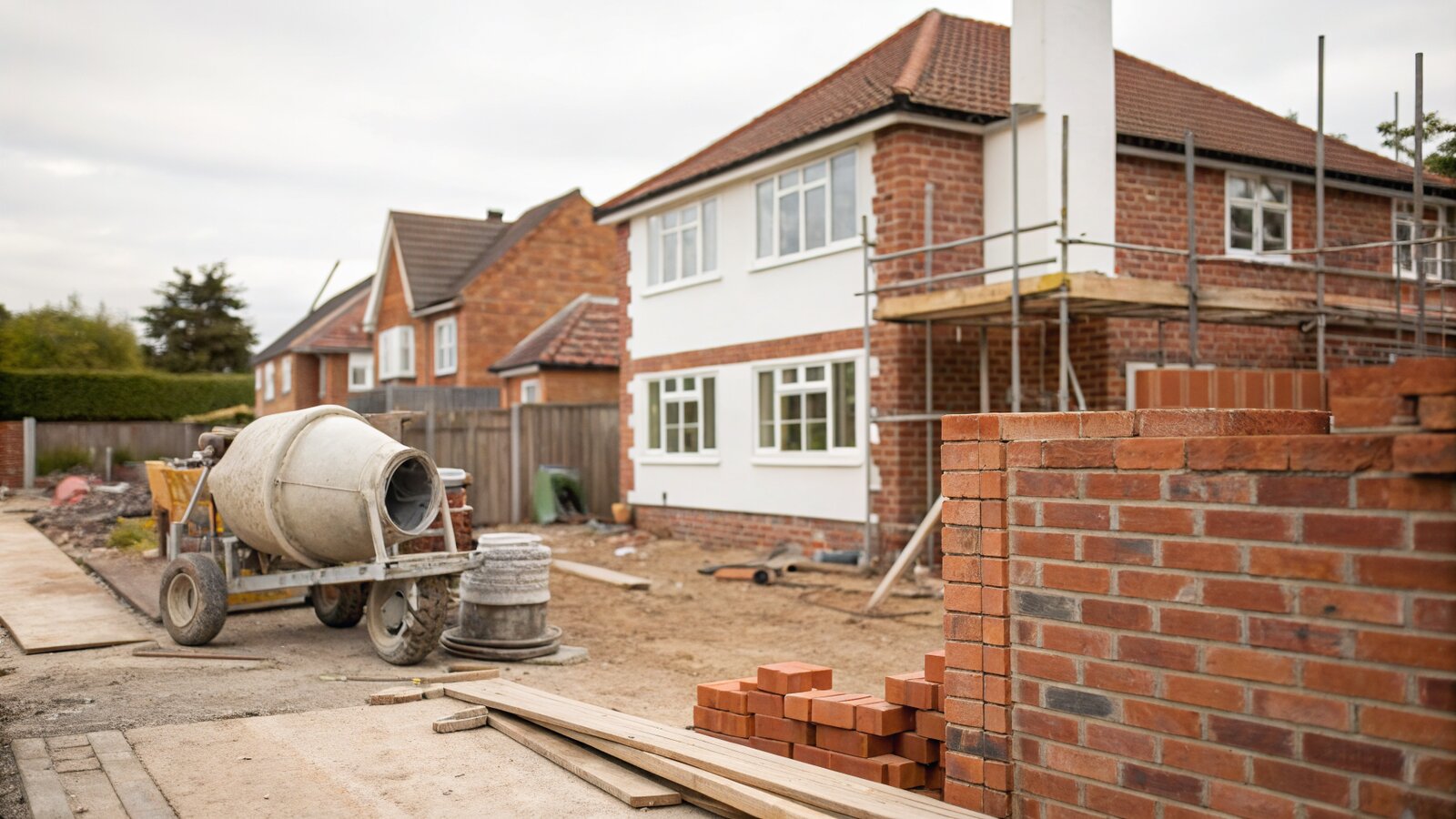
A 20 square metre single-storey rear extension, enough for a generous kitchen-diner, therefore lands somewhere around £45,000 to £65,000 for the build alone. On top of that, budget for architectural or design fees (commonly 7% to 15%), structural engineer’s calculations, a party wall agreement if you are semi-detached or terraced (often £1,000 to £2,500), and Building Regulations fees. VAT at 20% applies to most domestic building work. An all-in figure of £55,000 to £80,000 is realistic for a well-specified Kent single-storey extension.
Two-storey extensions and loft conversions change the maths. A two-storey addition spreads the cost of foundations and roof across more floor area, so the price per square metre often falls even though the total rises. A loft conversion that adds a double bedroom and en-suite is frequently the strongest value move, because RICS notes a well-executed loft can add up to around 25% to a home’s value.
The planning side is often cheaper and faster than people fear. Many single-storey rear extensions fall under permitted development and need no planning application at all, provided they meet the limits set out by the Planning Portal: broadly up to 3 metres deep for an attached house or 4 metres for a detached one, no taller than 4 metres, no closer than 2 metres to a boundary at that height, and covering no more than half the garden. Larger rear extensions up to 6 metres (attached) or 8 metres (detached) can sometimes go through the prior approval, or Larger Home Extension, notification route. Always check first, because some Kent streets, conservation areas and homes carry an Article 4 direction that removes permitted development rights.
Added value and the local ceiling price
The number that decides whether extending is good value is the ceiling price of your street. Every road has a level above which buyers simply will not pay, no matter how good your kitchen is. A four-bed detached on a street of three-bed semis will struggle to sell for what the build cost you, because comparable evidence sets the valuation.
This matters enormously across Kent, where prices swing from around £185,000 in parts of Maidstone to over £950,000 in the most sought-after Sevenoaks postcodes. If your home is at £350,000 on a street where similar extended houses sell for £450,000, a £60,000 extension that lifts you towards that ceiling is sound. If your street already tops out at £400,000 and you are at £370,000, spending £70,000 to chase £30,000 of value is poor maths, and moving is likely the better call.
A quick way to test this: look at sold prices on your street and the next few roads for the configuration you would create. If extended versions of your house type regularly sell for meaningfully more than your current value plus the build cost, extending adds equity. If they do not, you are buying lifestyle, not value, and that is a legitimate choice as long as you go in knowing it. A short paid valuation from a local RICS surveyor, or a frank chat with two or three Kent estate agents, will give you a defensible ceiling figure rather than a guess.
When each option wins
Extending usually wins when: you like your location, your home sits below the street ceiling, the extra space you need (kitchen-diner, extra bedroom, home office, utility) can be added without overdeveloping the plot, and your current layout has a logical way to grow. The money largely stays in your asset. You also avoid roughly £28,000 to £36,000 of unrecoverable moving costs.
Moving usually wins when: you are already near or at your street’s ceiling price, you need a fundamentally different home rather than more of the same (a bigger garden, a different school catchment, a shorter commute, off-street parking that the plot cannot offer), your house cannot physically take the extension you want, or you simply cannot face six to twelve months of living through a building site. Moving also sidesteps the design risk of overcapitalising on one property.
Disruption is the factor people weigh too late. A single-storey rear extension typically means three to six months of building work, dust, noise and a part-functioning kitchen, often through one winter. A move is intense for a few weeks and then over. Neither is painless, but they hurt in different ways, and that should sit in your decision alongside the spreadsheet. If you want to talk through what a specific extension would cost and add on your plot, our team at Contemporary Structures can help you scope it before you commit.
A worked comparison for a Kent home
Take a £400,000 three-bed semi in Kent whose owners need a fourth bedroom and a bigger kitchen. Option A, move: sell at £400,000 (agent and conveyancing roughly £9,000) and buy a four-bed at £550,000 (SDLT £17,500, conveyancing and removals roughly £2,500). Net cost of moving: about £29,000, and they take on a £150,000 larger mortgage or equity outlay. Option B, extend: a single-storey rear extension plus a loft conversion at roughly £90,000 to £110,000 all-in, adding both the kitchen space and the fourth bedroom, on a street where extended four-beds sell for £510,000 to £540,000.
In this case the numbers favour extending: the family reaches a similar end home, keeps the location, and the spend tracks reasonably close to the added value rather than vanishing in transaction costs. Flip the street ceiling down to £460,000, though, and the same extension overcapitalises, and moving becomes the rational choice. The answer is never universal; it is set by your plot and your postcode.
Frequently asked questions
Is it cheaper to extend or move in Kent?
It depends on the size of the extension and your street’s ceiling price, but moving carries large unrecoverable costs. A typical Kent upsizing move costs around £28,000 to £36,000 in stamp duty, agent fees, conveyancing and removals, none of which adds living space. A single-storey extension spends a similar or larger sum but converts most of it into space and resale value, which often makes extending better value where your home sits below the local ceiling.
How much stamp duty would I pay moving up in Kent?
SDLT is charged on the home you buy, using England’s tiered rates. On a £550,000 purchase the bill is £17,500; on £700,000 it is £25,000. If you complete on the new home before selling your old one, an additional 5% surcharge applies across the bands, which can add tens of thousands until the first property sells and you reclaim the surcharge within the time limit.
Do I need planning permission for a rear extension in Kent?
Often not. Many single-storey rear extensions fall under permitted development if they stay within the Planning Portal’s limits on depth, height, boundary distance and garden coverage. Larger ones may use the prior approval notification route. Always confirm with your local planning authority first, because conservation areas and Article 4 directions in parts of Kent can remove permitted development rights.
What is a street ceiling price and why does it matter?
It is the most that buyers will realistically pay for a home on your road, set by recent sold prices for comparable properties. If your home plus the build cost would push past that ceiling, you are unlikely to recover the spend on resale. Checking sold prices for extended versions of your house type nearby tells you whether an extension adds equity or just lifestyle.
Does an extension always add value to my home?
No. A well-planned, well-built extension usually adds value, and RICS notes a good loft conversion can add up to around 25%. But value is capped by the street ceiling and by build quality. An extension that overdevelops the plot, eats most of the garden or pushes the home above what the street supports can add less than it cost.
How long does an extension take compared with moving?
A single-storey rear extension typically takes three to six months of on-site work, plus design and approval time beforehand. A house move is intense for a few weeks around exchange, completion and the move itself. Extending means living through disruption at home; moving compresses the upheaval into a shorter, sharper period.
Related guides
- Conservatory Roof Replacement vs Glass Film: Which Fixes a Too-Hot, Too-Cold Conservatory?
- Air Source Heat Pump Cost in 2026 After the £7,500 Grant: What You Actually Pay
- Do You Need Planning Permission for a Rear Extension in Kent? 2026 Permitted Development Rules
- How Much Does a Conservatory Base Cost in the UK? (2026 Price Guide)
- Do You Need a Party Wall Agreement for a Rear Extension? Cost and Rules Explained
- Underfloor Heating vs Radiators for a Home Extension: Cost, Running Bills and Which to Choose
- How Much Does a House Extension Cost in 2026? Full UK Price Breakdown
- Loft Conversion Cost and Types: Dormer, Hip-to-Gable and Velux Explained
- Kent Home Improvement News: June 2026
- House Extensions: The Complete UK Homeowner’s Guide
- Single Storey Extension Ideas, Costs and Planning Rules
- Double Storey Extensions: Costs, Designs and What You Can Build
- Side Return Extensions Explained: Cost, Light and Layout
- Kent Home Improvement News: Mid-June 2026
- Garage Conversion Guide: Cost, Building Regs and Best Uses
- Wraparound vs Rear Extension: Cost and Space Compared
- House Extension Builders in Kent: Costs, Lead Times and How to Choose
- Conservatory Guide: Styles, Costs and How to Choose One
- Kent Home Improvement News: Late June 2026
- How Much Does a Conservatory Cost in 2026? UK Prices by Type
- Conservatory vs Orangery vs Extension: Which to Build?
- Conservatory Roof Options: Glass, Polycarbonate and Tiled Compared
- Kent Home Improvement News: Early July 2026
- How to Keep a Conservatory Warm in Winter and Cool in Summer
- Tiled Conservatory Roof Cost and Replacement Process Explained
- Conservatories in Kent: Choosing an Installer, Costs and What to Ask
- Kent Home Improvement News: Mid-July 2026
- Roofing Guide: Repairs, Replacement, Materials and Costs
- New Roof Cost UK 2026: Replacement Prices by Roof Type
- Roof Repair Cost UK 2026: Slipped Tiles and Flashing Prices
- 7 Signs Your Roof Needs Replacing (and What You Can Ignore)
- Flat Roof vs Pitched Roof: Cost, Lifespan and Best Uses
- EPDM vs Felt vs Fibreglass Flat Roofs Compared
- Kent Home Improvement News: Mid-July 2026
- Roof Tile Types Explained: Clay, Concrete and Slate Compared
- Fascias, Soffits and Guttering: When to Replace and What It Costs
- How to Find a Good Roofer: Vetting Checklist for UK Homeowners
- Roofers in Kent: Costs, How to Choose and What to Ask in 2026
- Kitchen Renovation Guide: Planning, Cost and Design in 2026
- How Much Does a New Kitchen Cost in 2026? UK Price Guide
- Kitchen Layout Ideas: Galley, L-Shape, Island and Open Plan
- Worktops Compared: Quartz vs Granite vs Laminate vs Solid Wood
- Fitted vs Bespoke vs Flat-Pack Kitchens: Cost and Quality
- Kitchen Island Ideas, Sizes and Costs: A 2026 UK Guide
- Kent Home Improvement News: Late July 2026
- Open Plan Kitchen Diner: Costs, Layouts and Knock-Through Rules
- How Long Does a Kitchen Fitting Take? Realistic UK Timeline
- Kitchen Fitters in Kent: Costs and How to Choose (2026)
- Bathroom Renovation Guide: Planning, Cost and Layout
- New Bathroom Cost 2026: What You’ll Pay in the UK
- Kent Home Improvement: Roofing Costs Rise (Aug 2026)
- Small Bathroom Ideas: Layouts That Feel Bigger
- Wet Room Cost 2026: £2,000 to £9,000 Fitted, by Size
- En Suite Cost and Minimum Size: £4,000 to £10,000 in 2026
- Kent Home News: £9,000 Heat Pump Grant Now Open
- Electric vs Mixer vs Power Shower: What Your Boiler Allows
- Bathroom Underfloor Heating Cost: 16p an Hour to Run
- Window Replacement Cost 2026: £350 to £600 Per uPVC Window
- uPVC vs Aluminium Windows: the 1.4 U-Value Rule
- How Long Does a Bathroom Take to Fit? 5 to 10 Working Days
- Home Improvement News: Solar Up 14%, Heat Pumps Down 17%
- Double vs Triple Glazing: Part L Still Stops at 1.4
- Bathroom Fitters in Kent: What to Ask Before You Pay
- Sash Window Repair or Replace? What Kent Councils Allow
- Bifold vs Sliding Doors: What Building Regs Actually Set
- Composite Door Cost 2026: £550 to £2,350 Fitted
- Window Energy Ratings: Band B Is the Rule, Not C
- Replacement Windows: the 1.4 U-Value and Vent Rules
- Double Glazing Kent: the 1.4 U-Value Every Quote Must Hit
- Heat Pumps in Kent: the £7,500 Grant and the 1.5m³ Rule
- Heat Pump vs Gas Boiler: Break-Even Is a SCOP of 3.0
- Permitted Development Rights: The 8m Rear Extension Rule