
Search for heat pump prices and you get a wall of £10,000 to £15,000 figures. Those are gross numbers, before the grant comes off. The figure that actually leaves your bank account is usually a lot smaller, because the Boiler Upgrade Scheme takes £7,500 (sometimes more) straight off the quote before you pay a penny. This guide walks through what you genuinely pay in 2026, how the grant gets applied at the point of sale, who qualifies, and the new £9,000 top-up for oil and LPG homes that lands in July 2026.
We fit and survey heating systems across Kent, so the numbers here are written from the homeowner’s side of the table, not the marketing brochure. For other home upgrades, our Contemporary Structures homepage covers roofing, extensions, windows and more.
The headline grant and what it actually means
The Boiler Upgrade Scheme is a government grant run by Ofgem in England and Wales. As of 2026 it pays:
- £7,500 towards an air-to-water air source heat pump (the standard wet system that connects to your radiators and hot water cylinder)
- £7,500 towards a ground source heat pump
- £2,500 towards an air-to-air heat pump (added to the scheme on 28 April 2026)
- £5,000 towards a biomass boiler
The important word is “towards”. The grant is not a cheque that arrives months later. It is a discount applied to your quote up front, which is the part most ranking pages skip over. You can read the official figures on the GOV.UK Boiler Upgrade Scheme page.
Scotland runs a separate route through Home Energy Scotland, so if you are reading this from north of the border the numbers below do not apply to you.
How the installer-led voucher deduction actually works
This is the bit that confuses most people, so here is the order of events in plain terms.
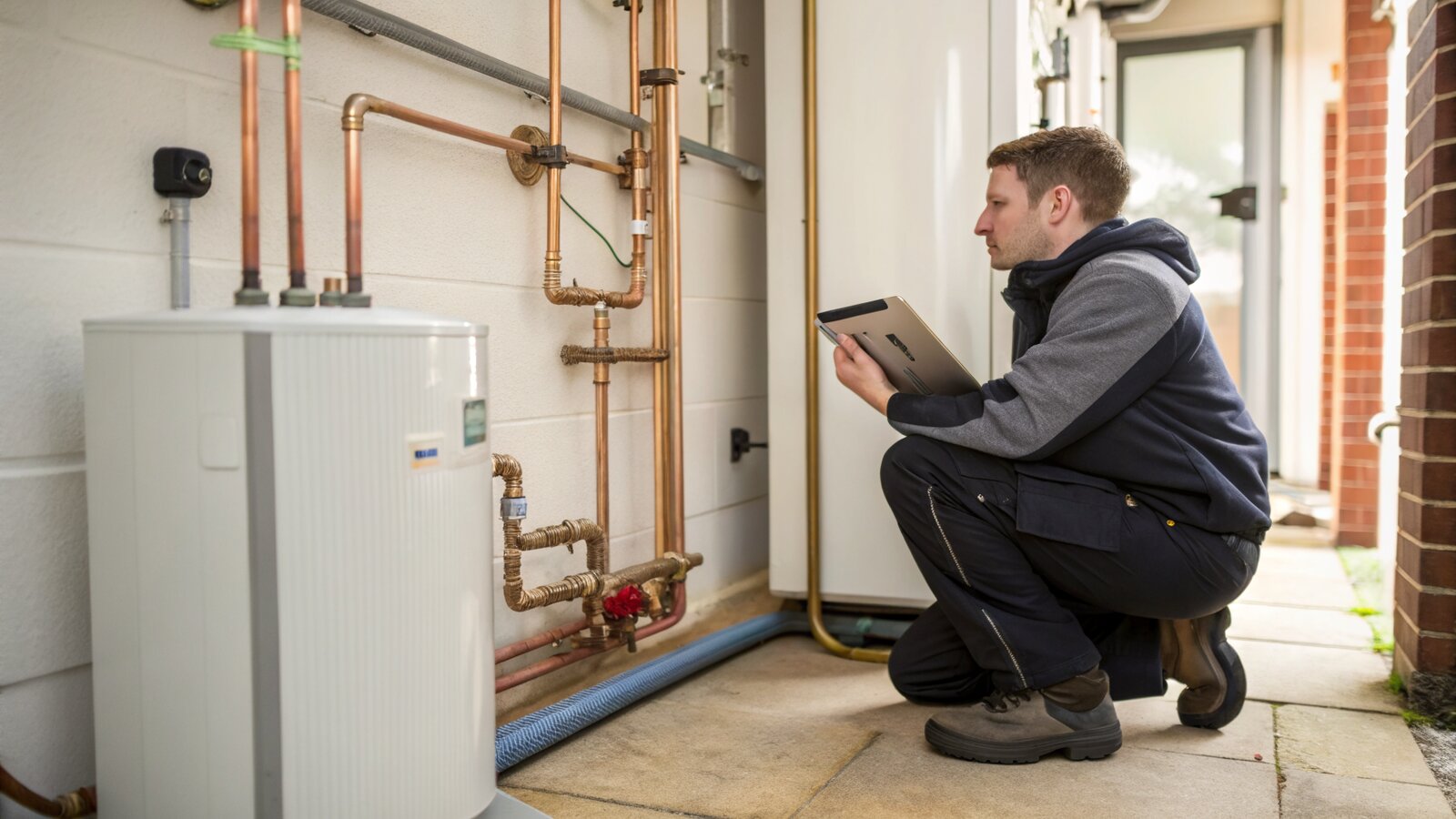
You do not apply for the grant yourself. The whole thing is installer-led. Your MCS-certified installer applies to Ofgem on your behalf and the grant amount is shown as an upfront discount on your quote. You pay the difference, and Ofgem pays the £7,500 directly to the installer. No upfront cash from you, no waiting for a refund, no form-filling at your end beyond confirming a couple of details.
The step-by-step looks like this:
- An MCS-certified installer surveys your home and gives you a quote with the £7,500 (or £9,000) already deducted. The quote should show both the gross price and the net price after grant.
- The installer submits the grant application to Ofgem. You receive a request to confirm a few details, usually within 14 days.
- You confirm, the installation goes ahead, and you pay only the net figure.
- Ofgem pays the grant to the installer behind the scenes. You never handle that money.
Because the discount only works through a certified installer, the single most important thing you can do is check the firm is listed on the MCS Find an Installer tool before signing anything. No MCS certificate means no grant, full stop. Get the MCS number, search it, and confirm the firm is certified for heat pumps specifically rather than just solar.
What you actually pay after the grant
Here is the honest range. A full air-to-water heat pump installation in 2026 typically lands somewhere between £8,000 and £16,000 before the grant, depending on the size of the system, how many radiators need changing and whether you need a new hot water cylinder. Bigger or more complicated jobs can run higher.
Take £7,500 off and the net cost most homeowners pay tends to fall in a broad band from a few hundred pounds at the cheap end up to around £8,500 for a large property with extensive radiator work. A common outcome for a typical three-bed semi, after survey and after grant, sits in the low-to-mid thousands. These are realistic ranges, not promises: your number depends entirely on your house, so treat any fixed figure online with suspicion until you have a proper heat loss survey.
What drives the variation:
- System size (kW): sized to your home’s heat loss, not your old boiler rating. A well-insulated three-bed needs a smaller unit than a draughty five-bed.
- Radiators: heat pumps run at lower flow temperatures than a gas boiler, so some radiators may need upsizing. Many homes only need a handful changed, not the whole house.
- Hot water cylinder: if your current cylinder is not heat-pump compatible (or you currently have a combi with no cylinder at all), a new one is part of the job.
- Pipework and electrics: older properties sometimes need a bit of pipe upgrading or a consumer unit tweak.
When you compare quotes, check what is actually included. Labour, pipework and commissioning are standard. New radiators, a cylinder and any electrical upgrades may be priced separately, and that is where two quotes for the “same” job can differ by thousands.
EPC and eligibility: what changed in April 2026
Eligibility rules loosened significantly in 2026, which is good news if an EPC recommendation was previously holding you back.
The old rules required a valid EPC with no outstanding recommendations for loft or cavity wall insulation. That insulation barrier was scrapped first, and then the Boiler Upgrade Scheme amendment regulations that came into force on 28 April 2026 went further: the requirement to have a valid EPC at all was removed. Where there is no EPC, the installer provides alternative evidence instead, typically proof of the existing fuel type, such as a recent utility bill, plus photos of the current heating system.
So you no longer get blocked because your EPC says “install loft insulation” and you have not done it yet. A heat pump still performs far better in a well-insulated home, though, so insulation remains a sensible thing to sort out. It is just no longer a legal hurdle for the grant.
To qualify in 2026 you generally need to tick these boxes:
- The property is in England or Wales.
- You are replacing a fossil fuel system (gas, oil, LPG) or electric heating, not adding to it. Hybrid setups that keep a fossil fuel boiler are not eligible.
- It is an existing property or an eligible self-build. New builds and social housing do not qualify.
- The installation has not already been funded by other government support.
- The work is done by an MCS-certified installer.
The scheme has also been extended to 2030, so there is no immediate cliff edge forcing a rushed decision.
The new £9,000 grant for oil and LPG homes from July 2026
If you heat with oil or LPG and you are off the gas grid, there is a bigger number coming. The government has confirmed a temporary uplift that takes the grant from £7,500 to £9,000, an extra £1,500 on top of the standard amount.
The details that matter:
- Applications are expected to open in July 2026, once the Department for Energy Security and Net Zero (DESNZ) publishes the formal grant change notice. That date is the government’s target rather than a guarantee, so confirm the latest position with your installer.
- It applies to air-to-water and ground source heat pumps only. The uplift is not available for biomass boilers or air-to-air heat pumps.
- You qualify if your property currently relies on heating oil or LPG, which mostly means rural, off-gas-grid homes. Homes on mains gas stay on the standard £7,500.
- It is a time-limited boost, confirmed for the current financial year to the end of March 2027. Applications made after the window closes revert to the standard £7,500.
Around 1.7 million households in England and Wales heat with oil or LPG, and those are exactly the homes where running costs fall the most after switching, because oil and LPG are expensive fuels to start with. If you are in that group, it is worth getting your survey lined up so you can apply once the window opens rather than scrambling later.
How to get an accurate number for your home
The only figure worth trusting is one that comes from a heat loss survey of your actual property. An MCS installer measures how much heat your home loses room by room, factoring in wall type, insulation, windows and floor area, then sizes the heat pump and works out which radiators (if any) need changing. That survey is what turns a vague online range into a real net price.
Practical steps:
- Get two or three quotes from MCS-certified installers and check each MCS number is current.
- Make sure every quote shows the gross price, the grant deduction and the net price you pay.
- Ask exactly what is included: which radiators, the cylinder, electrical work and commissioning.
- If you are on oil or LPG, ask the installer to confirm whether your application can use the £9,000 uplift and what the timing means for you.
For wider context on grants and running costs, the Energy Saving Trust’s Boiler Upgrade Scheme page is a solid independent reference.
Frequently asked questions
Do I get the £7,500 as a cash payment?
No. The grant is applied as a discount on your installer’s quote before you pay. Your MCS-certified installer claims it from Ofgem on your behalf and Ofgem pays them directly. You only ever pay the net figure, so there is no upfront outlay and no refund to chase.
Do I need an EPC to get the grant in 2026?
No longer. The requirement for a valid EPC was removed when the amended regulations took effect on 28 April 2026. If your property has no EPC, the installer provides alternative evidence such as a recent utility bill showing your current fuel type and photos of the existing heating system.
Will I have to replace all my radiators?
Usually not all of them. Heat pumps run at lower flow temperatures, so the survey checks each room. Many homes need only a few radiators upsized, while some need none. The installer’s heat loss calculation tells you exactly which ones, and that cost is part of the quote.
Can I get the £9,000 grant if I have a gas boiler?
No. The £9,000 uplift is only for homes currently heated by oil or LPG that are off the gas grid. If you are on mains gas you get the standard £7,500 towards an air-to-water or ground source heat pump.
Does the grant cover a hybrid system?
No. Hybrid setups that keep a fossil fuel boiler alongside a heat pump are not eligible. The grant is for replacing your fossil fuel heating, not supplementing it.
Is the grant available in Scotland?
The Boiler Upgrade Scheme covers England and Wales. Scotland has its own support through Home Energy Scotland, with different amounts and rules, so check that route if you live in Scotland.
Related guides
- Conservatory Roof Replacement vs Glass Film: Which Fixes a Too-Hot, Too-Cold Conservatory?
- Do You Need Planning Permission for a Rear Extension in Kent? 2026 Permitted Development Rules
- How Much Does a Conservatory Base Cost in the UK? (2026 Price Guide)
- Do You Need a Party Wall Agreement for a Rear Extension? Cost and Rules Explained
- Underfloor Heating vs Radiators for a Home Extension: Cost, Running Bills and Which to Choose
- How Much Does a House Extension Cost in 2026? Full UK Price Breakdown
- Loft Conversion Cost and Types: Dormer, Hip-to-Gable and Velux Explained
- Kent Home Improvement News: June 2026
- House Extensions: The Complete UK Homeowner’s Guide
- Single Storey Extension Ideas, Costs and Planning Rules
- Double Storey Extensions: Costs, Designs and What You Can Build
- Side Return Extensions Explained: Cost, Light and Layout
- Kent Home Improvement News: Mid-June 2026
- Garage Conversion Guide: Cost, Building Regs and Best Uses
- Extension vs Moving House: Which Is Better Value in Kent?
- Wraparound vs Rear Extension: Cost and Space Compared
- House Extension Builders in Kent: Costs, Lead Times and How to Choose
- Conservatory Guide: Styles, Costs and How to Choose One
- Kent Home Improvement News: Late June 2026
- How Much Does a Conservatory Cost in 2026? UK Prices by Type
- Conservatory vs Orangery vs Extension: Which to Build?
- Conservatory Roof Options: Glass, Polycarbonate and Tiled Compared
- Kent Home Improvement News: Early July 2026
- How to Keep a Conservatory Warm in Winter and Cool in Summer
- Tiled Conservatory Roof Cost and Replacement Process Explained
- Conservatories in Kent: Choosing an Installer, Costs and What to Ask
- Kent Home Improvement News: Mid-July 2026
- Roofing Guide: Repairs, Replacement, Materials and Costs
- New Roof Cost UK 2026: Replacement Prices by Roof Type
- Roof Repair Cost UK 2026: Slipped Tiles and Flashing Prices
- 7 Signs Your Roof Needs Replacing (and What You Can Ignore)
- Flat Roof vs Pitched Roof: Cost, Lifespan and Best Uses
- EPDM vs Felt vs Fibreglass Flat Roofs Compared
- Kent Home Improvement News: Mid-July 2026
- Roof Tile Types Explained: Clay, Concrete and Slate Compared
- Fascias, Soffits and Guttering: When to Replace and What It Costs
- How to Find a Good Roofer: Vetting Checklist for UK Homeowners
- Roofers in Kent: Costs, How to Choose and What to Ask in 2026
- Kitchen Renovation Guide: Planning, Cost and Design in 2026
- How Much Does a New Kitchen Cost in 2026? UK Price Guide
- Kitchen Layout Ideas: Galley, L-Shape, Island and Open Plan
- Worktops Compared: Quartz vs Granite vs Laminate vs Solid Wood
- Fitted vs Bespoke vs Flat-Pack Kitchens: Cost and Quality
- Kitchen Island Ideas, Sizes and Costs: A 2026 UK Guide
- Kent Home Improvement News: Late July 2026
- Open Plan Kitchen Diner: Costs, Layouts and Knock-Through Rules
- How Long Does a Kitchen Fitting Take? Realistic UK Timeline
- Kitchen Fitters in Kent: Costs and How to Choose (2026)
- Bathroom Renovation Guide: Planning, Cost and Layout
- New Bathroom Cost 2026: What You’ll Pay in the UK
- Kent Home Improvement: Roofing Costs Rise (Aug 2026)
- Small Bathroom Ideas: Layouts That Feel Bigger
- Wet Room Cost 2026: £2,000 to £9,000 Fitted, by Size
- En Suite Cost and Minimum Size: £4,000 to £10,000 in 2026
- Kent Home News: £9,000 Heat Pump Grant Now Open
- Electric vs Mixer vs Power Shower: What Your Boiler Allows
- Bathroom Underfloor Heating Cost: 16p an Hour to Run
- Window Replacement Cost 2026: £350 to £600 Per uPVC Window
- uPVC vs Aluminium Windows: the 1.4 U-Value Rule
- How Long Does a Bathroom Take to Fit? 5 to 10 Working Days
- Home Improvement News: Solar Up 14%, Heat Pumps Down 17%
- Double vs Triple Glazing: Part L Still Stops at 1.4
- Bathroom Fitters in Kent: What to Ask Before You Pay
- Sash Window Repair or Replace? What Kent Councils Allow
- Bifold vs Sliding Doors: What Building Regs Actually Set
- Composite Door Cost 2026: £550 to £2,350 Fitted
- Window Energy Ratings: Band B Is the Rule, Not C
- Replacement Windows: the 1.4 U-Value and Vent Rules
- Double Glazing Kent: the 1.4 U-Value Every Quote Must Hit
- Heat Pumps in Kent: the £7,500 Grant and the 1.5m³ Rule
- Heat Pump vs Gas Boiler: Break-Even Is a SCOP of 3.0
- Permitted Development Rights: The 8m Rear Extension Rule