
New boiler cost in 2026 lands between roughly £1,800 and £4,500 fitted for most Kent homes, and the spread has almost nothing to do with which brand goes on the wall. It is decided by whether the boiler stays where it is, whether the system type changes, and how much of the old pipework has to come out with it. This guide breaks the number down, then covers the three rules that quietly change what a legal installation has to include: Boiler Plus, VAT, and building control.
What a new boiler costs fitted in 2026
These are installed prices including VAT and including the flue, standard controls, a filter, and taking the old unit away. They assume the boiler stays in roughly the same place.
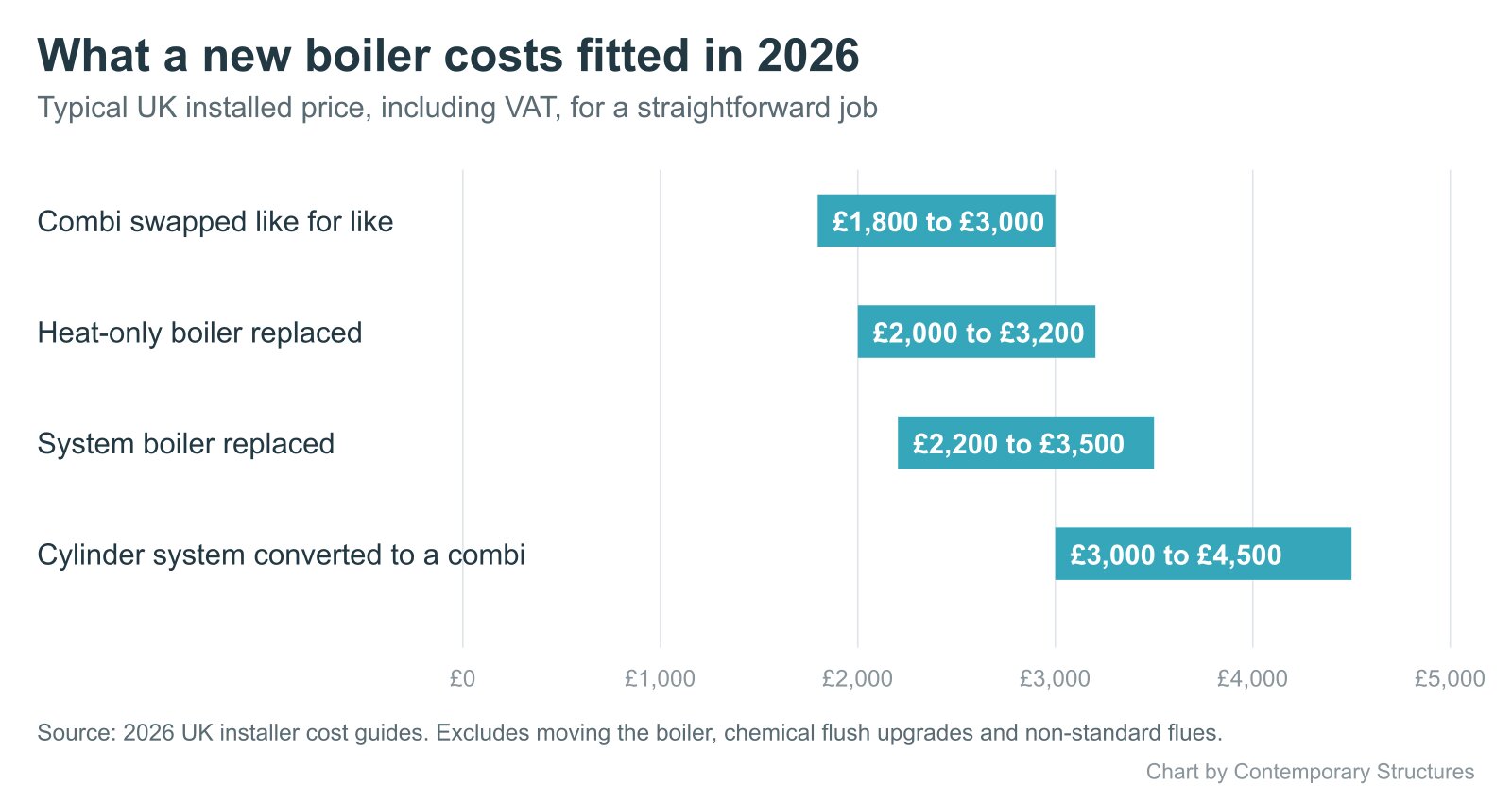
- Combi swapped like for like: £1,800 to £3,000. The cheapest job there is. Same position, same pipework, usually one day.
- Heat-only (regular) boiler replaced: £2,000 to £3,200. Tanks and cylinder stay, so the work is contained.
- System boiler replaced: £2,200 to £3,500. Slightly more pipework and controls than a heat-only swap.
- Cylinder system converted to a combi: £3,000 to £4,500. Cylinder out, tanks out of the loft, pipework reworked, and usually a plasterer and a decorator afterwards.
Above that band you are into genuinely awkward work: moving the boiler to a different room, removing a back boiler from a fireplace, or upsizing to a high-output boiler that needs a larger gas supply pipe run back to the meter. Any one of those can add £500 to £1,500 on its own.
What you are actually paying for
A quote that just says “supply and fit” is hiding the half of the job that decides how long the boiler lasts. The line items that should be there:
- The appliance. Usually a third to a half of the total on a straightforward swap.
- Labour. One to two days for a swap, three or more for a conversion.
- The flue and any extensions. A vertical flue through a roof costs more than a short horizontal one through a wall.
- A chemical flush or power flush, and an inhibitor. BS 7593 is the code of practice for treating water in domestic heating systems, and a new boiler dropped onto a system full of black magnetite sludge will block its heat exchanger. Ask which type of clean is quoted; a power flush is a different price from a chemical flush.
- A magnetic filter. It catches what the flush leaves behind, and most manufacturers now make one a condition of the longer warranties.
- Controls. See Boiler Plus below. Not optional in England.
- Gas soundness testing, commissioning and the Benchmark checklist. The checklist in the back of the boiler manual is what a manufacturer asks for if you ever claim on the warranty. Make sure it is filled in and left with you.
The five things that move the price most
- Changing the system type. Going from a cylinder to a combi is the single biggest jump, because it is a plumbing job with a boiler in it rather than a boiler swap.
- Moving the boiler. A new position means new gas, water, condensate and flue routes, and making good where the old one was.
- The gas supply pipe. Older houses often have a 15mm run that will not feed a 30kW-plus combi. Upgrading to 22mm across a house is a day’s work and a lot of lifted floorboards.
- Condensate disposal. A condensing boiler produces acidic condensate that has to reach a drain. If the nearest one is outside and exposed, it needs the right pipe size and lagging, or it freezes in January and locks the boiler out.
- Access. A loft-mounted boiler, a boxed-in cupboard, or a flue over a conservatory roof all add time before anyone touches a spanner.
Boiler Plus: the rules your quote has to meet
Since April 2018, Part L of the Building Regulations in England has set a minimum standard for every new and replacement domestic boiler. Any new gas or oil boiler must have a seasonal efficiency of at least 92% ErP, and the system must have time and temperature control with a boiler interlock so the boiler is not firing when there is no demand.
Combi boilers carry an extra requirement. The installation must also include one of four energy-saving measures: flue gas heat recovery, weather compensation, load compensation, or smart controls with automation and optimisation. A quote for a combi that lists none of these is either incomplete or non-compliant, and the four options are not equivalent in price or in benefit. Weather compensation, which uses an external sensor to drop flow temperature in mild weather, is usually the cheapest way to satisfy the rule and the one that actually reduces gas use.
VAT: 20 per cent on a gas boiler, nothing on a heat pump until March 2027
This catches people out when they compare a boiler quote against a heat pump quote. Installing an energy-efficient gas boiler is standard-rated, so 20 per cent VAT sits inside the price. Heat pumps are treated as energy-saving materials and are zero-rated, and HMRC’s Notice 708/6 confirms the zero rate runs until 31 March 2027, after which energy-saving material installations revert to the reduced rate of 5 per cent.
In cash terms, on a £3,000 boiler job, £500 of what you pay is VAT. The equivalent tax on a heat pump installed before April 2027 is nil. That gap does not make a heat pump cheaper, but it narrows the difference more than most comparisons admit.
Grants: there is no grant for a gas boiler
The Boiler Upgrade Scheme, despite the name, does not fund boilers that burn gas. It funds the alternatives. Since 21 July 2026 the approved grant values are £7,500 for an air-to-water or ground source heat pump, £2,500 for an air-to-air heat pump, and £5,000 for a biomass boiler. For off-gas-grid properties replacing oil or LPG heating, the air-to-water and ground source grant rises to £9,000.
That last figure matters more in Kent than the county’s size suggests. Plenty of homes in the Weald, on Romney Marsh and in the villages off the main gas network run on oil, and for those households the difference between a like-for-like oil boiler replacement and a grant-assisted heat pump is smaller than the headline prices imply. We compare the two routes in detail in our guide to heat pumps versus gas boilers, and the grant rules themselves in our Boiler Upgrade Scheme explainer. The application is installer-led and the installer must be MCS certified; you can check the current rules on the GOV.UK Boiler Upgrade Scheme page.
Building control, the certificate, and your future house sale
Replacing a heating system is notifiable building work. You do not apply yourself: a Gas Safe registered engineer working under a competent person scheme self-certifies the installation, notifies the local authority on your behalf, and must give you a certificate within eight weeks of completion. Keep it. That certificate shows up in solicitors’ searches when you sell, and its absence is the kind of thing that stalls a sale at the worst moment.
Without it, the local authority can require the work to be corrected and the person who did the work can be prosecuted. The GOV.UK building regulations guidance sets out both the requirement and the competent person route. Check the engineer’s Gas Safe registration number and the categories they are qualified for before work starts, not after.
Does the Future Homes Standard stop you replacing a gas boiler?
No, and the confusion is costing people money in delayed decisions. The Building Regulations etc. (Amendment) (England) Regulations 2026 were published on 24 March 2026 and come into force on 24 March 2027, with a later date of 24 September 2027 for higher-risk buildings. They apply to new buildings and new building work, not to swapping the boiler in a 1930s semi in Maidstone. Transitional arrangements protect non-higher-risk work where a building notice was submitted before 24 March 2027 and work starts within a year.
So if your boiler is 15 years old and losing pressure every fortnight, nothing in that legislation requires you to wait, and nothing in it bans the replacement. What it does mean is that the direction of travel for new housing is electric heating, which is worth factoring in if you are also planning an extension or a deep retrofit rather than a straight swap.
How to compare boiler quotes in Kent
Ask all three installers to quote the same thing, and insist the quote names: the boiler model and output in kW, the controls being fitted and which Boiler Plus measure they satisfy, whether the clean is chemical or power, whether a filter is included, the warranty length and what conditions attach to it, and how long the job will take.
Be suspicious of an output figure that has been guessed. Boilers in British homes are routinely oversized, which makes them cycle on and off, wear faster and run less efficiently. A proper heat loss calculation, or at minimum a count of radiators and hot water outlets, should sit behind the kW number on the quote.
Finally, compare warranties on their conditions, not their length. A ten-year warranty that requires an annual service by an approved engineer and proof of a filter and inhibitor is a real ten years only if you keep the paperwork. For more on heating choices across the county, browse the rest of Contemporary Structures.
Frequently asked questions
How much does a new boiler cost in 2026?
For most homes, £1,800 to £3,000 fitted for a like-for-like combi swap, £2,000 to £3,500 for a heat-only or system boiler, and £3,000 to £4,500 to convert a cylinder system to a combi. Moving the boiler, removing a back boiler or upgrading the gas supply pipe pushes it higher.
How long does a boiler installation take?
A straight swap in the same position is usually one day, occasionally two. A conversion from a cylinder system to a combi is typically two to three days, plus making good afterwards. If a quote promises a conversion in a single day, ask what is being left out.
Is there a grant to help with a new gas boiler?
No. The Boiler Upgrade Scheme funds heat pumps and biomass boilers only: £7,500 for an air-to-water or ground source heat pump, £2,500 for air-to-air, £5,000 for biomass, and £9,000 for an air-to-water or ground source heat pump in an off-gas-grid property replacing oil or LPG.
Do I need building regulations approval to replace my boiler?
The work is notifiable, but you do not apply yourself if you use a Gas Safe registered engineer registered with a competent person scheme. They self-certify and notify the council, and must give you a compliance certificate within eight weeks. That certificate is what a buyer’s solicitor will look for.
Will gas boilers be banned in 2027?
Not in existing homes. The Future Homes and Buildings Standards regulations come into force on 24 March 2027 and set the standard for new buildings and new building work. Replacing an existing boiler in an existing house is unaffected.
What size boiler do I need?
It should come from a heat loss calculation, not a rule of thumb. Oversizing is the most common fault in British installations: too large a boiler short-cycles, which wastes gas and shortens its life. Radiator count, hot water demand and how many bathrooms run at once all feed into the figure.
Related guides
- Heat Pump vs Gas Boiler: Break-Even Is a SCOP of 3.0
- Boiler Upgrade Scheme: £9,000 Grants From 21 July 2026
- Heat Pumps in Kent: the £7,500 Grant and the 1.5m³ Rule
- Electric vs Mixer vs Power Shower: What Your Boiler Allows
- Underfloor Heating vs Radiators for a Home Extension: Cost, Running Bills and Which to Choose