
The Boiler Upgrade Scheme is the grant that takes a large lump out of the cost of swapping a fossil fuel boiler for a heat pump in England and Wales, and it is no longer the flat £7,500 offer most articles still describe. Approved grant values effective from 21 July 2026 set a higher £9,000 rate for properties off the gas grid replacing oil or LPG, and a new £2,500 category for air-to-air heat pumps that did not exist in the scheme at all a year ago. If you are weighing up a heating change on a Kent property, the category your home falls into is worth more than any quote comparison you will do.
What the Boiler Upgrade Scheme pays in 2026
The Department for Energy Security and Net Zero publishes a notice of approved grant categories and values, and that notice, not the headline figure, is what your installer claims against. From 21 July 2026 the values are:
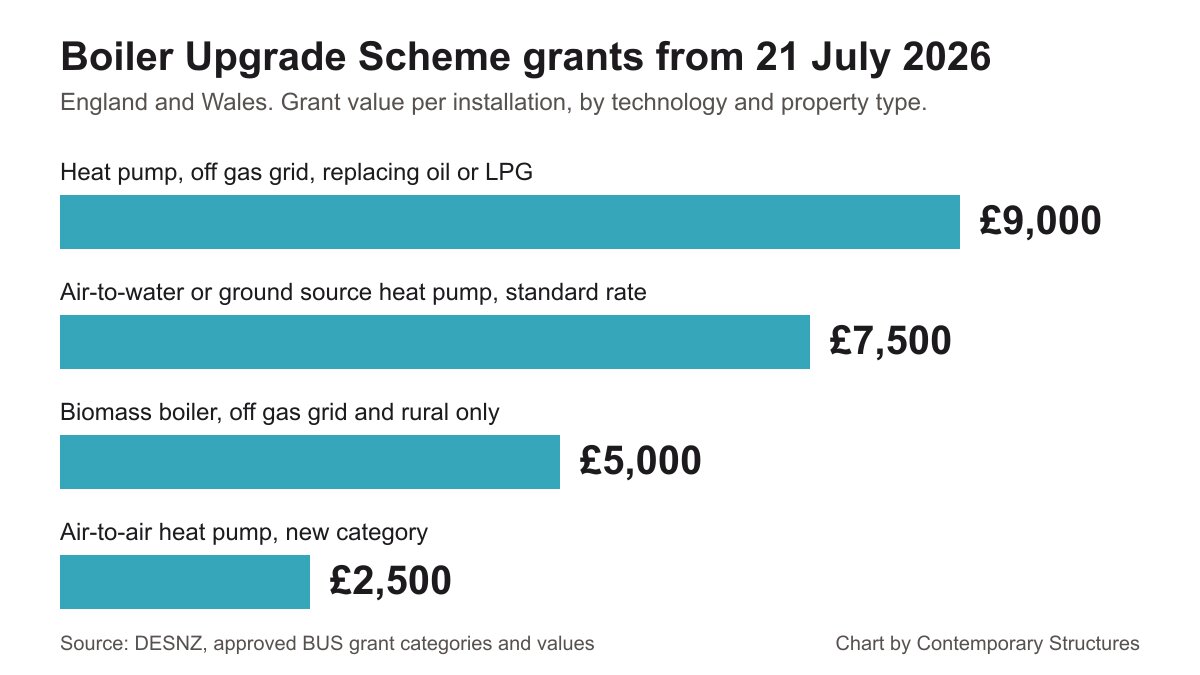
- £9,000 for an air-to-water or ground source heat pump in an off gas grid property replacing oil or LPG heating.
- £7,500 for an air-to-water or ground source heat pump in any other qualifying case, including on-gas-grid properties and off-grid properties replacing coal, a fossil fuel hybrid, electric heating that is not a heat pump, or other fossil fuels.
- £5,000 for a biomass boiler, which remains restricted to off gas grid properties.
- £2,500 for an air-to-air heat pump, the newest category.
Ground source heat pumps sit in the same brackets as air-to-water, and the ground source figure covers water source heat pumps and units on shared ground loops. There are capacity ceilings: 45kWth for an individual system, 70kWth where a heat pump is installed alongside additional heat pumps, and 300kWth for shared ground loop arrangements. Biomass is capped at 45kWth. Domestic installations in Kent houses sit far below all of these, so the limits generally only bite on large properties, converted farm buildings and small commercial premises.
Who can get a grant, and who cannot
The scheme is open in England and Wales. You must own the property you are applying for, and that includes a business property, a second home or a property you let out. You must be replacing a fossil fuel heating system, which the guidance defines as oil, gas, electric or LPG.
Three exclusions catch people out:
- Most new build properties. The scheme is aimed at replacement, not first fit.
- Social housing. Funded through other routes.
- Any property that has already received government funding or support for a heat pump or biomass boiler. You cannot stack the Boiler Upgrade Scheme on top of another grant for the same technology.
Biomass carries an extra condition: it is for rural, off gas grid properties, so it is not an alternative for a suburban home that simply prefers the idea of a log boiler. Air-to-air has its own restriction. The 2026 regulations inserted a new provision barring air-to-air heat pumps in non-residential buildings, so the £2,500 is a domestic grant only.
The EPC rule that changed
You still need a valid Energy Performance Certificate, generated within the last ten years. What you no longer need is a clean sheet on insulation. The original rules refused a grant where the EPC carried outstanding recommendations for loft or cavity wall insulation, which meant homeowners had to pay for insulation work first. Government removed that requirement, estimating that it cut around £2,500 from the cost of getting a heat pump into a typical semi-detached house.
The advice has not changed even though the rule has. Insulation still reduces heat loss and still improves how a low-carbon heating system performs, and government continues to recommend energy efficiency upgrades where they are practical and affordable. The difference is that a draughty Kent cottage is now eligible on day one rather than after a five-figure fabric project, and you can sequence the work in whatever order your budget allows.
How the money actually reaches you
You do not apply. Your installer applies on your behalf through Ofgem, and the grant is deducted from what you pay rather than refunded to you later. Government guidance is explicit that the value of the grant will be taken off the amount you pay for installation, and that it will be shown on your quotation and on your invoice.
Practical consequences worth planning around:
- Ask to see the grant on the quote. If a quote shows a single net figure with no grant line, you cannot tell whether the £7,500 or £9,000 has been passed to you or absorbed.
- Ofgem will contact you to confirm your installer is acting on your behalf, and may carry out property visits or other checks. Respond, or the voucher can stall.
- Use an MCS certified installer. The guidance points homeowners to an MCS certified installer to assess whether the property is suitable, and certification is how the scheme verifies the installation.
- Confirm eligibility before committing. Your installer should tell you which grant category your property sits in, and the answer between £7,500 and £9,000 turns on whether you are off the gas grid and on what you are replacing.
What changed on 28 April 2026
The Boiler Upgrade Scheme (England and Wales) (Amendment) Regulations 2026 came into force on 28 April 2026 and did two substantial things. They extended the operation of the scheme through to 2030, replacing the previous 2028 horizon, and they added new categories of grant for air-to-air heat pumps, including separate categories for new build, non-new-build and off gas grid properties.
Air-to-air is a meaningful addition rather than a technical footnote. It is the technology most people already recognise as air conditioning: it heats and cools air directly rather than feeding radiators or underfloor pipework, so it suits flats, small houses and properties with no wet central heating to connect to. Announcing the expansion, government put the typical cost of installing an air-to-air heat pump in a flat or small house at around £4,500, which makes a £2,500 grant a majority of the upfront cost rather than a contribution to it.
The budget moved with it. The Boiler Upgrade Scheme budget for 2026 to 2027 was set at £400 million, and the funding for the extension across 2026/27 to 2029/30 totals £2,392 million, sized against a target of more than 450,000 heat pump installations a year by 2030.
Planning permission is no longer the obstacle it was
For years the practical blocker on a Kent terrace or a tight suburban plot was the permitted development rule requiring an air source heat pump to sit at least one metre from the property boundary. The Town and Country Planning (General Permitted Development) (England) (Amendment) Order 2025 removed that one metre boundary rule with effect from 29 May 2025, so a heat pump can now be installed within a metre of the boundary under permitted development.
The same amendment raised the permitted size of a unit for a dwellinghouse from 0.6 cubic metres to 1.5 cubic metres, doubled the number of permitted heat pumps on a detached house from one to two, and brought air-to-air units that can also provide cooling into scope. One restriction survives: where a unit is installed on a flat roof, all parts of it must still be at least one metre from the external edge of that roof. Listed buildings and conservation areas are a separate question and still need checking with the local planning authority.
How many people have used it
Ofgem publishes a monthly scheme update, and the figures to 31 July 2026, covering the whole scheme since 23 May 2022, are:
- 151,136 voucher applications received
- 101,029 vouchers issued, worth £721,534,000
- 93,981 redemption applications received
- 93,364 vouchers redeemed, with £661,303,000 paid out
The gap between applications and vouchers issued is the useful number in that list. Around a third of applications do not convert into an issued voucher, through rejection at eligibility checks, withdrawal or expiry. The commonest avoidable causes are the ones covered above: no valid EPC, a property that already had heat pump funding, or a new build. Check those three before your installer submits.
Frequently asked questions
Is the Boiler Upgrade Scheme still running in 2026?
Yes. The 2026 amendment regulations, in force from 28 April 2026, extended the scheme through to 2030, and the budget for 2026 to 2027 was set at £400 million. It is a budgeted scheme rather than an open-ended entitlement, so vouchers are issued while funding lasts in each scheme year.
Can I get £9,000 rather than £7,500?
Only if your property is off the gas grid and you are replacing oil or LPG heating with an air-to-water or ground source heat pump. On-gas-grid properties, and off-grid properties replacing coal, electric heating or a hybrid system, sit at £7,500. Your installer confirms the category when they apply.
Do I need to insulate my loft before I can get the grant?
No. The requirement to clear outstanding loft and cavity wall insulation recommendations on your EPC was removed, and government estimated that change saved around £2,500 on a typical semi-detached installation. You still need a valid EPC less than ten years old, and insulating is still worth doing for running costs.
Does the grant cover an air conditioning unit?
It covers an air-to-air heat pump, which is the same technology used for air conditioning, at £2,500, and only in residential buildings. The 2026 regulations specifically exclude air-to-air installations in non-residential buildings.
Can a landlord claim the grant?
Yes. The eligibility rule is that you own the property you are applying for, and that explicitly includes business properties, second homes and rental properties. Social housing is excluded.
Do I need planning permission for a heat pump in Kent?
Usually not. Since 29 May 2025 the one metre boundary rule no longer applies in England, the size limit for a domestic unit is 1.5 cubic metres, and a detached house may have two units under permitted development. A unit on a flat roof must still be a metre from the roof edge, and listed buildings and conservation areas need a check with the council before you order anything.
Full scheme detail is on GOV.UK’s Boiler Upgrade Scheme guidance, the grant values quoted above come from the notice of approved grant categories and values, and our other heating and heat pump guides are collected at Contemporary Structures.
Related guides
- New Boiler Cost 2026: £1,800 to £4,500 Fitted
- Heat Pump vs Gas Boiler: Break-Even Is a SCOP of 3.0
- Heat Pumps in Kent: the £7,500 Grant and the 1.5m³ Rule
- Electric vs Mixer vs Power Shower: What Your Boiler Allows
- Underfloor Heating vs Radiators for a Home Extension: Cost, Running Bills and Which to Choose