
A heat pump is now the default replacement for a gas or oil boiler in Kent, and two of the numbers behind that decision have moved since 2025. The Boiler Upgrade Scheme takes £7,500 off an air source installation before you pay a penny, and since May 2025 the planning rules no longer force the outdoor unit a metre back from your boundary. Both of those changes remove a reason people used to say no.
What has not changed is that a heat pump is a different machine from a boiler, and installing one badly produces a cold house and a large electricity bill. This guide sets out what the technology does, what it costs in 2026, what the grant covers, and where the planning line sits.
How a heat pump differs from a boiler
A boiler makes heat by burning fuel. A heat pump moves heat that already exists, from the outside air or the ground, and concentrates it using a compressor. Because it is moving energy rather than creating it, it delivers more heat than the electricity it consumes. The Energy Saving Trust puts current units at more than three times as efficient as a gas or oil boiler.
The practical consequence is flow temperature. A gas boiler will happily push 70C water round small radiators. A heat pump is most efficient at much lower flow temperatures, which is why radiators often have to be upsized and why a heat pump run like a boiler, hot bursts then off, performs badly. It wants to run steadily at a lower temperature.
The second consequence is hot water. A standard air source heat pump does not produce hot water on demand the way a combi boiler does, so you need a cylinder. The Energy Saving Trust’s rule of thumb is that a domestic cylinder will usually fit a cupboard of at least 80cm by 80cm. If your combi freed up the airing cupboard years ago, you are getting it back.
Air source, ground source or air to air
Air source is the common choice, suitable for most UK housing. Monobloc systems put everything in one outdoor box and are cheaper and quicker to fit. Split systems separate indoor and outdoor units and are slightly more efficient, because some of the heat transfer happens inside where it is warmer, but they cost more.
Ground source extracts heat from buried pipework. For a new build three-bedroom house that means roughly two trenches of 30 to 40 metres, on land with no trees and accessible to a digger. Where space is tight, a borehole about 20cm wide and between 75 and 200 metres deep can be drilled instead, which usually needs a thermogeological survey and costs considerably more. The indoor unit is about the size of an American style fridge, roughly 120cm by 60cm by 60cm, and often contains the cylinder.
Air to air heat pumps blow warm air rather than heating water. They do not provide hot water, but they are now grant eligible and suit flats, park homes and small well insulated properties where a cylinder simply will not fit.
What it costs to install
The Energy Saving Trust puts a typical air source installation at around £12,000 and a ground source system with trenched ground loops at around £15,000, with boreholes costing considerably more. Those are before the grant. The spread around them is wide, and it is driven by the size of the property, whether radiators need upgrading, and whether the house is a new build or an existing one.
We have set out what an air source heat pump costs once the grant is deducted separately. Radiator upgrades are the item most often missing from a cheap quote. If a quotation does not mention a room by room heat loss calculation, treat it with suspicion, because sizing the heat pump and sizing the emitters are the same exercise.
The Boiler Upgrade Scheme: what comes off the price
In England and Wales the Boiler Upgrade Scheme pays one grant per property:
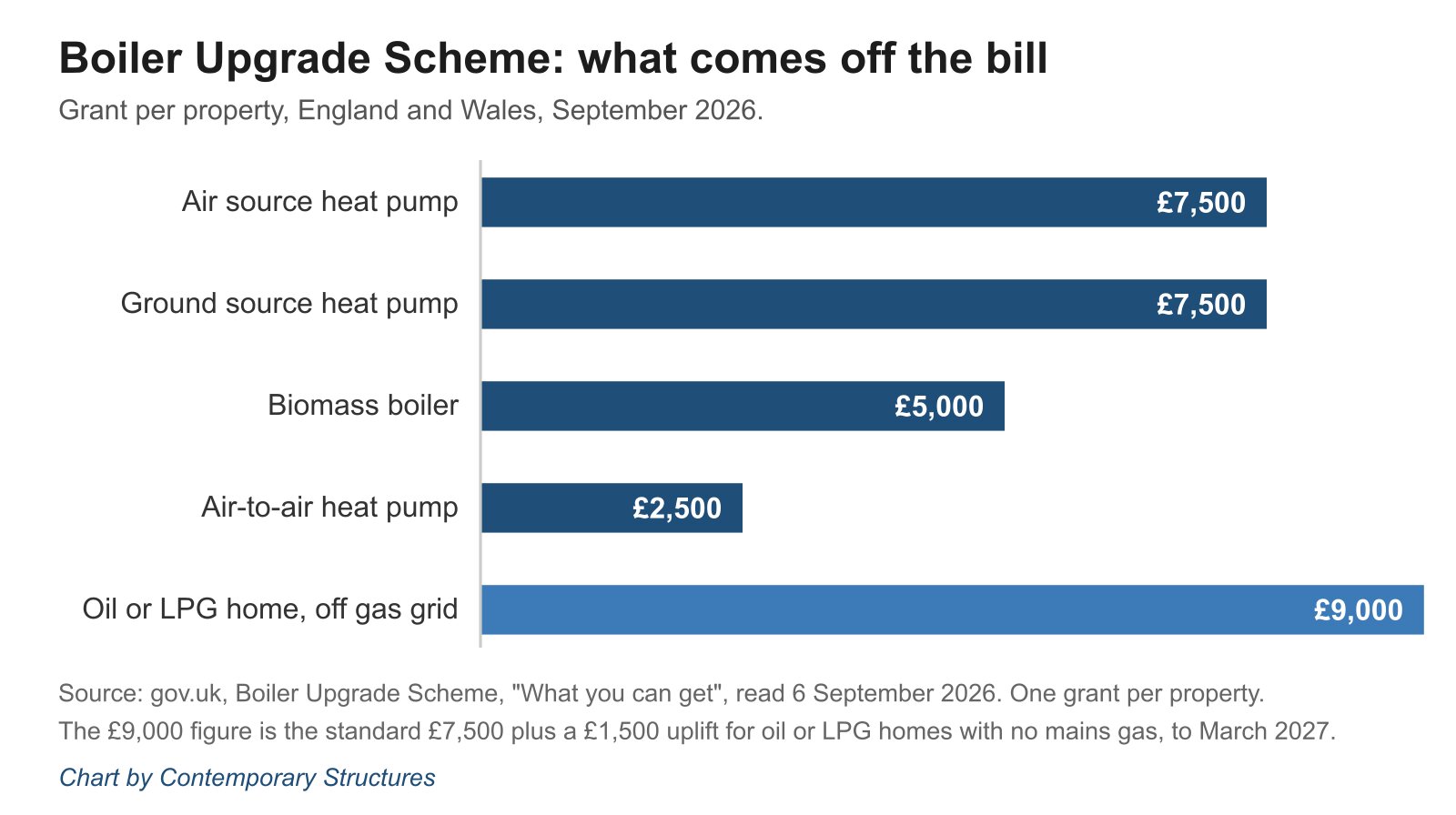
- £7,500 towards an air source heat pump
- £7,500 towards a ground source heat pump, including water source and shared ground loop systems
- £5,000 towards a biomass boiler
- £2,500 towards an air-to-air heat pump
- An extra £1,500 on top of the heat pump grants, until March 2027, if the property currently runs on oil or LPG and has no mains gas connection, taking it to £9,000
The mechanics matter. An MCS certified installer applies on your behalf and deducts the grant from the invoice, so you never handle the money. There are capacity limits of 45kWth for a single system, 70kWth where multiple heat pumps are installed and 300kWth for shared ground loops, which no ordinary house will approach. Hybrid arrangements that keep a gas boiler alongside a heat pump are not eligible, and neither is replacing an existing low carbon heating system. Scotland and Northern Ireland run separate schemes.
Running costs: the part quotes skate over
This is where the honest answer is uncomfortable. A heat pump is more than three times as efficient as a boiler, but on a standard tariff electricity costs nearly four times as much per unit as gas. Those two numbers very nearly cancel out, which is why the Energy Saving Trust says a heat pump on a standard tariff can cost slightly more to run than a new gas or oil boiler.
The saving comes from three things stacked together. Switching to a heat pump time-of-use tariff, which prices electricity far lower at certain hours, is the big one. Sizing the radiators properly so the system can run at a low flow temperature is the second. Disconnecting the gas supply entirely, so you stop paying the gas standing charge, is the third, and it only works if nothing else in the house burns gas.
If you are coming off oil or LPG rather than mains gas, the arithmetic is much friendlier from the start, and the £9,000 grant applies.
Planning permission: what changed in May 2025
On 29 May 2025 the permitted development rules for air source heat pumps in England were loosened significantly. The changes were:
- The requirement to keep the unit a metre from the property boundary was removed
- The size limit for the outdoor unit rose from 0.6 cubic metres to 1.5 cubic metres on a house
- Detached houses can now have two units under permitted development rather than one
- Air source units used for cooling were brought within the rights, which covers air-to-air systems
In exchange, installations in England must comply with the MCS 020(a) standard, which replaced MCS 020 on that date and contains the sound calculation. Scotland, Wales and Northern Ireland still work to the original MCS 020.
The exclusions still bite, and they bite hard in Kent. Permitted development rights do not apply within the curtilage of a listed building or on a scheduled monument. In a conservation area or a world heritage site the unit must not go on a wall or roof fronting a highway, or nearer to a highway that bounds the property than any part of the house. Blocks of flats are limited to one unit and the smaller 0.6 cubic metre size. Given how much of Kent sits in conservation areas, this is the first thing to check, not the last.
What has to change inside the house
Expect three things. A hot water cylinder, in a cupboard of at least 80cm by 80cm, unless you go for a heat battery or a compact unit. Radiator upgrades in the rooms where the existing ones are undersized for a lower flow temperature. And controls, because a heat pump is managed by weather compensation and steady running rather than a timer and a boost.
Insulation sits behind all of it. Every kilowatt of heat loss you remove first is a kilowatt of heat pump capacity you do not have to buy or run.
Choosing an installer
The grant requires an MCS certified installer, which is also the practical quality filter. Get at least three quotes, and compare them on the heat loss calculation and the radiator schedule rather than on the headline price. Ask what flow temperature the design assumes, ask what the predicted seasonal efficiency is, and ask what happens if the house does not reach temperature on the coldest day.
If you are weighing this against simply replacing the boiler, our breakdown of how much electricity a heat pump actually uses puts the running cost case in numbers, and Contemporary Structures covers the wider home improvement picture across Kent.
Frequently asked questions
How much is a heat pump in 2026?
The Energy Saving Trust puts a typical air source installation at around £12,000 and a trenched ground source system at around £15,000, before the Boiler Upgrade Scheme grant of £7,500 is deducted. Boreholes for ground source cost considerably more than trenches.
Do I need planning permission for a heat pump?
Usually not. Since 29 May 2025 an outdoor unit up to 1.5 cubic metres on a house is permitted development in England with no boundary distance requirement, provided it complies with MCS 020(a). Listed buildings and scheduled monuments are excluded, and conservation areas restrict where the unit can go relative to a highway.
Will a heat pump cost more to run than my gas boiler?
On a standard electricity tariff it can, because electricity costs nearly four times as much per unit as gas and a heat pump is a little over three times as efficient. Switching to a heat pump time-of-use tariff, sizing radiators correctly and disconnecting the gas supply are what turn it into a saving.
Can I keep my gas boiler alongside a heat pump?
You can, but a hybrid system is not eligible for the Boiler Upgrade Scheme. The grant is only paid where the fossil fuel system is being replaced rather than supplemented.
Do heat pumps work in older houses?
Yes, but the heat loss has to be calculated properly and the emitters sized to match. An older solid wall house needs either more insulation, larger radiators, or a bigger unit, and often all three. The failures people hear about are almost always sizing failures rather than technology failures.
How much space does a ground source heat pump need?
For a new build three-bedroom house, expect roughly two trenches of 30 to 40 metres, on ground free of trees and reachable by machinery. Where there is not enough land, a borehole 75 to 200 metres deep is the alternative, at higher cost.
Sources
Grant amounts from gov.uk, Boiler Upgrade Scheme; planning conditions from the Planning Portal; costs and efficiency from the Energy Saving Trust. All read on 6 September 2026.
Related guides
- Do Heat Pumps Work in Cold Weather? (Explained)
- How Much Electricity Does a Heat Pump Use? Must Know This!
- Why Are Air Source Heat Pumps So Expensive? A Detailed Look at the High Initial Costs
- How Long Do Heat Pumps Last? Lifespan and Factors that Impact Performance
- What Size of the Air Source Heat Pump Is Right for Your Home
- Air Source Heat Pump Cost in 2026 After the £7,500 Grant: What You Actually Pay
- Heat Pump vs Gas Boiler: Break-Even Is a SCOP of 3.0