
Window replacement cost in 2026 runs from about £350 to £600 for a standard uPVC casement supplied and fitted, and £4,000 to £6,000 to do a whole three-bedroom semi in uPVC. Those are the numbers most Kent homeowners will be quoted against. What moves the price is frame material, size, style and access, in roughly that order.
The figures below are typical UK ranges for 2026 rather than a quote, and they assume a straight replacement into an existing opening. Below the costs there is the part that quotes rarely spell out: the Building Regulations your installer has to meet, and the certificate you should get at the end.
Window replacement cost by type in 2026
Per window, supply and fit:
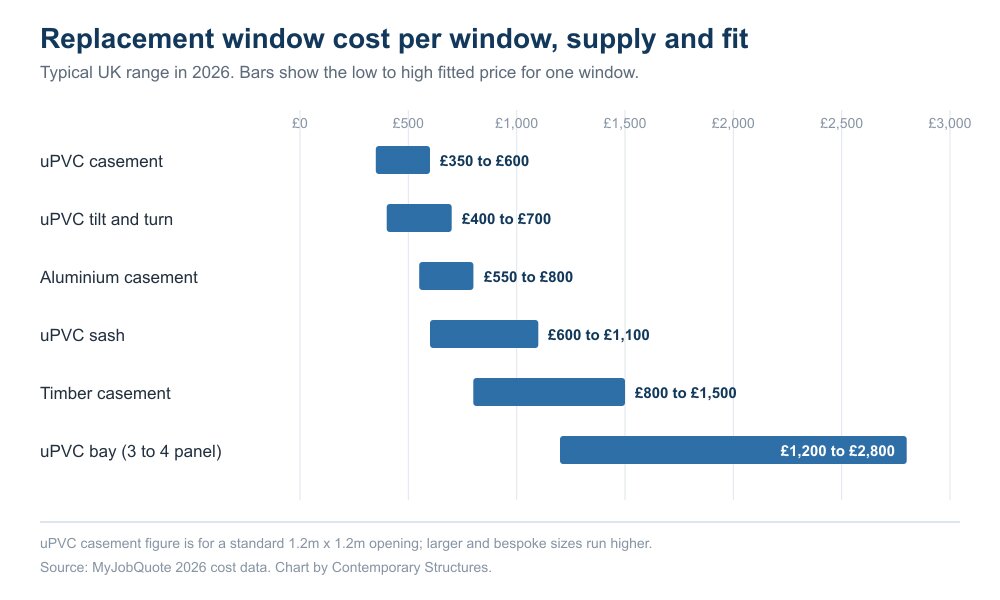
- uPVC casement: £350 to £600 for a standard opening around 1.2m by 1.2m. Larger and bespoke sizes climb to £1,250 and beyond.
- uPVC tilt and turn: £400 to £700.
- Aluminium casement: £550 to £800, roughly a quarter more than uPVC.
- uPVC sash: £600 to £1,100. Aluminium sash runs £800 to £1,800, timber sash £1,200 to £2,500 and up.
- Timber casement: £800 to £1,500, well over double uPVC.
- uPVC bay, three to four panels: £1,200 to £2,800. Aluminium bays start around £1,800 and pass £3,500.
A bay is the line item that surprises people. It is structurally a different job from a flat window, often carrying load above it, and the price reflects that rather than the glass area alone.
What a whole house costs
Doing the lot at once is cheaper per window than doing them in ones and twos, because the fixed costs of setting up, scaffolding and disposal are spread across the job.
- Three-bed semi, 6 to 10 windows: £4,000 to £6,000 in uPVC, £7,000 to £10,000 in aluminium, £10,000 to £16,000 in timber.
- Four-bed detached, 9 to 12 windows: £6,000 to £9,000 in uPVC, £9,000 to £13,000 in aluminium, £12,000 to £15,000 and up in timber.
A ten-window job is usually two to three days for a two-person team, so plan for the house being open to the weather in stages rather than all at once.
What you are actually paying for
Breaking a quote down helps you compare like with like:
- Labour: around £100 to £150 per window for a straightforward swap, £200 to £400 where access is awkward or the opening needs making good. Fitters’ day rates sit around £200 to £350.
- Scaffolding: £300 to £800 per elevation. Anything above single storey at the back of a house usually needs it, and a quote that omits it is not complete.
- The glass unit: the sealed unit is a large slice of the frame cost, and the spec matters more than the frame colour. Argon fill, a warm-edge spacer bar and a low-emissivity coating are what get a window to the required U-value.
- Making good: plastering, rendering or brickwork repair around the reveal. Ask whether it is included or extra.
- Disposal: removing and tipping the old frames, particularly old timber or steel.
Get three written quotes and check each one lists the U-value or Window Energy Rating, whether trickle vents are included, whether scaffolding is in the price, and who makes good the reveals.
The Building Regulations your installer has to meet
Replacement windows are controlled work in England. Two Approved Documents apply, and both affect what you are allowed to buy.
Part L, energy. A replacement window must achieve a U-value of 1.4 W/m²K or better, or a Window Energy Rating of Band B or better. Either route is acceptable. A lower U-value means less heat lost, so 1.2 is better than 1.4.
Part F, ventilation. This is the one that causes arguments on the doorstep. Since the 2021 edition of Approved Document F took effect on 15 June 2022, if the window you are replacing had trickle vents, the new one must have them too, they must be no smaller than the originals, and they must be controllable. Where the original had none, LABC guidance sets out the minimum equivalent areas to provide: 8,000mm² for a habitable room, 8,000mm² for a kitchen and 4,000mm² for a bathroom. Sealing a draughty old house up tight without replacing the ventilation is how condensation and mould problems start.
If an installer offers to leave the trickle vents off because they spoil the look, understand that you are being offered a non-compliant window.
The certificate you should get at the end
Replacement windows must be notified to your local authority building control. In practice almost nobody does this directly, because approved installers can self-certify through a competent person scheme.
FENSA is the best known, and CERTASS runs an equivalent scheme. A registered installer does the job, registers it with your local council on your behalf, and you receive a certificate confirming the installation complies with Building Regulations. Keep it. Your buyer’s solicitor will ask for it, and without one you are looking at a retrospective building regulations application or an indemnity policy at the point of sale.
Check the registration before you sign rather than after. Both schemes let you look an installer up, and a certificate is only worth something if the company was registered on the day the work was done.
What changes in 2027
The Future Homes Standard takes effect in England on 24 March 2027 for building work not connected with higher-risk buildings, and 24 September 2027 where it is. It raises the bar substantially for new build, where the notional U-value for windows drops to 1.2 W/m²K and U-values must be calculated for each window’s actual size and configuration rather than a standard test size.
For replacement windows in an existing home, the requirement is unchanged: still 1.4 W/m²K or WER Band B. Industry bodies expect the tighter approach to reach replacements eventually, but that has not been announced. If you are replacing windows now, specify against today’s rules and do not let anyone sell you an upgrade on the basis of a 2027 rule that does not apply to your job.
If the price difference is small, though, specifying better than 1.4 is worth doing on its own merits rather than for compliance. We have looked separately at whether triple glazing beats double glazing on a uPVC frame.
uPVC, aluminium or timber
Cost is only one axis.
uPVC is the cheapest and the most thermally forgiving, because the frame itself insulates well. Modern foiled finishes look far better than the white plastic of twenty years ago. The frames are chunkier than aluminium for the same glass area.
Aluminium costs roughly 25 per cent more and buys you slim sightlines and a lot more glass in the same opening. It needs a thermal break to perform, since the metal conducts heat, so check the frame is polyamide broken rather than a cheap unbroken section.
Timber is the most expensive by a distance and the right answer in a conservation area, on a listed building, or on a period property where uPVC would look wrong. Factory-finished modern timber needs far less maintenance than the softwood windows people remember, but it is not maintenance free.
Kent homes: conservation areas and listed buildings
Worth checking before you order anything. In a conservation area, permitted development rights for windows can be restricted by an Article 4 direction, which several Kent districts have used on their historic streets. On a listed building, replacing windows almost always needs listed building consent regardless of material, and doing it without consent is a criminal offence rather than a paperwork problem.
The Planning Portal’s guidance on doors and windows is the starting point, but ring your district council’s conservation officer before committing. A quote for slim-profile timber sashes is a different conversation from a quote for standard uPVC, and finding that out after you have paid a deposit is expensive.
How to bring the cost down without dropping the spec
- Do the whole house at once rather than a few at a time. The set-up and scaffolding costs are shared.
- Book outside the spring and summer peak. Installers are quieter in the new year and quote accordingly.
- Stick to standard sizes and styles where you can. Bespoke shapes, arched heads and unusual colours all carry a premium.
- Compare glass spec, not just headline price. A cheap quote often has a thinner unit or no argon fill.
- Refuse the discount-today sales tactic. A price that expires when the salesperson leaves your kitchen was never a real price.
- Keep the openings as they are. Changing an opening size brings in structural work, a lintel and making good.
If you want a second opinion on a quote, or help working out whether your windows need replacing at all rather than repairing, Contemporary Structures covers home improvement across Kent.
Frequently asked questions
How much does it cost to replace one window?
For a standard uPVC casement of roughly 1.2m by 1.2m, expect £350 to £600 supplied and fitted in 2026. A single window costs proportionally more than the same window as part of a full-house job, because the installer still has to set up, and scaffolding for an upstairs window can add £300 to £800 for that elevation on its own.
Do replacement windows need building regulations approval?
Yes. Replacement windows are controlled work and must be notified to building control. Using an installer registered with FENSA or CERTASS handles this: they self-certify the work, register it with your council and issue you a certificate. If you use an unregistered fitter, you have to make a building regulations application to your council yourself.
What U-value do replacement windows need in 2026?
A replacement window in England must achieve a U-value of 1.4 W/m²K or better, or a Window Energy Rating of Band B or better. That requirement is unchanged by the Future Homes Standard coming in on 24 March 2027, which tightens the rules for new build rather than for replacements in existing homes.
Are trickle vents compulsory on new windows?
If the window being replaced has them, then yes: the replacement must have trickle vents no smaller than the originals and controllable by the occupant. Where the old window had none, the guidance sets minimum equivalent areas of 8,000mm² for habitable rooms and kitchens and 4,000mm² for bathrooms, unless adequate ventilation is demonstrated another way.
How long does it take to replace the windows in a house?
A ten-window house is typically two to three days for a team of two, working room by room rather than opening the whole house at once. Add time for scaffolding to go up and come down, and allow extra where reveals need plastering or rendering afterwards.
Is it cheaper to repair or replace windows?
Repair is usually cheaper if the frames are sound and the problem is a failed sealed unit, a broken hinge or a worn gasket. Replacing a misted double glazed unit in an existing frame costs a fraction of a new window. Replace when the frames themselves have rotted, warped or dropped, when the whole house is single glazed, or when repairs are becoming an annual event.
Does replacing windows add value to a house?
New windows rarely pay for themselves pound for pound, but tired or single glazed windows are one of the things buyers price down for, and an improved EPC helps at valuation. The stronger argument is comfort and running costs, plus having a compliance certificate ready when you sell.
Related guides
- Conservatory Roof Replacement vs Glass Film: Which Fixes a Too-Hot, Too-Cold Conservatory?
- Air Source Heat Pump Cost in 2026 After the £7,500 Grant: What You Actually Pay
- Do You Need Planning Permission for a Rear Extension in Kent? 2026 Permitted Development Rules
- How Much Does a Conservatory Base Cost in the UK? (2026 Price Guide)
- Do You Need a Party Wall Agreement for a Rear Extension? Cost and Rules Explained
- Underfloor Heating vs Radiators for a Home Extension: Cost, Running Bills and Which to Choose
- How Much Does a House Extension Cost in 2026? Full UK Price Breakdown
- Loft Conversion Cost and Types: Dormer, Hip-to-Gable and Velux Explained
- Kent Home Improvement News: June 2026
- House Extensions: The Complete UK Homeowner’s Guide
- Single Storey Extension Ideas, Costs and Planning Rules
- Double Storey Extensions: Costs, Designs and What You Can Build
- Side Return Extensions Explained: Cost, Light and Layout
- Kent Home Improvement News: Mid-June 2026
- Garage Conversion Guide: Cost, Building Regs and Best Uses
- Extension vs Moving House: Which Is Better Value in Kent?
- Wraparound vs Rear Extension: Cost and Space Compared
- House Extension Builders in Kent: Costs, Lead Times and How to Choose
- Conservatory Guide: Styles, Costs and How to Choose One
- Kent Home Improvement News: Late June 2026
- How Much Does a Conservatory Cost in 2026? UK Prices by Type
- Conservatory vs Orangery vs Extension: Which to Build?
- Conservatory Roof Options: Glass, Polycarbonate and Tiled Compared
- Kent Home Improvement News: Early July 2026
- How to Keep a Conservatory Warm in Winter and Cool in Summer
- Tiled Conservatory Roof Cost and Replacement Process Explained
- Conservatories in Kent: Choosing an Installer, Costs and What to Ask
- Kent Home Improvement News: Mid-July 2026
- Roofing Guide: Repairs, Replacement, Materials and Costs
- New Roof Cost UK 2026: Replacement Prices by Roof Type
- Roof Repair Cost UK 2026: Slipped Tiles and Flashing Prices
- 7 Signs Your Roof Needs Replacing (and What You Can Ignore)
- Flat Roof vs Pitched Roof: Cost, Lifespan and Best Uses
- EPDM vs Felt vs Fibreglass Flat Roofs Compared
- Kent Home Improvement News: Mid-July 2026
- Roof Tile Types Explained: Clay, Concrete and Slate Compared
- Fascias, Soffits and Guttering: When to Replace and What It Costs
- How to Find a Good Roofer: Vetting Checklist for UK Homeowners
- Roofers in Kent: Costs, How to Choose and What to Ask in 2026
- Kitchen Renovation Guide: Planning, Cost and Design in 2026
- How Much Does a New Kitchen Cost in 2026? UK Price Guide
- Kitchen Layout Ideas: Galley, L-Shape, Island and Open Plan
- Worktops Compared: Quartz vs Granite vs Laminate vs Solid Wood
- Fitted vs Bespoke vs Flat-Pack Kitchens: Cost and Quality
- Kitchen Island Ideas, Sizes and Costs: A 2026 UK Guide
- Kent Home Improvement News: Late July 2026
- Open Plan Kitchen Diner: Costs, Layouts and Knock-Through Rules
- How Long Does a Kitchen Fitting Take? Realistic UK Timeline
- Kitchen Fitters in Kent: Costs and How to Choose (2026)
- Bathroom Renovation Guide: Planning, Cost and Layout
- New Bathroom Cost 2026: What You’ll Pay in the UK
- Kent Home Improvement: Roofing Costs Rise (Aug 2026)
- Small Bathroom Ideas: Layouts That Feel Bigger
- Wet Room Cost 2026: £2,000 to £9,000 Fitted, by Size
- En Suite Cost and Minimum Size: £4,000 to £10,000 in 2026
- Kent Home News: £9,000 Heat Pump Grant Now Open
- Electric vs Mixer vs Power Shower: What Your Boiler Allows
- Bathroom Underfloor Heating Cost: 16p an Hour to Run
- uPVC vs Aluminium Windows: the 1.4 U-Value Rule
- How Long Does a Bathroom Take to Fit? 5 to 10 Working Days
- Home Improvement News: Solar Up 14%, Heat Pumps Down 17%
- Double vs Triple Glazing: Part L Still Stops at 1.4
- Bathroom Fitters in Kent: What to Ask Before You Pay
- Sash Window Repair or Replace? What Kent Councils Allow
- Bifold vs Sliding Doors: What Building Regs Actually Set
- Composite Door Cost 2026: £550 to £2,350 Fitted
- Window Energy Ratings: Band B Is the Rule, Not C
- Replacement Windows: the 1.4 U-Value and Vent Rules
- Double Glazing Kent: the 1.4 U-Value Every Quote Must Hit