
An extension is the largest project most homeowners ever commission: a five or six figure spend, months of disruption and a dozen decisions that are expensive to reverse. The journey follows a predictable path, though, and once you can see the whole route each stage is far less intimidating.
This guide from Contemporary Structures is the map. It covers the main extension types, 2026 costs, planning and building regulations, the Party Wall Act, who to hire and how the build unfolds.
The six main types of extension
Most projects fall into one of six categories, and the right one depends on your plot, your budget and the room you are actually short of.
- Single storey rear extension. The most popular project in the UK, usually an open-plan kitchen-diner across the back of the house.
- Double storey extension. Adds a bedroom or bathroom above the new ground-floor space; shared roof and foundations make the cost per square metre lower than a single storey, though the total bill is higher.
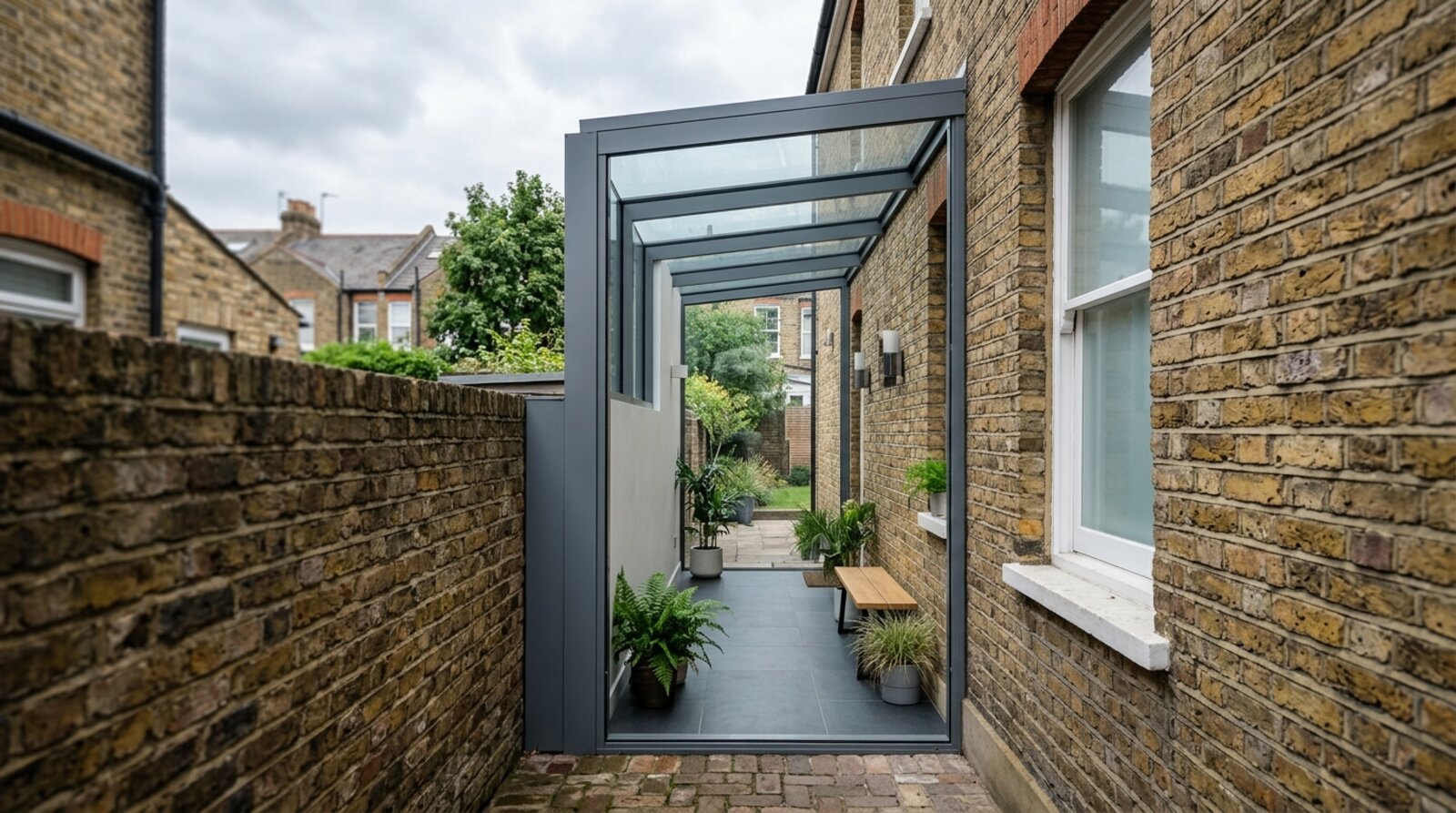
- Side return extension. Fills the narrow alley beside the rear projection of a Victorian or Edwardian terrace or semi, turning a cramped galley kitchen into a wide, light room.
- Wraparound extension. Combines rear and side return into an L-shaped addition: the biggest transformation of a period house, and the most likely of these extension types to need full planning permission.
- Loft conversion. Adds a bedroom and often an en suite without sacrificing any garden, where the roof has generous head height or a rear dormer is acceptable.
- Garage conversion. Typically the cheapest route to extra floor space because the walls, roof and slab already exist.
A useful early question: do you need more ground-floor living space, more bedrooms, or both? The answer usually narrows six options to two.
What an extension costs in 2026
Current guidance from Homebuilding and Renovating puts single storey extensions at £2,200 to £2,500 per square metre for a standard specification, £2,500 to £2,900 for a good specification, and £2,900 to £3,300 for excellent, with premium materials and a complex design. Two storey work is cheaper per square metre: roughly £2,000 to £2,400 basic, £2,400 to £2,800 mid range and £2,800 to £3,200 at the top end. Checkatrade’s current cost guide sits in the same territory, suggesting £1,800 to £3,000 per square metre as a general rule of thumb for standard rooms.
Three adjustments matter on top of the headline rate. Kitchens and bathrooms cost more per square metre than plain rooms because of the services and fittings, so treat the standard rates as a floor and budget the fit-out separately. London and the South East carry a premium of around 25 to 35 per cent, and west Kent commuter towns tend toward the upper half of the national ranges. Finally, almost every published figure and most builder quotes exclude VAT at 20 per cent, so add it before comparing anything against your budget. For early planning, multiply your floor area by a per-metre rate, add VAT, then add contingency.
Planning permission and permitted development
Many extensions do not need a planning application at all because they fall under permitted development rights. For a single storey rear extension in England, the standard limits are a projection of no more than 4 metres beyond the original rear wall for a detached house, or 3 metres for any other house, with a maximum height of 4 metres and eaves no higher than 3 metres within 2 metres of a boundary.
The larger home extension scheme extends those projections to 8 metres detached and 6 metres for other houses, but only after a prior approval application: the council consults your adjoining neighbours and the work cannot start until approval is confirmed. Two storey rear extensions under permitted development are limited to 3 metres of projection and must be at least 7 metres from the boundary opposite the rear wall. The enhanced allowances do not apply on designated land such as conservation areas or the Kent Downs National Landscape, which covers much of this county. The Planning Portal’s extension guidance sets out the full rules. Where you do need a householder application, councils work to a target decision period of eight weeks.
One safeguard worth its small fee: a lawful development certificate proves your permitted development extension was legal; solicitors increasingly ask for it when you sell.
Building regulations always apply
Planning permission and building regulations are separate systems, and while you can sometimes avoid the first, you can never avoid the second. Building regulations approval covers the technical performance of the work: foundations and structure, fire safety, insulation, ventilation, drainage, electrics and glazing. You comply through a full plans application, where drawings are checked before work starts, or a building notice for simpler projects, with inspections at key stages either way. At the end you receive a completion certificate. Keep it safe: buyers’ solicitors will ask for it, and an extension without one is a genuine obstacle to selling or remortgaging.
The Party Wall Act
The Party Wall etc. Act 1996 applies across England and Wales whenever you work on a shared wall, build a new wall at the boundary, or excavate within 3 metres of a neighbouring building and deeper than its foundations, which covers most extension foundations in terraced and semi-detached streets. You must serve written notice on the affected neighbours between two months and a year before the relevant work starts. If they consent in writing, you proceed; if they dissent or stay silent, surveyors produce a party wall award recording the condition of their property and how the work will be done. The government’s party wall guidance on GOV.UK is the official reference. The practical advice: talk to your neighbours early, before any letter arrives.
Who should design it
Three routes dominate. An architect (a protected title, registered with the Architects Registration Board) offers the strongest design thinking and is worth the fee where the project is complex, the site is awkward or design quality drives the value. An architectural technologist focuses on the technical detail and regulations drawings, often at a lower fee, and suits straightforward projects. A design and build firm wraps design and construction into one contract: simpler to manage and faster, at the cost of independent oversight of the builder’s work.
Whichever route you choose, you will also need a structural engineer for beam and foundation calculations. Design fees are commonly quoted as a percentage of the build cost, so agree the scope and the number in writing before anyone starts drawing.
The build, stage by stage
From first sketch to finished room, a realistic timeline for a single storey extension is nine to twelve months. The sequence rarely varies:
- Brief, survey and concept design: 1 to 3 months.
- Planning or prior approval: around 8 to 10 weeks if an application is needed.
- Technical design: 4 to 8 weeks for building regulations drawings and structural calculations.
- Tendering: 4 to 6 weeks for three like-for-like quotes; serve party wall notices in parallel.
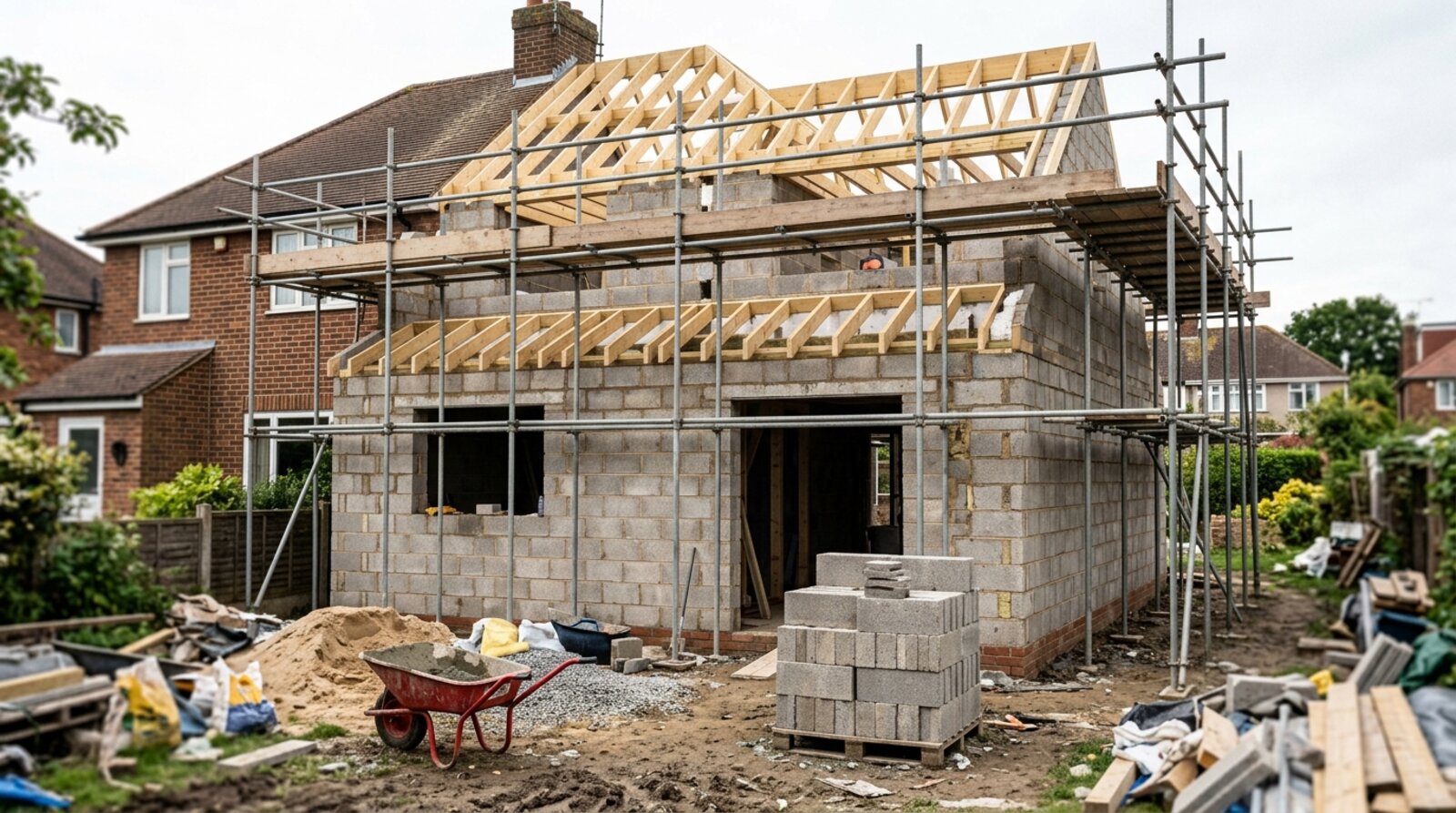
- Groundworks and shell: foundations, drainage, walls and roof structure, usually 4 to 6 weeks.
- Watertight to plaster: roof covering, windows and doors, first fix electrics and plumbing, insulation and plasterboard.
- Second fix and finishes: sockets, sanitaryware, kitchen, flooring and decoration.
On site, expect roughly 12 to 16 weeks for a single storey extension and 16 to 24 weeks for a double storey, longer where a kitchen is involved. Weather, steel lead times and discoveries underground are the usual sources of slippage.
Budgeting: VAT, contingency and comparing quotes
Build a budget in four layers: the construction cost, VAT at 20 per cent on labour and materials for work to an existing home, professional fees (designer, engineer, building control, any party wall surveyors), and a contingency of at least 10 per cent held back for the unknowns. Homebuilding and Renovating currently suggests a further 5 per cent to absorb price inflation on any project that will not start for six months or more.
When quotes arrive, insist on an itemised breakdown, check every quote prices the same drawings and specification, and look hard at provisional sums: large allowances for undecided items are where cheap quotes quietly become expensive projects. Agree a staged payment schedule tied to completed work, never pay a large sum up front, and put it all in a written contract such as a JCT homeowner contract. The cheapest of three quotes is rarely the best value when it is 20 per cent below the other two.
What an extension does to your home’s value
Nationwide Building Society’s October 2025 research found that adding floor space pays: a loft conversion or extension creating a large double bedroom and bathroom can add up to 24 per cent to the value of a three-bedroom, one-bathroom house, while an extra bathroom alone is worth roughly 4 per cent. The caveat is the ceiling price of your street: spend £120,000 extending a house in a road where nothing sells above the cost of yours plus £60,000 and you have bought space for your family, not profit. That can still be the right decision, but make it knowingly, after checking recent sold prices nearby.
Frequently asked questions
Do I need planning permission for a single storey rear extension?
Often not. In England, permitted development allows a rear projection of up to 4 metres on a detached house or 3 metres on any other house without an application, extendable to 8 metres and 6 metres respectively through the prior approval process. The allowances shrink on designated land such as conservation areas, so confirm your property’s status with the council first.
How long does a house extension take from start to finish?
Allow nine to twelve months from appointing a designer to moving furniture in. The build itself is typically 12 to 16 weeks for a single storey extension and 16 to 24 weeks for a double storey; the months before are design, planning, technical drawings, tendering and party wall notices.
What is the cheapest way to add space?
Converting what you already have. A garage conversion reuses the existing walls, roof and slab, so it usually costs far less per square metre than new-build extension work, and a loft conversion adds a bedroom without losing any garden. New single storey space starts at around £2,200 per square metre plus VAT in 2026.
Do I need an architect, or will a builder’s designer do?
You are not legally required to use an architect. For a straightforward rear extension, an architectural technologist or a reputable design and build firm can deliver perfectly good results for less. An architect earns their fee where the site is tricky, the design is ambitious or you want independent oversight of the builder.
Related guides
- Conservatory Roof Replacement vs Glass Film: Which Fixes a Too-Hot, Too-Cold Conservatory?
- Air Source Heat Pump Cost in 2026 After the £7,500 Grant: What You Actually Pay
- Do You Need Planning Permission for a Rear Extension in Kent? 2026 Permitted Development Rules
- How Much Does a Conservatory Base Cost in the UK? (2026 Price Guide)
- Do You Need a Party Wall Agreement for a Rear Extension? Cost and Rules Explained
- Underfloor Heating vs Radiators for a Home Extension: Cost, Running Bills and Which to Choose
- How Much Does a House Extension Cost in 2026? Full UK Price Breakdown
- Loft Conversion Cost and Types: Dormer, Hip-to-Gable and Velux Explained
- Kent Home Improvement News: June 2026
- Single Storey Extension Ideas, Costs and Planning Rules
- Double Storey Extensions: Costs, Designs and What You Can Build
- Side Return Extensions Explained: Cost, Light and Layout
- Kent Home Improvement News: Mid-June 2026
- Garage Conversion Guide: Cost, Building Regs and Best Uses
- Extension vs Moving House: Which Is Better Value in Kent?
- Wraparound vs Rear Extension: Cost and Space Compared
- House Extension Builders in Kent: Costs, Lead Times and How to Choose
- Conservatory Guide: Styles, Costs and How to Choose One
- Kent Home Improvement News: Late June 2026
- How Much Does a Conservatory Cost in 2026? UK Prices by Type
- Conservatory vs Orangery vs Extension: Which to Build?
- Conservatory Roof Options: Glass, Polycarbonate and Tiled Compared
- Kent Home Improvement News: Early July 2026
- How to Keep a Conservatory Warm in Winter and Cool in Summer
- Tiled Conservatory Roof Cost and Replacement Process Explained
- Conservatories in Kent: Choosing an Installer, Costs and What to Ask
- Kent Home Improvement News: Mid-July 2026
- Roofing Guide: Repairs, Replacement, Materials and Costs
- New Roof Cost UK 2026: Replacement Prices by Roof Type
- Roof Repair Cost UK 2026: Slipped Tiles and Flashing Prices
- 7 Signs Your Roof Needs Replacing (and What You Can Ignore)
- Flat Roof vs Pitched Roof: Cost, Lifespan and Best Uses
- EPDM vs Felt vs Fibreglass Flat Roofs Compared
- Kent Home Improvement News: Mid-July 2026
- Roof Tile Types Explained: Clay, Concrete and Slate Compared
- Fascias, Soffits and Guttering: When to Replace and What It Costs
- How to Find a Good Roofer: Vetting Checklist for UK Homeowners
- Roofers in Kent: Costs, How to Choose and What to Ask in 2026
- Kitchen Renovation Guide: Planning, Cost and Design in 2026
- How Much Does a New Kitchen Cost in 2026? UK Price Guide
- Kitchen Layout Ideas: Galley, L-Shape, Island and Open Plan
- Worktops Compared: Quartz vs Granite vs Laminate vs Solid Wood
- Fitted vs Bespoke vs Flat-Pack Kitchens: Cost and Quality
- Kitchen Island Ideas, Sizes and Costs: A 2026 UK Guide
- Kent Home Improvement News: Late July 2026
- Open Plan Kitchen Diner: Costs, Layouts and Knock-Through Rules
- How Long Does a Kitchen Fitting Take? Realistic UK Timeline
- Kitchen Fitters in Kent: Costs and How to Choose (2026)
- Bathroom Renovation Guide: Planning, Cost and Layout
- New Bathroom Cost 2026: What You’ll Pay in the UK
- Kent Home Improvement: Roofing Costs Rise (Aug 2026)
- Small Bathroom Ideas: Layouts That Feel Bigger
- Wet Room Cost 2026: £2,000 to £9,000 Fitted, by Size
- En Suite Cost and Minimum Size: £4,000 to £10,000 in 2026
- Kent Home News: £9,000 Heat Pump Grant Now Open
- Electric vs Mixer vs Power Shower: What Your Boiler Allows
- Bathroom Underfloor Heating Cost: 16p an Hour to Run
- Window Replacement Cost 2026: £350 to £600 Per uPVC Window
- uPVC vs Aluminium Windows: the 1.4 U-Value Rule
- How Long Does a Bathroom Take to Fit? 5 to 10 Working Days
- Home Improvement News: Solar Up 14%, Heat Pumps Down 17%
- Double vs Triple Glazing: Part L Still Stops at 1.4
- Bathroom Fitters in Kent: What to Ask Before You Pay